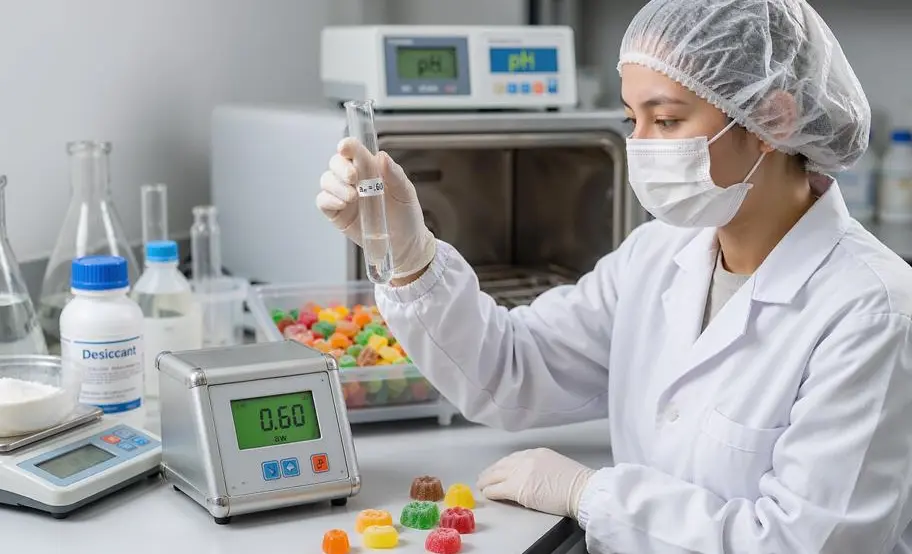

Clumping in the bottle and mold on the shelf rarely start in packaging. In water activity control in gummy production, both failures trace back to free water that was never bound, never removed, or was allowed back in after curing. A gummy can pass moisture-content testing and still fail in the market, because total moisture tells you how much water is present, not how available that water is for microbes, for sugar migration, or for surface stickiness.
Key Takeaways / Technical Summary
- Target finished aW at 0.58 to 0.62: Below 0.65, most mold and yeast growth is suppressed. Below 0.60, you gain a safety margin for humid storage and for batch variation.
- Control solids before you control drying: Cook to 75 to 78 degrees Brix at 105 to 115 degrees C, hold depositing at 95 to 105 degrees C, and set pH at 3.2 to 3.6 for pectin systems. Brix and pH decide aW before the gummy enters the curing room.
- Cure in 25 to 30 percent RH: Curing at 20 to 25 degrees C for 24 to 72 hours with staged airflow prevents case hardening, where a dry surface traps wet interior water that later equilibrates and causes clumping.
- Verify aW at four points: After curing, after coating, after packaging, and after accelerated stability. A single end-of-line check misses gradients that appear during equilibration.
As part of our ongoing work in Manufacturing and Processing, this article explains how aW is set in formulation, shifted in cooking and depositing, fixed in curing, and protected in packaging. It is written for R and D teams, procurement managers, and brand owners who need to diagnose a failing batch or qualify a supplier on technical grounds, not on claims.
Why Water Activity, Not Total Moisture, Controls Failure
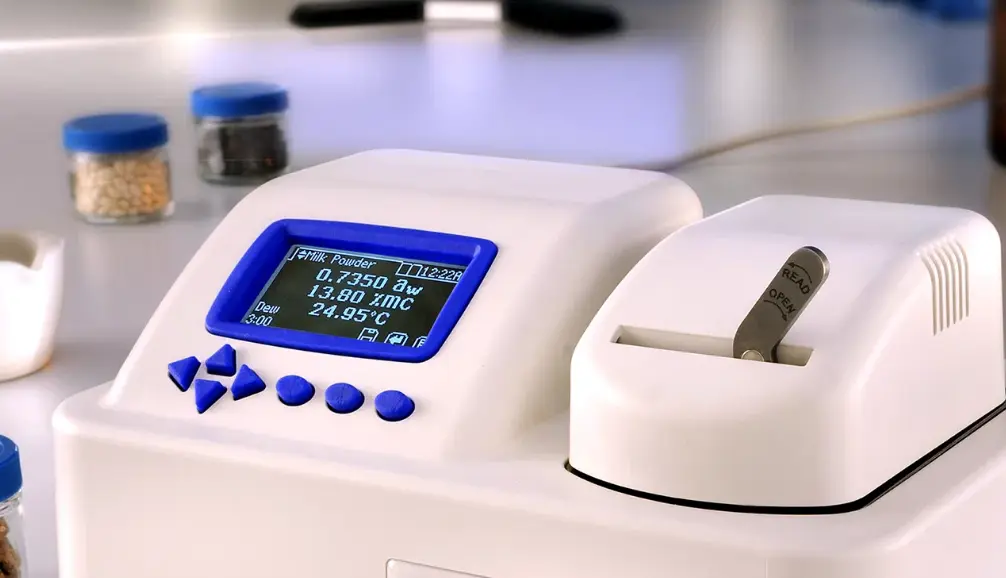
Water activity is the ratio of the vapor pressure of water in the product to the vapor pressure of pure water at the same temperature. It runs from 0 to 1.0. It measures free water, the water that microbes can use and that can move between gummies, coatings, and headspace air. Bound water, held by sugars, polyols, and hydrocolloids, does not count in the same way.
That distinction explains why two formulas with identical 12 percent moisture can behave differently. A formula high in glucose syrup and sucrose binds water through sugar solids. A formula high in glycerin, sorbitol, or maltitol binds water even more strongly per gram, because polyols have a stronger water-binding effect and lower aW at the same solids level. A formula with more free water left in the gel network will feel sticky, transfer moisture to a coating, and support mold at a lower total moisture.
Microbial risk follows aW thresholds, not moisture percentage. Most bacteria need aW above 0.85. Most yeasts need above 0.65. Most molds need above 0.70, with some xerophilic molds growing down to 0.65 in warm, humid storage. A finished gummy at 0.58 to 0.62 sits below those thresholds with margin. A gummy at 0.68 may pass an initial plate count, then fail after two months when a small moisture gain pushes a localized surface layer above 0.70.
The Target Window: 0.58 to 0.62 aW and Why the Edges Matter
The 0.58 to 0.62 window is a compromise between safety, texture, and process stability. Go too high and you trade shelf life for softness. Go too low and you trade chew for hardness and increase the risk of graining and syneresis.
| Finished aW Range | Typical Behavior | Commercial Risk |
|---|---|---|
| Below 0.55 | Firm, tough chew, fast moisture loss in dry storage, sugar graining possible | Consumer complaints on hardness, higher breakage in coating and bottling |
| 0.58 to 0.62 | Stable chew, low surface tack, coating adheres, low microbial risk | Preferred window for most pectin and gelatin gummies |
| 0.63 to 0.67 | Soft, sticky surface, gummies deform under weight in bulk bins | Clumping in bottles, coating melt-off, higher mold risk in humid climates |
| Above 0.68 | Wet surface, rapid moisture migration, visible mold possible | Fails USP microbial limits, recall risk, short shelf life |
Texture is part of this calculation. Gelatin gummies in the 150 to 250 Bloom range rely on a hydrated protein network. If aW drops too far, that network tightens and chew becomes rubbery. Pectin gummies rely on a sugar-acid gel. If aW stays too high, that gel never fully sets and the gummy slumps. The correct aW target therefore depends on the hydrocolloid, not on a single universal number. Confirm the target for your specific gel system during pilot trials, then lock it as a release specification.
Formulation: Where aW Is Set Before Cooking
Most aW problems are formulation problems that only become visible in curing. By the time a batch is in the curing room, you can remove water, but you cannot change how strongly the formula binds the water that remains.
Sugar solids and polyols. Sucrose and glucose syrup provide bulk solids and raise Brix, which lowers aW by reducing free water. Sorbitol, glycerin, and maltitol syrup lower aW more efficiently and add humectancy. The trade-off is texture and cost. Too much glycerin makes a gummy soft and sticky even at low aW. Too much sorbitol can cause cooling sensation and, in high doses, laxative labeling concerns for some markets. In a typical commercial production run, formulators balance sucrose and glucose syrup for structure with a controlled polyol fraction for aW stability, rather than using polyols as a fix for a wet formula.
Hydrocolloid selection. High-methoxyl (HM) pectin needs high solids at 75 to 78 degrees Brix and pH 3.2 to 3.6 to gel through Pectin gelation. Low-methoxyl (LM) pectin gels with calcium and tolerates lower solids, which can mean higher aW unless polyols compensate. Gelatin does not need low pH or high Brix to set, but it is sensitive to heat and to proteolytic ingredients like bromelain. Agar sets firmly and releases water more readily, which can raise surface aW if curing is rushed. Sodium alginate gels with calcium and gives a clean bite, but requires tight control of calcium dispersion to avoid uneven gel strength and uneven drying.
Actives and acids. Hygroscopic actives such as vitamin C, magnesium salts, and certain botanical extracts pull moisture from air and raise local aW on the surface. Acids lower pH for flavor and preservation, but acid added too early in cooking can hydrolyze gelatin and invert sucrose, which changes Brix and aW. Add acid, flavor, and heat-sensitive actives after cooking, in the final mixing stage, and account for their water contribution in the batch mass balance.
Overages and thermal decay. Continuous cooking exposes actives to 105 to 115 degrees C. HPLC testing shows that heat-sensitive vitamins lose potency during this step, so formulators add a validated overage to meet label claim at end of shelf life. That overage must be based on measured loss in your process, not on a textbook value. An overage that is too high can change taste and aW. An overage that is too low creates a label-claim failure that no curing step can fix.
Process Thermodynamics: Cooking, Depositing, and aW Drift
Cooking sets Brix, and Brix sets aW. If cooking is inconsistent, aW will be inconsistent.
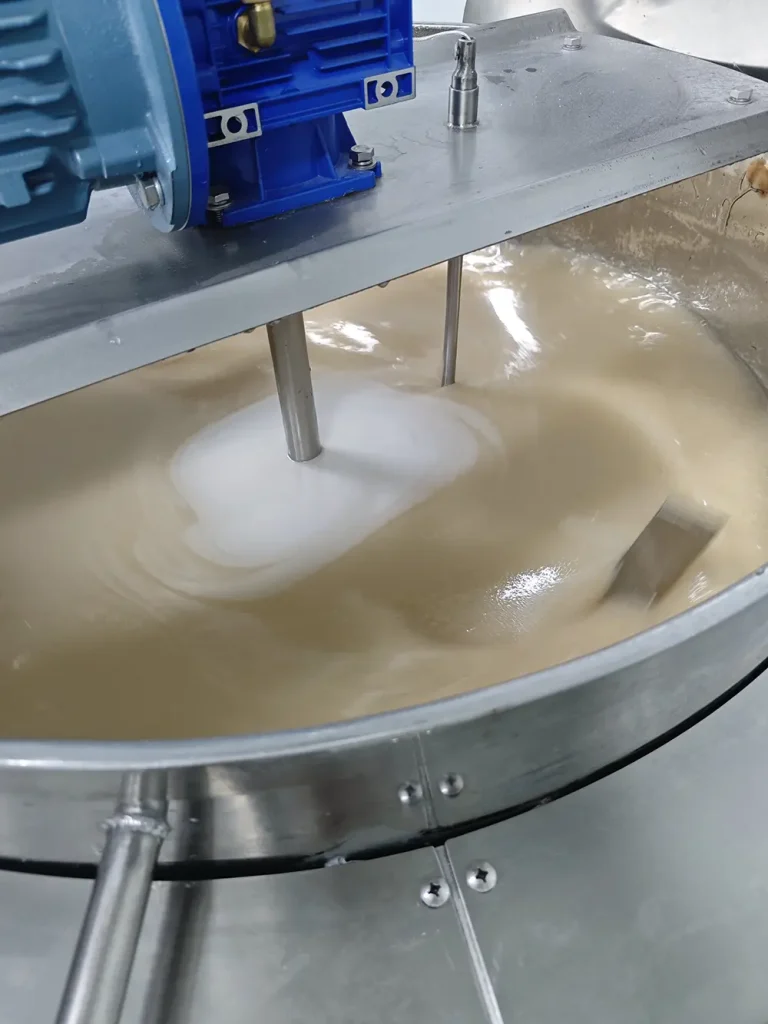
In batch cooking, evaporation depends on kettle size, agitation, and time at temperature. In continuous cooking, it depends on flow rate, steam pressure, and vacuum level. Vacuum cooking lowers the boiling point, reduces thermal exposure, and gives tighter Brix control. That matters for both aW and active retention. Without an inline refractometer and a defined Brix release range of 75 to 78 degrees, operators chase temperature instead of solids, and two batches cooked to the same temperature can finish at different Brix and different aW.
Depositing adds a second drift. Slurry held at 95 to 105 degrees C in a depositor hopper continues to lose water. A batch deposited in the first 15 minutes will differ from the same batch deposited 60 minutes later if the hopper is open and unsealed. Lab-bench success does not guarantee commercial depositor yield for this reason. A 2 kg lab batch cools and deposits in minutes. A 300 kg commercial batch sits, evaporates, and changes viscosity. Commercial scale-up needs a covered, temperature-controlled holding system, a defined maximum hold time, and a Brix check at start, middle, and end of depositing.
Mold type also shifts moisture. Starch mogul molds absorb surface moisture and help set the gummy, but they add a variable drying step and starch dust that must be removed. Silicone or polycarbonate molds do not absorb water, so all moisture removal must happen in curing. If you switch mold systems without adjusting curing time and RH, aW will shift even if the formula stays the same.
Curing: The Most Underestimated aW Control Step
Curing is where aW is made uniform. Freshly deposited gummies have an aW gradient. The surface is wetter than the core, or drier if it was exposed to air. If you package too early, that gradient equilibrates inside the sealed bottle. Moisture moves from core to surface, the surface becomes tacky, gummies stick, and local surface aW rises above the batch average.
Effective curing uses low RH, moderate temperature, and controlled airflow. A curing room at 25 to 30 percent RH and 20 to 25 degrees C removes water slowly enough to avoid case hardening. Case hardening happens when hot, dry air dries the surface into a dense skin. That skin traps interior water. The gummy feels dry on day one and sticky on day fourteen, because interior water slowly migrates through the skin after packaging.
Prevent case hardening with staged drying. Start with gentle airflow and moderate RH, then step down RH as the surface firms. Keep tray spacing even, avoid stacking trays that block airflow, and rotate tray positions if the room has hot or humid spots. Track drying curves, not just time. Weigh representative trays at set intervals and measure aW from core and surface samples separately. When core and surface aW converge within 0.02, the batch is ready for coating.
Coating adds another aW variable. Sugar sanding, oil-based polishing, and wax coatings create a barrier that slows moisture exchange, but they also trap surface moisture if applied to an under-cured gummy. Oil polishing on a wet surface will bead and separate. Sugar coating on a wet surface will dissolve and recrystallize into a hard, uneven crust. Cure first, then coat.
Packaging: WVTR Decides Whether Your aW Holds
Packaging does not fix aW. It preserves the aW you achieved in curing, or it lets it drift.
Water vapor transmission rate (WVTR) measures how much moisture passes through a film or bottle wall. A high-WVTR bottle in a humid warehouse will let moisture in. A gummy that left the factory at 0.60 aW can climb to 0.66 or higher during summer storage in Southeast Asia or the southern United States. A low-WVTR barrier, such as foil-sealed pouches, aluminum blister, or high-barrier PET with induction-sealed caps, slows that gain.
Desiccants, nitrogen flushing, and seal integrity matter just as much. A desiccant can buffer a small moisture gain, but it cannot absorb a continuous leak from a poor seal. A nitrogen flush reduces headspace oxygen and slows oxidation, but it does not remove the need for a barrier. Validate packaging with real stability data at 25 degrees C and 60 percent RH, plus accelerated conditions, and measure aW at each pull, not just appearance and microbial counts.
When a technical issue moves from pilot batches to high-speed depositing, curing capacity, and barrier packaging, it becomes a scale-up question. To learn more about scaling this formula into high-speed production, explore our gummy OEM production with validated moisture control.
Quality Verification: How Buyers Should Audit aW Control
Buyers should ask for aW data, not just a claim of low moisture. A credible supplier can show aW specifications, calibration records, and stability data by batch.
Measurement. Use a chilled-mirror or capacitance aW meter calibrated with saturated salt standards. Calibrate daily, verify with a known standard before each batch release, and record temperature, because aW shifts with temperature. Sample from top, middle, and bottom of curing trays and from start, middle, and end of depositing. A single sample from the easiest tray hides variation.
Microbial and chemical testing. Test to USP 61 and USP 62 for total aerobic microbial count, yeast and mold, and absence of specified pathogens. Use HPLC testing for active assay and potency through shelf life. Use ICP-MS for heavy metal limits where required by specification. These tests confirm that the aW control actually delivered safety and label claim, not just a number on a meter.
Documentation and cGMP audits. Under cGMP 21 CFR Part 111, batch records must show Brix, pH, cooking temperature, depositing temperature, curing RH and time, and aW at release. Deviations must be documented with corrective action. During cGMP audits, ask how the supplier handles a batch that finishes at 0.64 aW. The answer should be a defined rework, extended curing, or rejection procedure, not an informal decision to package and ship.
Troubleshooting: From Symptom to Root Cause
| Symptom | Likely aW Cause | Corrective Action |
|---|---|---|
| Clumping in bottle after 4 to 8 weeks | Packaged before core and surface aW equilibrated, or high WVTR packaging in humid storage | Extend curing until core and surface converge, improve barrier, add seal-integrity check |
| Sticky surface after coating | Coating applied to under-cured gummy, excess glycerin, or high curing RH | Hold coating until aW target is met, reduce humectant, lower curing RH to 25 to 30 percent |
| Mold on surface, batch otherwise passes | Localized surface aW above 0.68 from condensation, poor airflow, or tray stacking | Fix airflow and tray spacing, control cooling rate, verify surface aW separately |
| Hard, dry gummy after 3 months | Initial aW below 0.56, or packaging with high moisture loss in dry climate | Raise target Brix control, adjust polyol balance, use lower WVTR pack for dry markets |
Buyer Decision Checklist
- Ask for the aW specification: Finished aW range, measurement method, calibration frequency, and sampling plan.
- Ask for stability data: aW, texture, and microbial results at 0, 3, 6, 12, and 18 or 24 months, not just at release.
- Ask for process limits: Brix range, cooking temperature, depositor hold time, curing RH and time, and what triggers a hold.
- Ask for packaging validation: WVTR of the proposed pack, seal testing, and storage conditions used in the study.
- Ask for deviation handling: What happens to a batch that misses aW, and who authorizes release or rejection.
Water activity control is not a single step. It is a chain from formulation to cooking to curing to packaging. A break at any point will show up as clumping, mold, or texture loss, often weeks after the batch left the factory. Control the chain, measure at each link, and the gummy that leaves at 0.60 aW will still be at 0.60 aW when the consumer opens it.
FAQ
What is the ideal water activity for gummy supplements?
For most pectin and gelatin gummies, 0.58 to 0.62 aW is the preferred release range. It keeps mold and yeast risk low while preserving a soft, chewy texture. Gelatin systems at the low end may harden, and pectin systems at the high end may stay sticky, so confirm the exact target for your hydrocolloid and polyol balance during pilot trials.
Why does my gummy pass moisture testing but still mold?
Moisture content measures total water, not free water. A gummy can have acceptable total moisture but high surface aW from under-curing, condensation during cooling, or moisture gain through high-WVTR packaging. Measure surface aW separately from core aW, and test after equilibration and after stability storage, not only at release.
How long should gummies cure before packaging?
In a typical commercial production run, curing takes 24 to 72 hours at 25 to 30 percent RH and 20 to 25 degrees C. The correct time depends on gummy size, gel system, tray loading, and airflow. Use drying curves and core-versus-surface aW convergence as the release criterion, not a fixed clock time.
Can packaging alone fix a high-aW gummy?
No. Barrier packaging slows moisture exchange, but it cannot remove free water already in the gummy or fix an aW gradient. If you package a gummy at 0.68 aW in a foil pouch, moisture will still migrate inside the pack and the surface will stay tacky. Fix aW in formulation and curing first, then protect it with low-WVTR packaging, For more details, please visit our Knowledge Center or the Manufacturing & Processing page..
About the Author
Jack Luo|Senior Technical Advisor, Nutrition Research Center. Representing Gothink Biology, a cGMP-certified dietary supplement manufacturer based in Shenzhen, China.