
When you evaluate a Gummy Manufacturer for your next launch, the first commercial decision is not flavor or shape. It is whether to use an existing private label formula or invest in a custom formulation. This choice determines your cost structure, MOQ, lead time, stability risk, and how defensible your product will be in the market.
Private label gummy models give you speed and lower entry cost. Custom gummies give you control over dosage, ingredient combinations, texture, and brand differentiation. Both can be profitable, but they serve different business stages and risk profiles. This article breaks down the real manufacturing logic behind each path so you can decide based on economics and technical feasibility, not marketing language.
Direct Answer: Which Model Should You Choose?
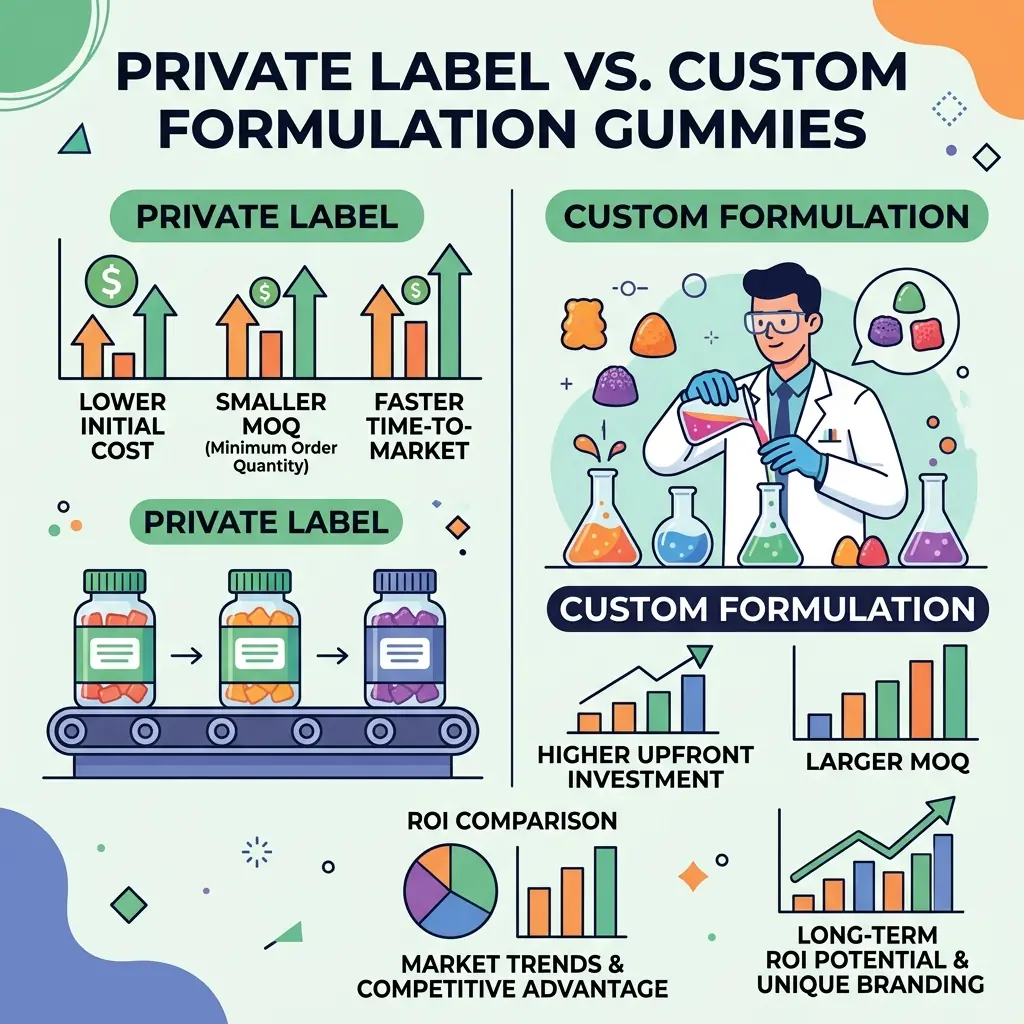
Choose private label gummy when you need to launch fast, validate a channel, or keep initial inventory risk low. You use a proven formula, existing raw material supply chain, and standard tooling. MOQ is lower, unit cost is predictable, and stability data already exists.
Choose custom gummies when your formula, dosage, or positioning cannot be achieved with stock formulas. You need a unique active combination, higher active loading, specific dietary claim like pectin-based vegan, sugar-free, or a flavor and texture profile that differentiates your brand. Expect higher MOQ, R&D time, and validation cost, but stronger margin and IP potential at scale.
Most brands start private label to generate cash flow, then migrate to custom once volume and customer data justify the investment.
Why This Decision Matters for Supplement Brands
The search behind this topic is not just informational. Buyers are asking: How much more will custom cost me? What MOQ can I actually afford? Will custom deliver enough ROI to justify development?
From a manufacturing perspective, these questions translate to:
- Can the target active be loaded at the desired dose without breaking the gel system or growing gummy weight beyond consumer acceptance?
- Will the ingredient combination remain stable for 18-24 months under real water activity and pH conditions?
- What process adjustments, testing, and packaging are required to protect sensitive actives?
- How does batch size affect cost per unit and supply chain resilience?
Answering these early prevents costly reformulation after tooling and packaging are already ordered.
What Private Label and Custom Formulation Actually Mean in Gummy Manufacturing
Private Label Gummy
A private label gummy is an existing, validated formula owned and maintained by the manufacturer. Active levels, excipients, pH, Brix, gel type, and process parameters are already locked. Your brand customization is limited to flavor intensity, color, shape from existing molds, and packaging.
Manufacturing risk is low because the manufacturer has already solved ingredient compatibility, drying curve, water activity control, and batch-to-batch texture consistency. Raw materials are stocked, QC specifications exist, and finished product testing methods are already validated.
Custom Gummies
Custom gummies are developed to your brief. You define the active ingredients, dosage per serving, serving count, dietary system, claims, and sensory targets. The manufacturer’s R&D team builds the formula from scratch or significantly modifies a base.
This involves ingredient selection, pre-formulation compatibility screening, lab trials, pilot batching, stability assessment, and process parameter optimization for depositing, cooling, and drying. You own the differentiation, but you also absorb development time and validation requirements.
Manufacturing Differences That Affect Cost and Risk
Both models share core stages: concept review, raw material testing, batch preparation, cooking, mixing, depositing, cooling and setting, drying or conditioning, coating, inspection, and packaging. The difference is how much engineering is needed at each stage.
Private Label Production Flow
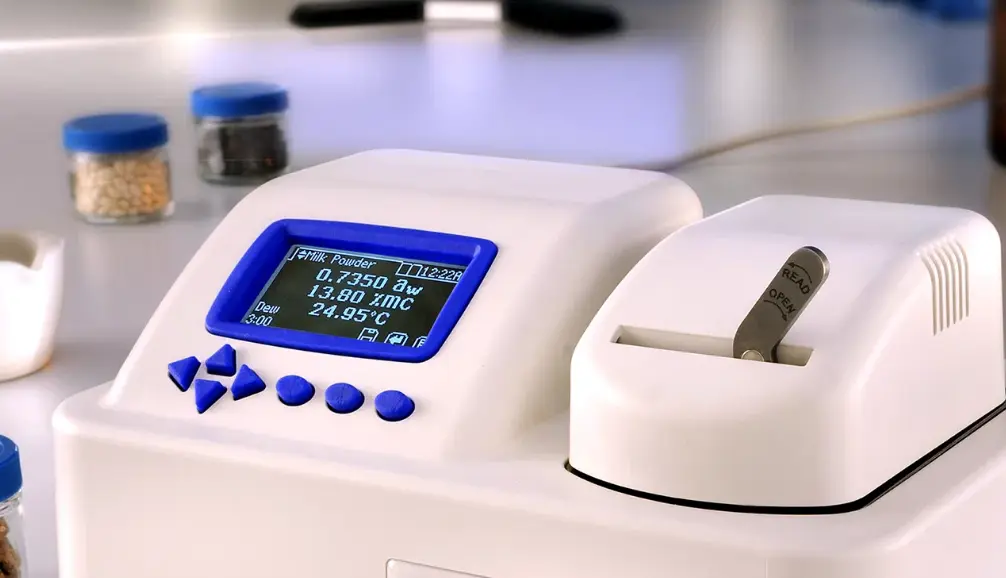
For private label, batch preparation follows a fixed SOP. The gelatin or pectin gel mass is cooked to a target Brix and pH. Actives are added at a defined point where temperature exposure is controlled. Mixing and homogenization time is fixed to avoid air entrapment and ensure active uniformity. Deposition uses existing molds. Drying time and temperature are already optimized to reach target water activity, typically 0.65-0.75 for gelatin systems, lower for pectin.
Because these parameters are proven, scale-up is linear. Quality control focuses on in-process Brix, pH, weight variation, and finished product assay.
Custom Formulation Production Flow
Custom requires additional control points. The R&D team must first assess:
- Active loading: High-dose ingredients like magnesium citrate, calcium, or certain botanicals increase gummy mass. Above 30-40% active load, gel strength drops and chewing texture becomes gritty.
- pH sensitivity: Pectin sets only within a narrow pH window around 3.2-3.6. Acidic actives like vitamin C or apple cider vinegar powder can prematurely set the mass or cause syneresis. Gelatin is more pH tolerant but loses strength below pH 3.5.
- Heat sensitivity: Probiotics, vitamin B12, and certain enzymes degrade above 60-70°C. The process must add them downstream after initial cooking, which requires precise mixing to avoid cold spots and uneven assay.
- Moisture and hygroscopicity: Ingredients like choline bitartrate or some plant extracts pull moisture, raising water activity and microbial risk. The drying protocol must be adjusted and packaging barrier requirements increased.
- Flavor masking: Minerals, hemp, and high-botanical loads create bitterness, metallic notes, or earthiness. Masking may require flavor modulation, acid balancing, or oil-based flavor coating rather than water-based.
These factors explain why custom development needs pilot runs and stability testing before commercial batch commitment.
Cost Breakdown: What Really Drives Unit Economics
Private Label Cost Structure
Cost is driven by active ingredient market price, gummy weight, and packaging. Since formula development, stability, and process validation are already amortized, you do not pay R&D fees. Standard molds and packaging lines keep tooling cost at zero. The main variable is serving size. A 3g gummy costs less to produce than a 4.5g gummy because it uses less gel, sweetener, and active per unit.
Custom Gummies Cost Structure
Cost drivers expand significantly:
- Formulation complexity: Multi-active formulas require compatibility testing and often more expensive pectin or modified starch systems.
- Dosage and gummy weight: Higher active dose increases raw material cost and often forces larger gummy size, which raises freight and packaging cost per bottle.
- Flavor and masking system: Custom masking or natural flavor systems can cost more than standard flavors.
- Testing and validation: Assay methods for new actives, microbiological testing, and accelerated and real-time stability studies add upfront cost.
- Tooling: Custom shapes require new molds. Custom counts or bottle sizes require packaging line changeover.
A common mistake is focusing only on cost per kilogram of gummies. You should calculate cost per serving and cost per daily dose. A heavier gummy with two-per-day serving doubles your packaging and logistics cost versus a one-per-day format.
MOQ and Production Economics
MOQ is not arbitrary. It reflects minimum batch size for uniform mixing, depositor efficiency, and drying tunnel load. Small batches below equipment minimums create high weight variation and poor content uniformity.
Private label MOQ is lower because the manufacturer can combine multiple brand orders using the same bulk mass or run inventory in advance. Custom MOQ is higher because the bulk mass cannot be shared, raw materials may need special ordering, and line clearance and validation are dedicated to your formula.
| Factor | Private Label Gummy | Custom Gummies |
| Typical MOQ Range | Lower, driven by packaging and standard batch size | Higher, driven by dedicated raw materials and minimum bulk mass |
| Lead Time | 2-4 weeks after artwork approval in most cases | 6-12 weeks including R&D, pilot, and stability initiation |
| R&D Cost | Usually none or minimal | Yes, for formulation, pilot, and testing |
| Tooling | Existing molds and packaging | New molds, packaging formats, or depositing parameters may be needed |
| Stability Data | Existing data can be referenced | New accelerated and real-time data required |
| Regulatory Documentation | Standard spec, COA, MSDS, allergen statement | Custom spec, method validation, additional compliance review |
When cash flow is constrained, MOQ has a direct impact on working capital. A 50% lower MOQ can mean the difference between launching one SKU versus two SKUs with the same budget.
ROI Comparison: When Each Model Wins
ROI should be calculated as gross margin over total landed cost including development, inventory carrying cost, and obsolescence risk, not just unit price.
| ROI Driver | Private Label Advantage | Custom Advantage |
| Time to Market | Fast launch, faster revenue recognition | Slower, but first-mover advantage if formula is novel |
| Margin Potential | Moderate, limited differentiation | Higher, due to unique positioning and price power |
| Customer Acquisition | Harder to differentiate in ads | Easier to build story around dosage, clean label, or functional blend |
| Inventory Risk | Low, proven sell-through | Higher until demand is proven |
| Long-Term Brand Equity | Limited, formula is not exclusive | Strong, formula can be protected via trade secret or exclusivity agreement |
For startups and Amazon sellers, private label often delivers better ROI in months 0-6 because development cost is zero and sell-through risk is lower. For established brands doing over 50,000 bottles per SKU per year, custom typically delivers better ROI after month 12 because higher perceived value supports premium pricing and repeat purchase.
Formulation and Technical Challenges That Change the Decision
Certain ingredient classes push a project from private label feasibility to custom necessity:
- High-dose minerals: Zinc, magnesium, calcium salts reduce gel strength and create astringent taste. They require pH buffering and texture system adjustment.
- Botanical extracts: Ashwagandha, elderberry, and turmeric bring color variation and polyphenol interaction that can affect clarity and stability. Batch consistency requires standardization of extract potency.
- Acidic ingredients: Apple cider vinegar, vitamin C above 200mg per serving, and citric acid blends can prevent proper pectin setting. The manufacturer must adjust buffer salts and set order of addition.
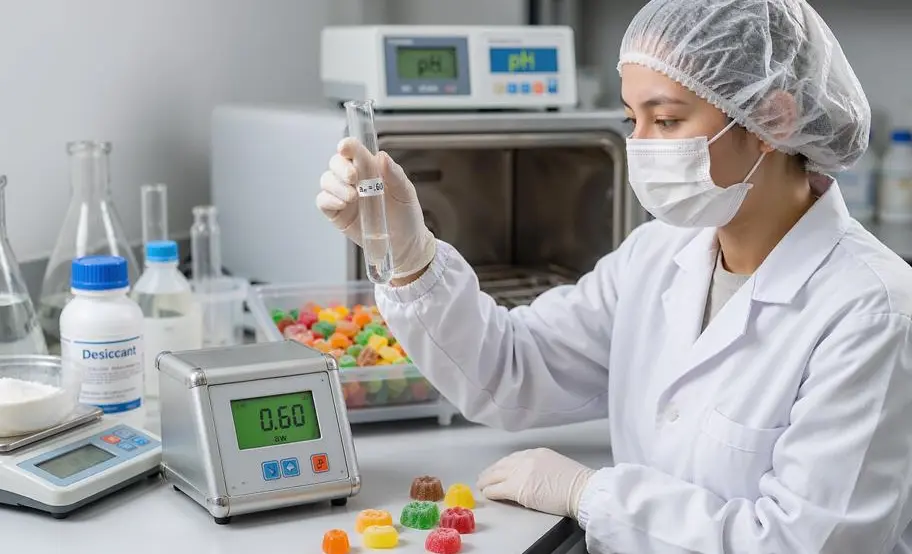
- Heat-sensitive actives: Probiotics need low-temperature addition and often require water activity below 0.60 and specialized barrier packaging. Standard gummy lines without post-deposit dosing cannot handle them.
- Sugar-free systems: Replacing sucrose with maltitol or allulose changes Brix, drying behavior, and laxation threshold. Cooling and drying profiles must be re-validated.
If your brief contains any of these, ask your gummy manufacturer for specific experience with that ingredient class, not just general gummy experience.
Quality, Testing, and Documentation Differences
Private label benefits from established specifications. Custom requires building them.
Key quality points to confirm for both models:
- Water activity and moisture control during drying. This controls texture and microbial stability more than moisture content alone.
- Content uniformity testing for actives added after cooking. Low-dose actives like vitamin D3 or biotin can segregate if mixing is inadequate.
- Metal detection and visual inspection after drying, before coating.
- Packaging compatibility: Pectin gummies are more sensitive to humidity. Bottles need induction seal and desiccant, pouches need high-barrier film.
- Shelf-life validation: Private label can reference existing data. Custom needs accelerated data at 25°C/60% RH and 40°C/75% RH with assay at 0, 1, 3, 6 months.
Documentation requirements also differ by market. In the US, private label may only need standard FDA food facility registration, spec, COA, and allergen declaration. Custom may need additional label review, method validation, and heavy metal or pesticide data for botanicals. Always distinguish manufacturing certifications from market compliance.
How to Evaluate a Gummy Manufacturer for Private Label vs. Custom Projects
The capabilities that matter depend on the model you choose.
For private label gummy sourcing, verify:
- GMP and ISO22000, HACCP, BRC or FSSC 22000 systems with batch traceability
- Daily capacity and ability to handle seasonal spikes, e.g., 16 tons daily production and clear scheduling
- Standard portfolio depth and stability data availability
- Flavor and packaging flexibility within standard MOQ
- Export experience and documentation support
For custom gummies, verify in addition:
- Dedicated R&D lab with 10,000-class environment and pilot depositing line separate from commercial line
- Formulation experience with your specific active class and gel system
- Analytical capability to validate assay and test water activity, pH, texture, and microbiology in-house
- Ingredient sourcing control for standardized extracts and patented ingredients
- Scale-up experience from lab to commercial depositing and drying without texture shift
Shenzhen Gothink Biotech Co., Ltd. operates a GMP-certified facility with a 100,000-class cleanroom, a 10,000-class R&D laboratory, approximately 16 tons of daily capacity and 5,000 tons annual capacity across gummy, capsule, tablet, powder, liquid and drop formats. Certifications include ISO9001, ISO22000, HACCP, FDA, HALAL, GMP, KOSHER, BRC, FSSC 22000, PJPH, and Vegan. This infrastructure allows private label execution for speed and custom development for differentiation within the same quality system.
Common Mistakes Brands Make
- Choosing custom for novelty alone without validating that dose is technically feasible in gummy format.
- Underestimating the impact of gummy weight on freight, retail price, and serving cost. A 3g vs 4g gummy at 60-count is 180g vs 240g per bottle.
- Requesting pectin vegan claims without understanding pH limits for acidic actives.
- Asking for low MOQ on a complex custom blend that requires dedicated raw material import. The MOQ is driven by supply chain, not willingness.
- Skipping packaging compatibility discussion. High-barrier packaging adds cost but prevents returns due to stickiness or melting.
Practical Checklist Before Requesting a Quote
Provide this information to your gummy manufacturer to get an accurate cost, MOQ, and lead time:
- Active ingredients and target dose per serving, plus serving size per day
- Preferred gel system: gelatin, pectin, or starch-based, and dietary needs: vegan, sugar-free, halal, kosher
- Target gummy weight and shape, and whether you can use existing molds
- Flavor and sweetener preference, and any ingredients to avoid
- Packaging format: bottle count, pouch, and barrier requirements
- Target markets and required documentation
- Estimated annual volume and launch volume per SKU
- Any stability or sensory benchmarks you must meet
With this data, a manufacturer can tell you within one review cycle whether private label is possible or custom is required, and what the ROI trade-off looks like.
FAQ
What is the typical MOQ difference between private label gummy and custom gummies?
Private label uses stocked raw materials and existing molds, so MOQ is tied mainly to a full production batch and packaging minimums. Custom requires dedicated material procurement and line-specific validation, so MOQ is higher to cover minimum bulk mass for uniform mixing and depositing. Your manufacturer should explain MOQ based on depositor capacity and drying tunnel load, not just a flat bottle number.
Can I start with private label and move to custom later?
Yes, and many brands do. This approach lets you validate demand, collect customer feedback on flavor and texture, and fund custom development. Keep the same gel system and packaging format during transition to reduce re-registration and stability work. Ask for exclusivity or semi-exclusivity terms if you plan to invest in custom after private label success.
How does active dosage affect gummy size and cost?
Every active has a practical load limit per gram of gummy. High-dose minerals or botanicals force larger gummy weight or more gummies per serving. Larger weight increases gel, sweetener, packaging, and freight cost. In some cases, splitting dose across two gummies per day improves texture and assay uniformity but increases bottle fill count and cost per daily dose.
Which ingredients are technically difficult in gummy manufacturing?
Minerals create taste and texture challenges, acidic ingredients interfere with pectin setting, hygroscopic ingredients raise water activity, and heat-sensitive ingredients like probiotics or certain vitamins degrade during cooking. These do not mean the product is impossible. They mean the manufacturer must adjust pH, temperature addition point, mixing, drying curve, and packaging barrier.
What documentation should I request from a gummy manufacturer?
At minimum: finished product specification, COA template, allergen statement, MSDS, manufacturing flowchart, water activity and pH range, microbiological criteria, heavy metal limits, and stability summary. For custom gummies, also request pilot batch data, assay method, and accelerated stability protocol. Documentation differs from market registration. Manufacturing certificates do not automatically equal market approval.
How long does custom gummy development take?
Development time depends on complexity. A simple flavor or dosage tweak on an existing base may take 2-3 weeks. A novel multi-active, sugar-free, or pectin-based vegan formula with stability initiation typically takes 6-12 weeks including lab trials, pilot run, and initial QC. Timelines extend if patented ingredients require supplier collaboration or if custom molds are needed.
When does custom formulation deliver better ROI than private label?
Custom delivers better ROI when differentiation supports premium pricing, lower customer acquisition cost, and repeat purchase. If your market is crowded with similar apple cider vinegar or ashwagandha gummies, a custom blend, dosage, or delivery claim can improve margin enough to offset higher MOQ and development cost within 12 months, provided volume exceeds the manufacturer’s efficient batch threshold.
Next Step: Discuss Your Project With a Manufacturing Team
If you have a target formula or sales channel in mind, share your active list, dose, gel preference, and target MOQ. A technically capable gummy manufacturer can advise whether your concept fits an existing private label gummy or requires custom gummies, and what that means for cost, MOQ, lead time, and stability.
Review our gummy manufacturing capabilities to compare formats, then request a formulation review or OEM/ODM quotation with your specifications. Starting with a clear technical brief shortens development and improves cost accuracy.
Jack Luo|Senior Technical Advisor, Nutrition Research Center Representing Gothink Biology, a GMP-certified dietary supplement manufacturer based in Shenzhen, China.
Explore more B2B insights in our Knowledge Hub
Learn how sourcing and MOQ affect cost in our Sourcing and MOQ Guide