
Direct Answer: How to Hide Bitterness in High-Dose Ashwagandha Gummies
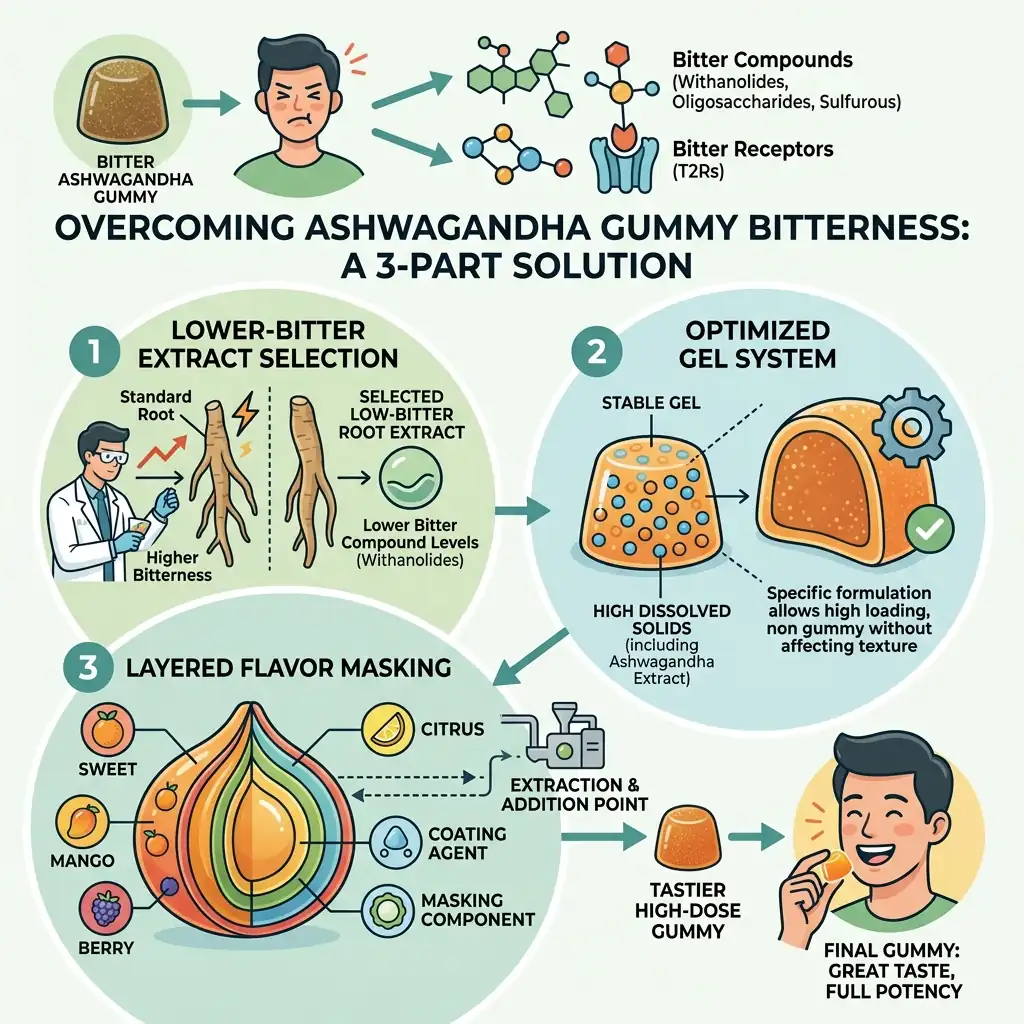
High-dose ashwagandha gummies taste bitter because root extracts are rich in withanolides, oligosaccharides, and sulfurous compounds that bind to bitter receptors and linger after swallowing. To remove that aftertaste without reducing dosage, you need three things working together: a lower-bitter extract selection, a gel system that tolerates high solids, and a layered flavor-masking system added at the right process stage.
For a 300-600 mg per serving product, most experienced Gummy Manufacturer teams move the active addition to the cool-down phase below 85°C, keep pH at 3.8-4.2 for pectin or 4.5-5.0 for gelatin, increase gummy weight to 2.5-3.0 g to keep active load below 18% of mass, and build flavor masking with sweetness, sourness, aroma, and a bitter blocker instead of relying on one strong flavor alone. This approach protects texture, controls water activity, and prevents the earthy, metallic finish that causes consumer complaints.
Why High-Dose Ashwagandha Is a Formulation Challenge
Supplement brands want high-dose ashwagandha because retail buyers recognize 300 mg, 500 mg, or 600 mg per serving. For a private label gummy, that dose has to fit into 1-2 gummies that still taste like candy.
Ashwagandha root powder is not water-soluble. Commercial extracts like KSM-66, Sensoril, or Shoden are concentrated powders with 2-10% total solids that are hygroscopic, dark brown, and bitter. At 150 mg per gummy, you add bitterness. At 300 mg per gummy, you add bitterness plus texture disruption, moisture retention, and color darkening.
The real question behind this search is not how to add more flavor. It is how to deliver a clinically relevant dose in a gummy that remains stable, chewy, and palatable for 18-24 months without requiring an oversized gummy that consumers will not repurchase.
What Brands Actually Need to Decide
Before formulation starts, a product developer should answer:
- What is the target withanolide content per serving and which extract standard supports it?
- Is the serving 1 gummy or 2 gummies, and what is the maximum acceptable gummy weight?
- Is the product vegan pectin, gelatin, or hybrid pectin-gelatin?
- What flavor profile fits the brand and also masks earthy notes?
- What shelf-life and water activity target does the market require?
These decisions affect everything from active loading and Gummy Manufacturing feasibility to cost per kilogram and MOQ.
Choosing the Right Ashwagandha Extract for Gummies
Not all ashwagandha extracts behave the same in a gummy matrix.
Extract Type and Bitterness Load
Root-only extracts such as KSM-66 are water-extracted and generally cleaner in taste than root-and-leaf extracts. Leaf-containing extracts often have higher withanolide concentration but carry greener, more bitter and sulfurous notes. For high-dose gummies, many formulators prefer a root-only extract standardized to 5% withanolides or a high-potency root extract that allows 300 mg to be delivered with less total powder.
High withanolide potency reduces powder load but can increase bitterness intensity per milligram. Low potency requires more powder, which increases gummy mass and affects gel structure. The balance is commercial: dose on label, powder weight in formula, and sensory impact.
Physical Properties That Affect Manufacturing
Ashwagandha extracts are hygroscopic and have fine particle size. They absorb water during mixing and increase viscosity. If added too early in the cooking kettle, they can cause foaming, uneven hydration, and dark spots. They also contain reducing sugars that can accelerate Maillard browning in gelatin systems during drying.
| Extract Characteristic | Impact on Gummy | Formulation Adjustment |
| High withanolide % (8-10%) | Stronger bitter aftertaste, less powder mass | Requires stronger masking system, lower total solids |
| Root-only water extract | Milder earthy note, lighter color | Easier to flavor with fruit profiles |
| Root + leaf hydroalcoholic extract | More intense bitter, green, metallic finish | Needs bitter blockers and stronger aroma coverage |
| Fine particle, hygroscopic powder | Clumping, viscosity rise, water activity shift | Pre-blend with carrier, add in cool-down phase |
How Active Loading Affects Gummy Size and Texture
Active loading is the percentage of gummy weight that comes from functional ingredients. For conventional vitamin gummies, it is 5-10%. For high-dose ashwagandha, it can reach 15-22%.
Example: If you want 600 mg ashwagandha per serving in 2 gummies, each gummy must hold 300 mg extract. In a standard 2.0 g gummy, that is 15% load before counting sweeteners, acids, and flavors. At 3.0 g per gummy, the same dose is 10% load, which is much easier for texture.
Higher load weakens gel structure. Pectin needs sufficient solids and pH control to set. When extract displaces sugar and pectin, the gummy becomes soft, sticky, or brittle. Gelatin is more tolerant of high solids but can become chewy and rubbery if pH drops too low.
Most commercial solutions increase gummy weight to 2.5-3.2 g and keep serving at 2 gummies. This keeps chew pleasant, avoids oversized molds that slow depositing, and keeps water activity within 0.65-0.75. Ask your manufacturer for active loading calculations before locking label claims.
Flavor Masking System That Actually Works
Single-flavor masking fails for ashwagandha. The aftertaste is not just bitter. It is bitter plus earthy, woody, and slightly sulfurous. Effective masking uses four layers that work in sequence during chewing and after swallowing.
| Layer | Purpose | Common Options for Ashwagandha |
| Sweetness modulation | Suppresses initial bitter perception | Sugar, tapioca syrup + small amount of stevia or monk fruit to round sweetness, sodium salt at 0.05-0.15% |
| Sourness and pH | Brightens top notes, reduces earthy persistence | Citric + malic acid blend, keep pectin at pH 3.8-4.2, avoid excess acid that accentuates bitterness |
| Aroma coverage | Covers woody and sulfurous volatiles | Mango, pineapple, passion fruit, spiced berry, chocolate, caramel, coffee notes work better than delicate strawberry |
| Bitter blocking | Blocks receptors for aftertaste | Natural bitter blockers, yeast extracts, lipophilic flavor encapsulates, small amount of vanilla or brown flavors |
Salt is often overlooked. A very low level of sodium chloride or sodium citrate at 0.08-0.12% can reduce bitter perception without tasting salty. The reason is physiological: sodium ions interfere with bitter receptor signaling.
Fat-based flavor carriers help too. MCT oil or sunflower oil at 0.3-0.6% used to pre-disperse the extract can coat particles and slow release of bitter compounds during chewing. This also improves content uniformity.
What a Capable Gummy Manufacturer Does Differently at Scale
Lab samples can taste acceptable. Production batches fail when process control is weak. For high-dose botanicals, process determines whether bitterness returns and whether texture holds.
1. Ingredient Selection and Pre-Treatment
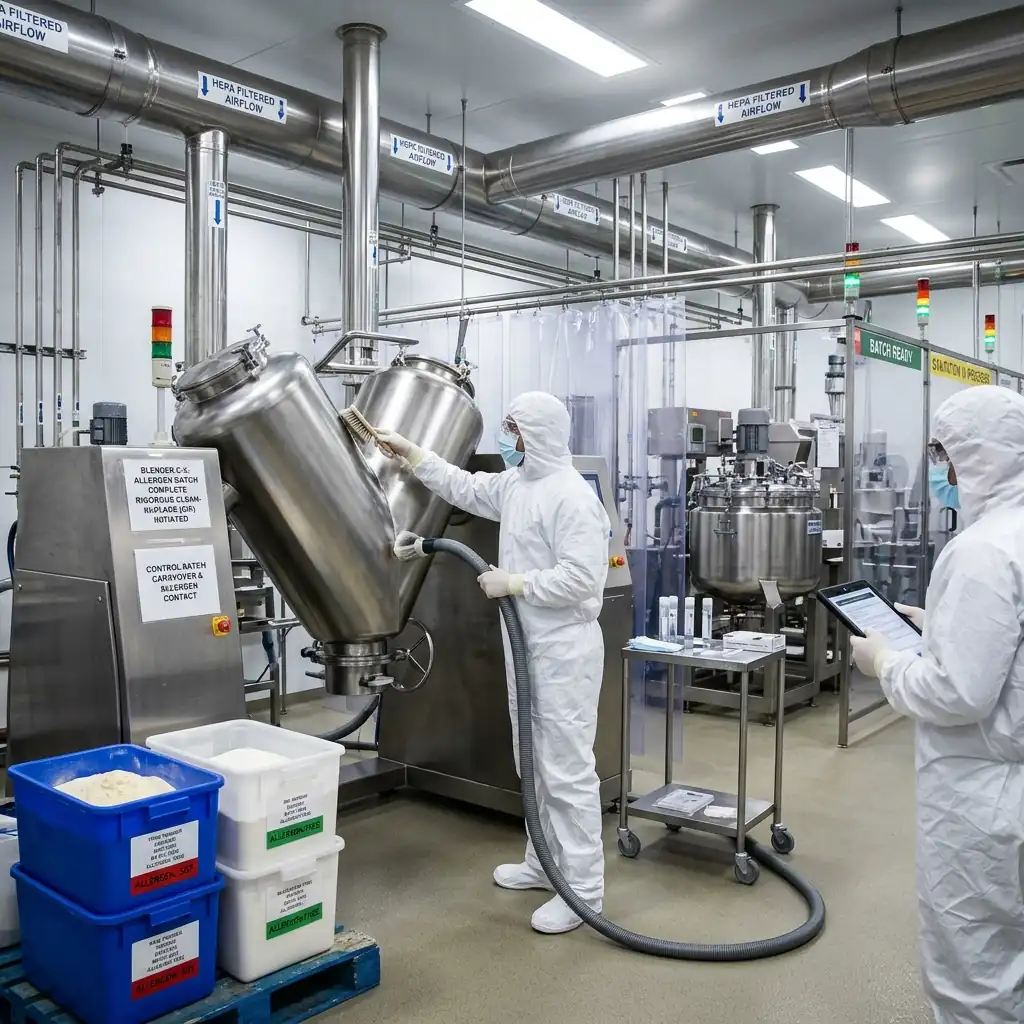
Raw material testing includes withanolide assay, heavy metals, particle size, and moisture. Ashwagandha root is prone to soil contamination. A manufacturer should have incoming limits for lead and microbial load and should reject lots outside spec.
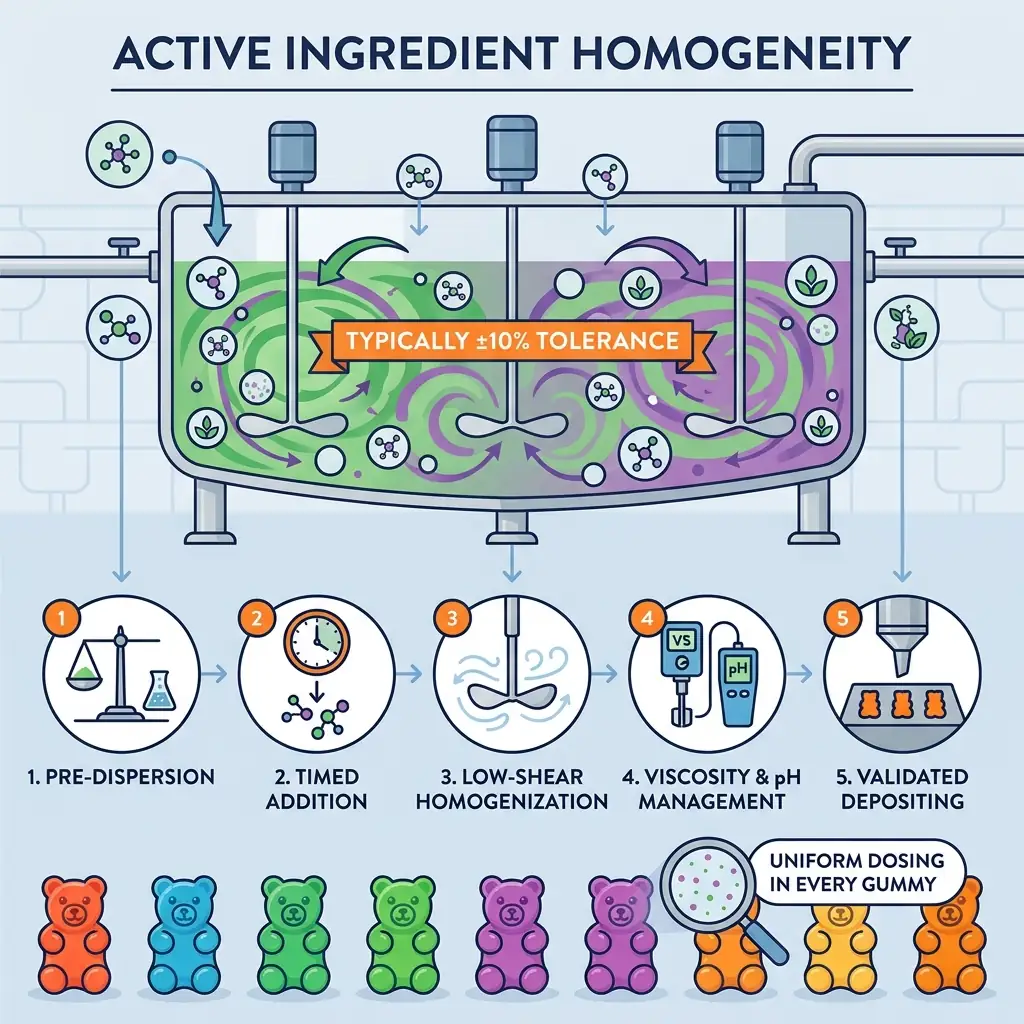
Pre-blending extract with a carrier such as maltodextrin or MCT oil before addition prevents clumping and improves dispersion. Some manufacturers micronize and sieve the extract to under 80 mesh to avoid gritty mouthfeel.
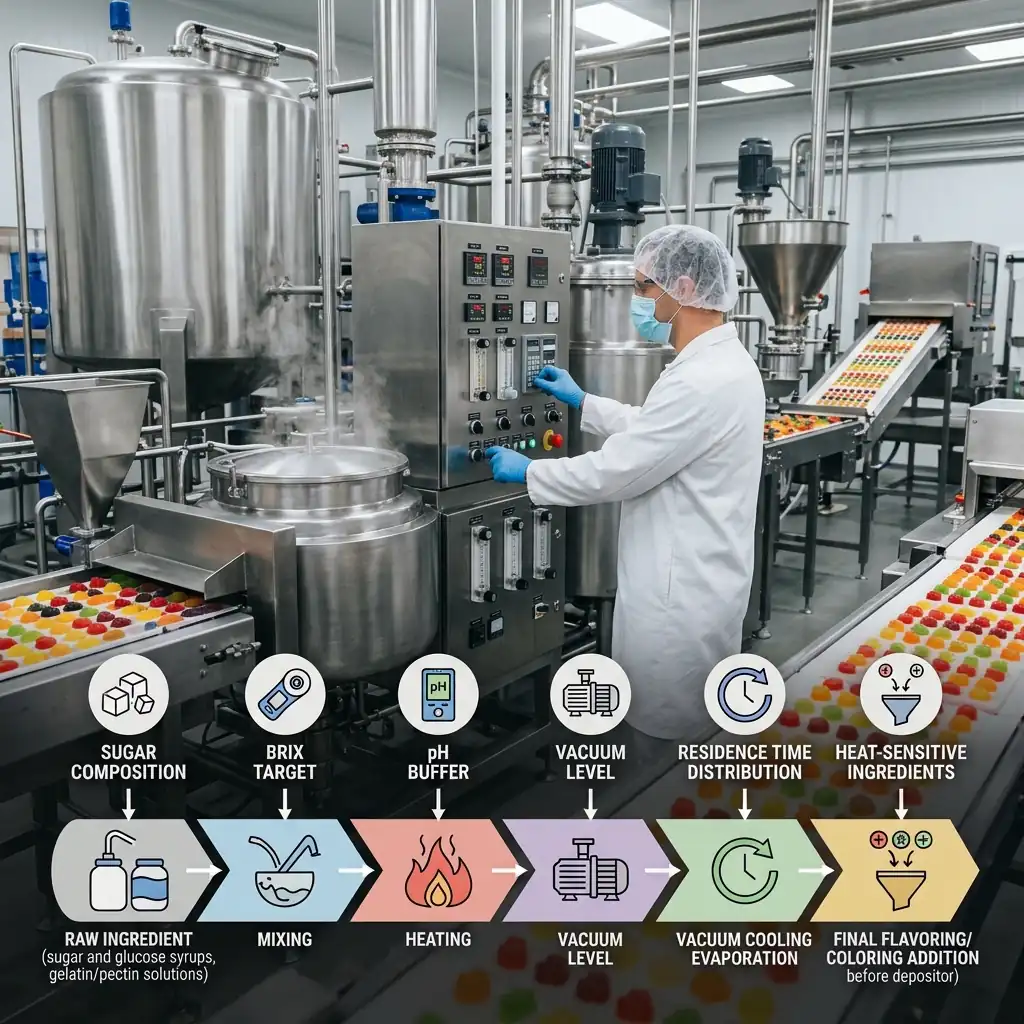
2. Cooking and Active Addition
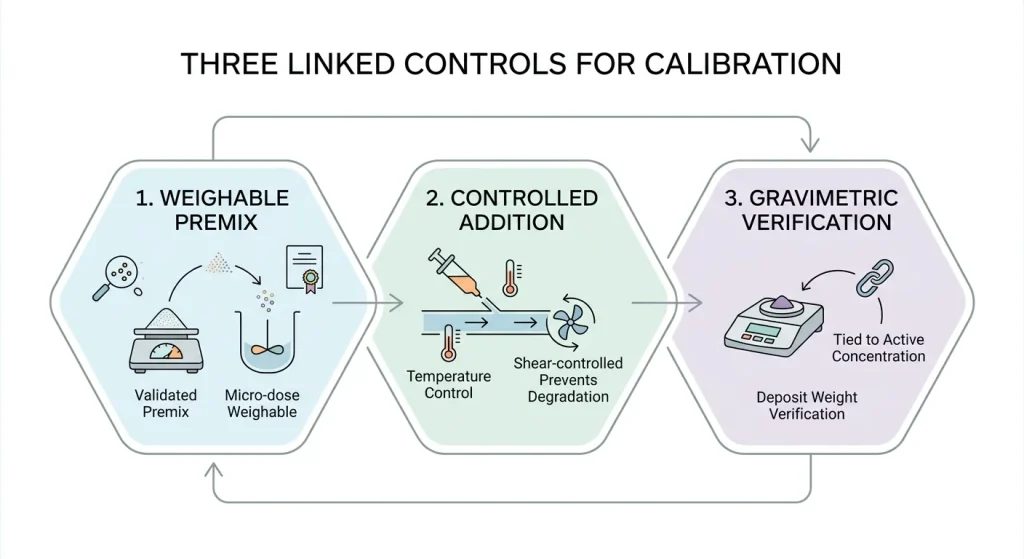
For pectin gummies, the pectin-sugar syrup is cooked to 108-112°C and then cooled to 85-90°C before acid and actives. Adding ashwagandha above 95°C increases bitter volatiles and can cause withanolide degradation and color darkening. Adding below 80°C in pectin can cause premature setting.
For gelatin, the base is cooked lower, typically 85-90°C, and gelatin is added in the holding tank at 70-75°C. Ashwagandha can be added at 65-75°C with slow agitation. The lower temperature helps preserve aroma top notes and reduces foaming.
Mixing must be high-shear but short. Over-mixing incorporates air, which oxidizes brown pigments and makes the gummy look uneven.
3. Deposition, Cooling, and Drying
High-load gummies deposit slower. Depositing temperature should be controlled within ±2°C. If too hot, the extract settles. If too cold, tailing and incomplete molds occur.
Cooling tunnels should bring cores to under 25°C within 30-45 minutes to set gel structure before the extract migrates. Drying or conditioning at 22-26°C and 30-40% RH for 24-48 hours stabilizes water activity. Ashwagandha extracts pull moisture, so initial water activity may read 0.75-0.78 and needs conditioning to reach 0.70 or below for microbial stability.
4. Coating and Packaging
Wax or oil coating reduces surface stickiness caused by hygroscopic extract. Pectin gummies with ashwagandha often need a double coat. Packaging matters: high-barrier pouches or induction-sealed bottles with desiccant help control moisture pick-up during shelf life.
Stability, Water Activity and Shelf-Life Risks
High-dose botanical gummies have three stability risks.
First, water activity creep. Hygroscopic extracts absorb water from the gel matrix and from ambient air. If water activity rises above 0.78, you risk yeast and mold growth and texture softening. Manufacturers control this by adjusting final Brix, drying time, and packaging film MVTR.
Second, color and flavor fade. Ashwagandha darkens over time due to Maillard reaction between its amino compounds and sugars. This is faster in gelatin at higher pH and temperature. Accelerated stability testing at 40°C / 75% RH for 3 months helps predict 18-month color change.
Third, content uniformity. Botanical extracts do not dissolve. If mixing is weak, some gummies carry 20% more withanolides than others. Finished-product testing should include withanolide assay by HPLC and weight variation per USP or customer spec.
Cost, MOQ and Commercial Trade-Offs for Private Label Gummy Brands
Formulation complexity directly affects cost. Factors include:
- Extract cost: high-potency standardized extracts cost more per kilogram but reduce gummy weight and improve texture.
- Gummy weight: 3.0 g gummies use 50% more base and packaging than 2.0 g gummies but may reduce need for extra masking agents.
- Flavor system: natural bitter blockers and encapsulated flavors add 8-15% to flavor cost compared to standard fruit flavor.
- Pectin vs gelatin: pectin raw material costs more and depositing yields are slightly lower, but it supports vegan claims that command higher retail price.
- Testing: withanolide testing, heavy metals, and stability studies add to batch cost, especially for small MOQs.
MOQ becomes important when using custom molds or high-dose extracts. Most manufacturers set MOQ based on one full cooking batch, typically 150-300 kg of gummies, which equals 50,000-120,000 pieces depending on gummy weight. For a 600 mg serving product, low MOQ runs may require you to accept 3.0 g gummy weight to fit the dose into existing molds.
Lead time for ashwagandha extracts varies. Branded extracts like KSM-66 may have 6-10 week lead times during peak demand. Planning extract procurement before flavor finalization reduces delays.
How to Evaluate a Gummy Manufacturer for High-Dose Ashwagandha Projects
When sourcing a Gummy Manufacturer for high-dose botanical gummies, verify capabilities that can be measured:
- R&D capability with botanical extracts: ask for examples of gummies above 12% botanical load that passed stability.
- Gel system flexibility: can they run both pectin and gelatin and explain pH and water activity control for each?
- Flavor masking library: do they have in-house flavorists and bitter-blocking tools, not just off-the-shelf fruit flavors?
- Process control: temperature-controlled holding tanks, in-line viscosity control, and metal detection after drying.
- Quality systems: GMP, ISO22000, HACCP, and documented incoming testing for heavy metals and microbes.
- Testing: HPLC for withanolides, water activity meter, texture analyzer, and microbiological testing per batch.
- Scale-up experience: pilot batches of 20-50 kg that translate to commercial batches without changing gel set.
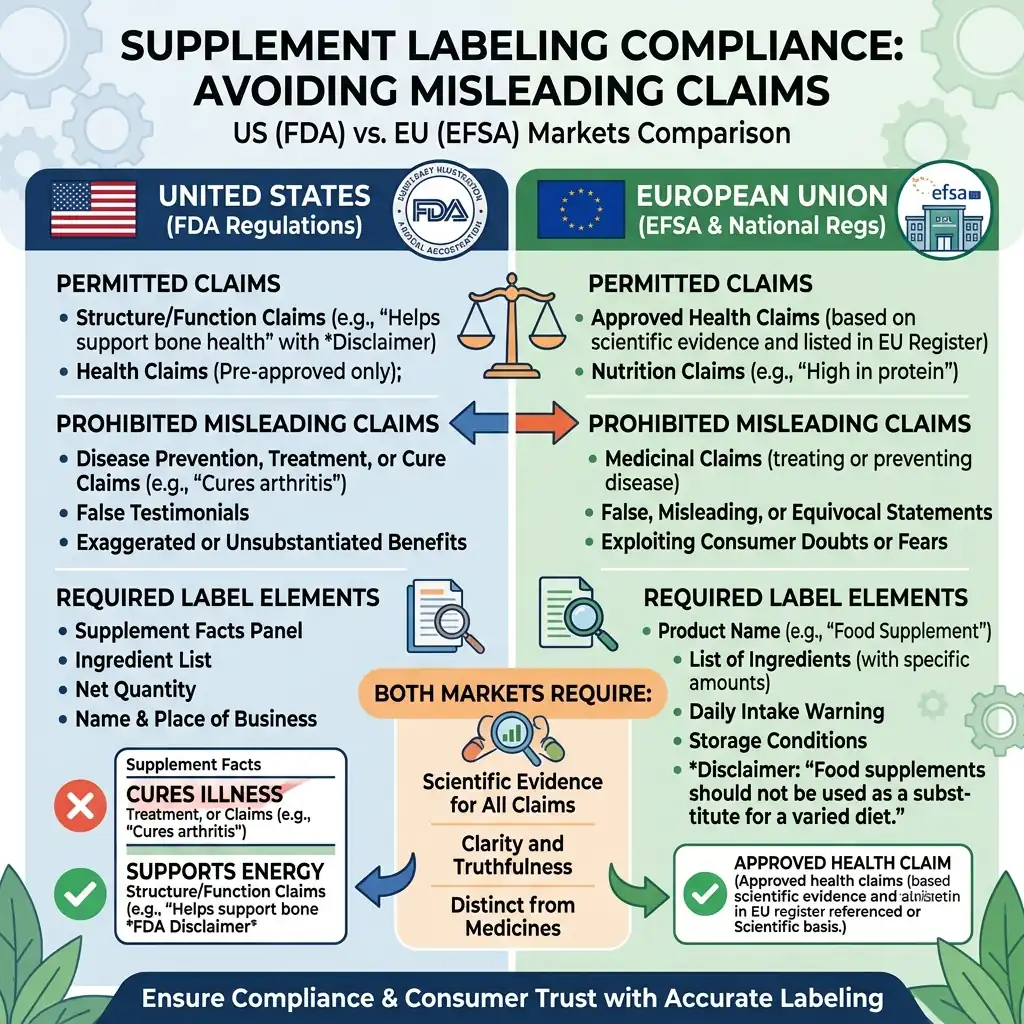
- Export documentation: COA, allergen statements, and regulatory support for target markets.
- Batch traceability and cleanroom class: 100,000-class cleanroom with 10,000-class lab area is standard for gummy export.
Shenzhen Gothink Biotech Co., Ltd. operates a GMP-certified facility with a 100,000-class cleanroom, a 10,000-class R&D laboratory, and approximately 16 tons daily production capacity. Its R&D team supports custom formulation development for high-load botanical gummies across pectin and gelatin systems. Capabilities like this matter when moving from concept to stable commercial production.
Common Mistakes to Avoid
- Adding ashwagandha at the cooking stage above 95°C to save time. This increases bitterness and darkens color.
- Using a delicate flavor like plain strawberry or watermelon without a brown or tropical base. Light fruit notes cannot cover sulfurous aftertaste.
- Keeping gummy weight at 2.0 g to save cost while pushing 300 mg per gummy. The texture fails and bitterness concentrates.
- Ignoring water activity and relying only on moisture content. Two gummies can have same moisture but different water activity and different mold risk.
- Skipping pre-blend and dumping extract directly into syrup. This creates lumps, uneven dose, and bitter hot spots.
- Not testing heavy metals and withanolide content for each lot. Ashwagandha root varies by season and origin.
Practical Checklist for Buyers
Provide this information to your manufacturer to get an accurate quotation and a feasible sample:
- Target ashwagandha extract name, withanolide %, and dose per serving and per gummy
- Desired gummy weight, serving count, gel type, and dietary claims (vegan, sugar-free, halal, kosher)
- Flavor direction and any flavors to avoid, plus target sweetness and sourness level
- Target water activity, shelf-life, and packaging format (bottle count, pouch, desiccant)
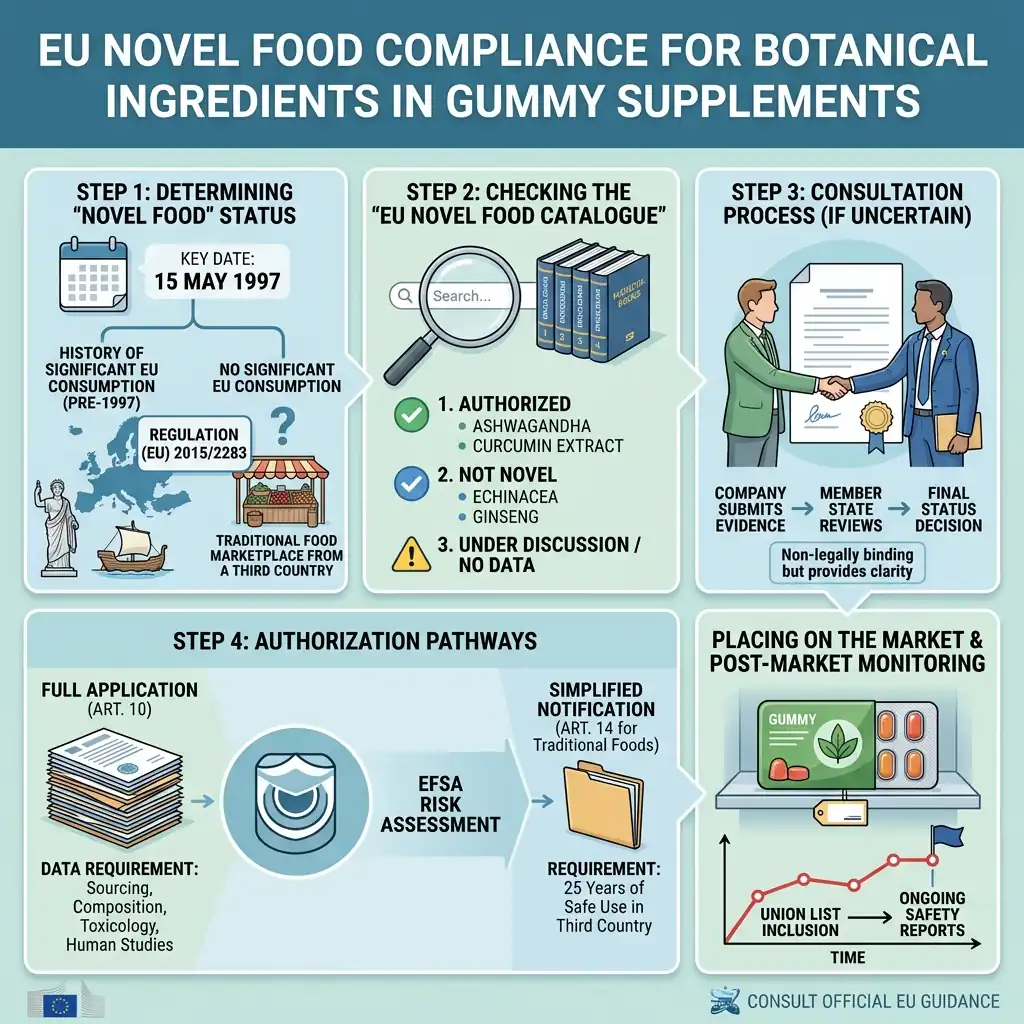
- Regulatory market, testing requirements, and documentation needed
- Estimated first order volume and annual forecast
FAQ
What is the maximum ashwagandha dose you can put in one gummy without bitterness?
Most gummies stay palatable up to 150-250 mg per gummy in a 2.5-3.0 g size when using root-only extract and layered masking. Above 300 mg per gummy, bitterness and texture disruption increase sharply and require 3.0 g+ gummy weight or a 2-gummy serving.
Is pectin or gelatin better for high-dose ashwagandha gummies?
Gelatin tolerates high solids and masks earthy notes slightly better due to higher pH and melt-in-mouth texture. Pectin supports vegan positioning and cleaner label but needs tighter pH control at 3.8-4.2 and longer drying to manage water activity. Choice depends on brand positioning and flavor target.
Why does ashwagandha cause a lingering aftertaste in gummies?
Withanolides and related saponins are bitter and have slow clearance from bitter receptors. Volatile sulfur compounds from root material add an earthy, metallic finish that appears after swallowing. Masking needs to block receptors and cover volatiles, not just add sweet flavor.
Can you use chocolate or caramel flavor to hide ashwagandha taste?
Yes. Brown flavors like chocolate, caramel, coffee, and spiced berry pair well with ashwagandha because their roasted and warm notes overlap with its natural profile. Tropical fruits like mango and passion fruit also work by providing strong aroma that dominates aftertaste.
Does high-dose ashwagandha affect gummy stability?
Yes. The extract is hygroscopic and can raise water activity, soften texture, and accelerate browning. Control requires optimized drying, barrier packaging, and monitoring water activity below 0.75, plus stability testing for color and withanolide content.
What should I ask a Gummy Manufacturer before ordering ashwagandha gummies?
Ask about maximum botanical load they have validated, pectin and gelatin capabilities, flavor masking approach for bitter botanicals, withanolide assay method, water activity control, MOQ per batch, extract sourcing options, and stability data for similar products.
What drives cost for private label ashwagandha gummies?
Extract standard and brand, gummy weight, gel system, flavor system complexity, testing requirements, packaging barrier level, and order volume. High-potency extracts reduce weight but increase raw material cost per kilogram.
Next Step: From Concept to Commercial Sample
High-dose ashwagandha gummies succeed when formulation, flavor, and process are designed together, not sequentially. If you have a target dose and flavor direction, request a feasibility review that includes active loading calculation, gel system recommendation, and a masking strategy with sample options.
For technical reference, review the Knowledge Hub and formulation R&D insights: Gummy Formulation Knowledge Hub and Formulation R&D Center. When ready, share your extract specification, serving size, and target gummy weight to discuss pilot batching and OEM/ODM quotation.
Jack Luo|Senior Technical Advisor, Nutrition Research Center Representing Gothink Biology, a GMP-certified dietary supplement manufacturer based in Shenzhen, China.