
Gummy Manufacturing & Process Engineering Hub
Precision mogul depositing, dynamic dehydration curing profiles, equilibrium water activity (aW) control, and anti-sticking surface coating technologies for scalable gummy supplement production.
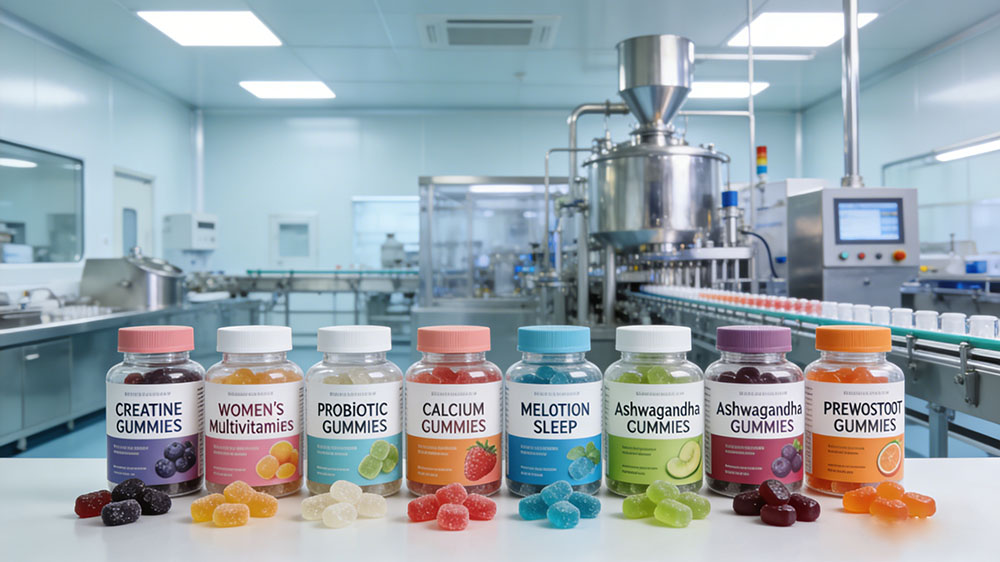
Industrial Engineering Standards for Contract Gummy Supplement Production
Scaling gummy supplement manufacturing from lab bench to continuous industrial throughput requires rigorous thermo-dynamic control and precision moisture management. Key process parameters include maintaining cooking slurry solids at 75–78 °Brix, calibrating pneumatic servo depositor pumps for dose accuracy within ±1.5%, and controlling drying room environments at 22–25 °C with 25–30% relative humidity (RH). To guarantee a 24-month shelf life without microbial risk, water activity (aW) must be brought below 0.62 aW, paired with automated anti-sticking oil distribution (medium-chain triglycerides / carnauba wax) to eliminate surface tackiness and container clumping during international bulk shipping.
Industrial Process Engineering Disciplines
Pillar 1: Mogul Depositing & Molding Technologies
Focus: Starch mogul vs. aluminum/silicone starchless depositing line engineering.
Technical Scope: Slurry viscosity control, nozzle temperature zones (95 °C – 105 °C), tailing prevention, and multi-color co-extrusion technology.
Pillar 2: Dehydration Curing & Moisture Thermodynamics
Focus: Multi-stage air-drying tunnels and environmental curing rooms.
Technical Scope: Psychrometric chart balancing, equilibrium moisture content (EMC), airflow velocity tuning, and gelatin/pectin gelling maturation curves.
Pillar 3: Water Activity (aW) & Shelf-Life Optimization
Focus: Preventing microbial proliferation and surface sweating via water activity control.
Technical Scope: Bound vs. free water ratio, dew point calibration, aW threshold monitoring (0.58–0.62 aW), and osmotic pressure management.
Pillar 4: Surface Finishing, Oil Spraying & Coating
Focus: Automated oil polishing and acid-sugar sanding systems.
Technical Scope: MCT oil / Carnauba wax micro-atomization, acid dusting (Malic/Encapsulated Citric) moisture barrier application, and oil-sanding tumblers.
Pillar 5: Continuous Cooking & Active Ingredient Homogeneity
Focus: Micro-dosing accuracy for vitamins, minerals, and active botanical extracts.
Technical Scope: Dynamic inline mixing, thermal degradation mitigation, vacuum flash cooling, and color-flavor-acid (CFA) dosing skid calibration.
Pillar 6: Bulk Packaging & Cross-Border Logistics Protection
Focus: Protecting bulk gummies from heat deformation and moisture migration during freight.
Technical Scope: Desiccant pouch integration, WVTR barrier liner selection, thermal container blankets, and ambient stress testing (40 °C / 75% RH).
Featured Process Engineering Guides & Production Studies
Mastering Water Activity (aW) Control in Gummy Production to Prevent Clumping & Mold
Why maintaining water activity between 0.58–0.62 aW is crucial for preventing microbial growth, sticky surface sweating, and structural deformation.
Looking for stable shelf-life formulas? View our Multivitamin Gummies Contract Manufacturing.
Starchless vs. Starch Mogul Molding Lines: Which is Best for High-Volume OEM Orders?
A direct comparison of starchless silicone molds versus cornstarch trays regarding turn-around time, cleaning protocols, and allergen cross-contamination risk.
Optimizing Dehydration Curing Profiles to Achieve Target Equilibrium Moisture Content
How gradual multi-stage humidity reduction prevents surface skinning and ensures uniform internal texture in high-pectin formulations.
Need turn-key production? Explore our Creatine Gummies OEM Manufacturing.
Oil Sanding vs. Acid Powder Coating: Preventing Moisture Migration and Clumping
Evaluating automated MCT oil spraying techniques against encapsulated malic acid sanding to maintain visual clarity and prevent hygroscopic clumping.
Preventing Melt & Deformation During Overseas Bulk Container Shipping
Thermal insulation packaging, anti-sticking surface treatments, and temperature-monitored freight strategies for cross-border bulk shipping to humid regions.
How Active Ingredient Homogeneity is Maintained in Large-Batch Gummy Cooking
Engineering inline dynamic mixing skids and vacuum dosing systems to guarantee micro-nutrients like Vitamin D3 and B12 achieve ±2% unit-to-unit consistency.
Formulating functional sleep products? Check our Melatonin & Sleep Gummies OEM Page.
Controlling Caramelization and Maillard Reaction During Continuous Gummy Cooking
Managing residence time and heat flux in scraped-surface heat exchangers to prevent unwanted browning and off-flavors in high-protein collagen gummies.
Precision Dosing Calibration for Micro-Nutrients in High-Speed Depositing Lines
How mass flow meters and peristaltic micro-pumps prevent nutrient thermal decay and over-dosing waste in continuous high-speed supplement lines.
Formulating live cultures? See our Probiotic Gummies Contract Manufacturing.
Industrial Facility & Equipment Capability Standards
🏭 Class 100,000 Cleanroom Processing
ISO 8 / Class 100,000 HEPA-filtered air handling units governing all depositing, curing, and primary packaging zones to eliminate airborne particulate risk.
⚙️ Continuous Servo Depositing Lines
Automated high-speed depositing capability producing up to 300,000 gummies per hour with automated vision inspection for weight and shape consistency.
🌡️ Climate-Controlled Curing Rooms
Independent dehumidification curing chambers maintaining continuous 20–25% RH and 22 °C temperature stability for uniform moisture evaporation.
🔍 Automated Vision Inspection & Metal Detection
In-line X-ray inspection, dual-frequency metal detectors, and high-speed optical camera sorters rejecting non-conforming gummies prior to packaging.
Frequently Asked Manufacturing & Process Engineering Questions
Q1: What is the ideal Water Activity (aW) level for contract manufactured supplement gummies?
The target equilibrium water activity (aW) for functional supplement gummies is between 0.58 and 0.62 aW measured at 25 °C. Water activity above 0.65 increases mold and bacterial growth risk, while levels below 0.55 cause rubbery hardening and crystal precipitation.
Q2: How do starchless depositors differ from traditional cornstarch mogul lines?
Starchless depositors utilize quick-release silicone or metal molds with mechanical ejectors. They eliminate cornstarch dust contamination, lower cleaning turnaround times, reduce allergen cross-contact, and enable faster curing cycles (1–4 hours vs 24–48 hours for starch).
Q3: How is active ingredient degradation minimized during high-temperature cooking?
Active heat-sensitive ingredients (Vitamins, Probiotics, Botanical Extracts) are introduced via a post-cook Inline CFA (Color, Flavor, Acid) Injection Skid just prior to depositing at reduced slurry temperatures (90–95 °C), minimizing thermal holding exposure to under 60 seconds.
Q4: What anti-sticking coatings are used to prevent gummies from clumping in bottles?
We apply an ultra-thin micro-atomized coating of Medium Chain Triglycerides (MCT Oil) blended with natural Carnauba Wax or Beeswax (0.1–0.2% by weight). Alternatively, encapsulated acid sanding (Malic or Fumaric acid) can be applied for sour profiles.
Q5: What humidity and temperature levels are maintained during the curing process?
Curing chambers operate under controlled environmental conditions: Temperature maintained at 22 °C ± 2 °C and Relative Humidity (RH) strictly controlled at 25% ± 3%. Air turnover rates are tuned to prevent rapid surface skinning.
Explore Related Formulation & Sourcing Knowledge Hubs
🧪 R&D & Formulation Guide
Master hydrocolloid matrix engineering (Pectin vs Gelatin), active ingredient stabilization, sugar-free allulose recipes, and bitter taste masking.
🛡️ Quality & Compliance
Review FDA cGMP audit protocols, ISO 17025 COA laboratory testing, heavy metal/microbial limits, and international labeling rules.
📊 Sourcing & Business Insights
Analyze OEM minimum order quantities (MOQ), cooking batch yields, bottle vs. pouch packaging economics, and freight shipping.
🏠 Main Knowledge Center Hub
Return to the top-level repository covering all 4 technical domains of custom contract gummy supplement production.
Scale Your Gummy Production with Precision Engineering
From low-MOQ pilot batches to continuous high-speed runs, leverage our US-educated Dual-PhD engineering team for optimal texture, stability, and dose accuracy.
Low-MOQ Pilot Production (From 500 Bottles)
Test complex formulas and new market concepts without heavy capital outlay. Flexible batch sizes engineered for fast-growing supplement brands.
US Dual-PhD Scientific R&D Support
Led by PhD food scientists and chemical engineers from top US universities. Specializing in thermal decay mitigation and precision micro-dosing.
100% Turnkey OEM/ODM Manufacturing
End-to-end contract execution: From slurry cooking and climate-controlled curing to automated bottle packaging and cGMP release testing.
🔒 100% Confidential | NDA Protected | Responded by Process Engineer within 24 Hours