
Direct Answer: Bottles vs. Pouches for Supplement Gummies
For most supplement brands sourcing from a Gummy Manufacturer, the choice between bottles and pouches comes down to three variables: moisture and oxygen barrier compatibility with the gummy formula, target serving count and retail format, and the packaging equipment available at your contract manufacturer. Bottles—typically HDPE or PET with induction-sealed closures and desiccant—remain the industry standard for retail-ready, multi-serving gummies because they provide reliable moisture protection, tamper-evidence, and strong shelf presence. Pouches, including flat-bottom stand-up pouches, three-side-seal sachets, and single-dose stick packs, are increasingly chosen for travel-friendly, e-commerce-first, or sample-size private label gummy lines where lighter freight and brand storytelling matter.
There is no universal best format. A high-dose, hygroscopic gummy with botanical extracts may require a rigid bottle with desiccant and an oxygen absorber to maintain water activity below 0.65 throughout shelf life. A low-dose, single-serving private label gummy formulated for vending or travel retail may perform better in a sealed pouch with a high-barrier film. The right decision starts from the formula and the target channel, not from a packaging catalog.
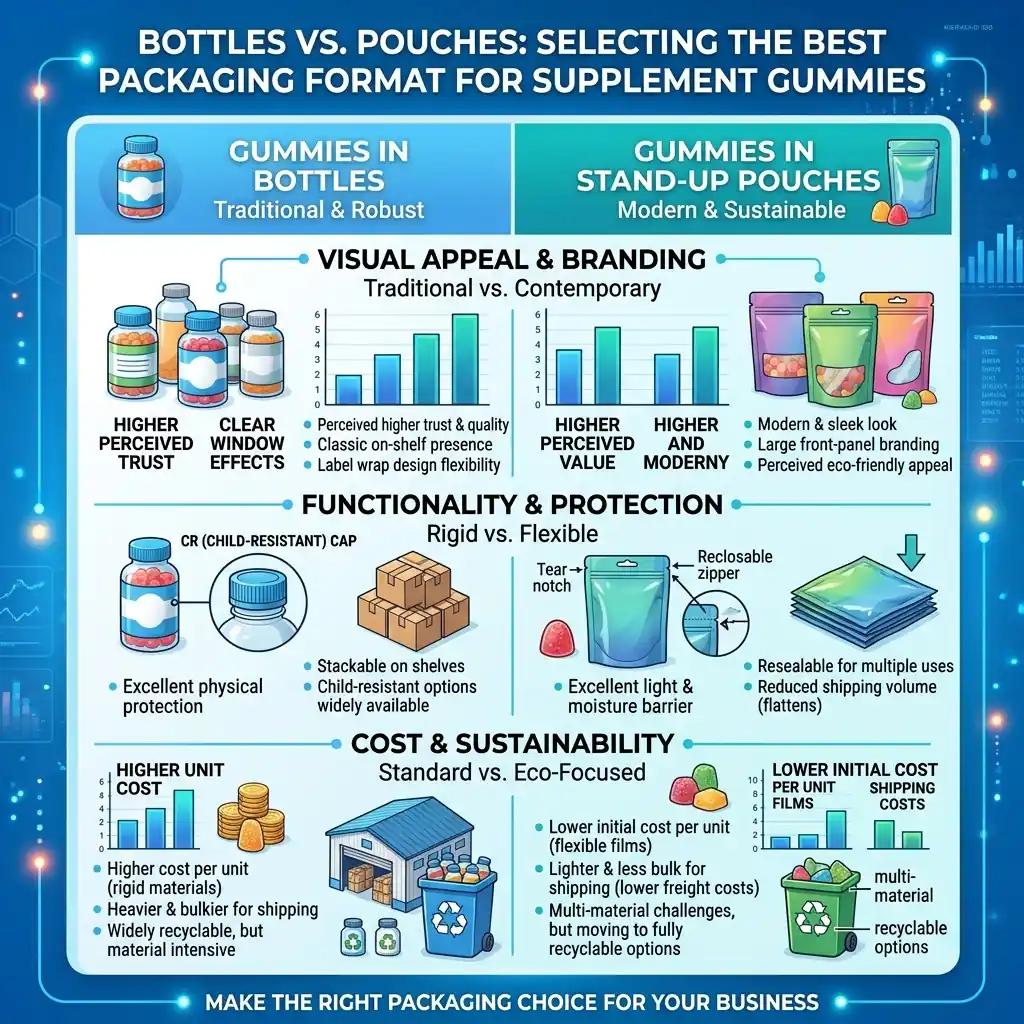
Why Packaging Format Is a Manufacturing Decision, Not Just a Branding Decision
Packaging for gummies is not a label applied to a container. It is a stability system that interacts with moisture migration, oxygen exposure, light, and the gel structure of the gummy itself. Gelatin and pectin gummies are sensitive to water activity; they either lose moisture and become tough, or absorb ambient moisture and become sticky, clumped, or in extreme cases microbially unstable during shelf life.
A Gummy Manufacturer must consider how each packaging format interacts with the following parameters before recommending a structure:
- Water activity (Aw) of the finished gummy, typically 0.55–0.70
- Equilibrium relative humidity (ERH) inside the sealed headspace
- Oxygen transmission rate (OTR) and water vapor transmission rate (WVTR) of the packaging material
- Heat-seal integrity at production speed, not only at lab speed
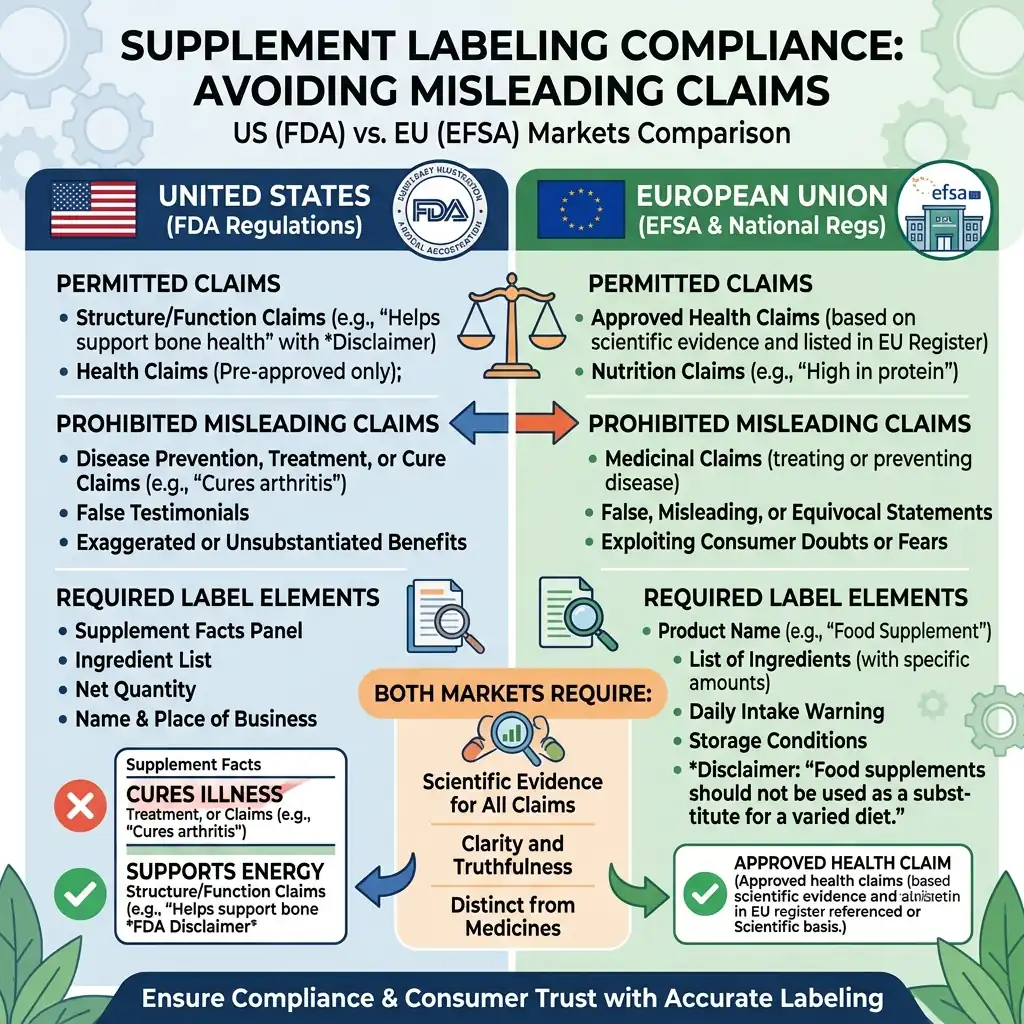
- Tamper-evidence and regulatory compliance in the destination market
- Recyclability and consumer-facing sustainability expectations
A packaging format that looks attractive at the concept stage can fail stability testing at the 18- or 24-month mark. Selecting the format early, in parallel with formulation, prevents costly reformulation or repackaging after launch.
Bottle Packaging: When and Why
Formats and Materials
Most supplement gummies are filled into HDPE or PET bottles, typically in 60-, 90-, 120-, or 150-count configurations. Bottles are usually paired with the following components, each of which is a separate specification:
- Induction-sealed foil liner for tamper evidence and moisture barrier
- Polyethylene cap with an optional desiccant chamber
- Molecular sieve or silica gel insert, often 1–3 g depending on bottle size and target Aw
- Cotton or rayon filler to prevent gummy movement and reduce surface abrasion
Technical Advantages
Bottles provide a near-rigid headspace, which means the desiccant and oxygen absorber can hold a stable microclimate around the gummies for the entire shelf life. For gummies with active ingredients sensitive to oxidation—such as omega-3-loaded gummies, certain vitamins, or polyphenol-rich botanical extracts—the controlled headspace inside a sealed bottle is a meaningful stability advantage.
Bottles also tolerate higher fill weights and complex gummy geometries. A 5 g pectin gummy with a multi-cavity mold fits more reliably into a 150-count bottle than into a pouch, where geometry-driven puncture risk rises sharply with piece count and pack volume.
Manufacturing Considerations
Bottle lines run on automated counter-fillers or net-weight fillers, followed by capping and induction-sealing machines. A typical commercial line runs 80–180 bottles per minute depending on count, gummy geometry, and line configuration. Tooling changeover between bottle sizes is moderate; mold tooling for unusual shapes may add lead time.
The biggest manufacturing constraint for bottle formats is counter accuracy for irregular gummy shapes. Pectin gummies with oil-coated surfaces can bridge in the counter and cause undercount. Your Gummy Manufacturer should validate counter performance for the specific formula and geometry before mass production, not only on a generic test piece.
Pouch Packaging: When and Why
Formats and Materials
Pouches used for supplement gummies generally fall into three commercial categories, each with distinct barrier and branding trade-offs:
- Flat-bottom stand-up pouches (SUP) for multi-serving retail formats
- Three-side-seal sachets for sample, single-dose, or trial formats
- Stick packs for single-dose, travel, and subscription e-commerce channels
Pouches are built from multi-layer films, typically PET/AL/PE, PET/MPET/PE, or PA/PE laminates. The aluminum foil or metalized PET layer provides the oxygen and moisture barrier; the inner PE layer provides sealability. The barrier performance is determined by the film structure, not by the pouch shape.
Technical Advantages
Pouches offer significantly lower freight weight and storage volume, which is critical for cross-border shipping and direct-to-consumer brands. A stand-up pouch for 60 gummies may weigh under 20 g, versus 25–35 g for a comparable bottle plus closure and desiccant. For a private label gummy brand sourcing from a China-based Gummy Manufacturer and shipping to North America or Europe, the freight delta can be material at the pallet level.
Pouches also fit premium, modern, or sustainability-oriented brand positioning. Pouch formats carry larger printable surface area, support full-bleed artwork, and accept resealable zippers that work well for travel and on-the-go consumption.
Manufacturing Considerations
Pouch lines run on rotary or intermittent-motion fill-and-seal machines. Pouch pre-forms are purchased pre-made and filled through the top opening, or the line forms pouches from roll stock in an HFFS (horizontal form-fill-seal) configuration. Speeds typically range from 40–120 pouches per minute, slower than comparable bottle lines.
The primary technical risk is seal integrity. A small wrinkle in the seal area, or contamination from gummy surface oil on the sealant layer, can produce a leaker that fails during distribution. In-line seal inspection—pressure-decay, vacuum-bubble, or vision systems—is essential for any Gummy Manufacturer running pouch formats at commercial scale.
Comparison Table: Bottles vs. Pouches at a Glance
| Attribute | Bottles (HDPE/PET) | Pouches (SUP/Sachet/Stick) |
| Typical serving count | 30–150 count retail | Single dose to 60-count SUP |
| Moisture barrier | High, especially with desiccant | High with AL/MPET layer; moderate with PE-only |
| Oxygen barrier | Strong with induction foil + absorber | Strong only with foil or metalized layer |
| Tamper-evidence | Built in (induction seal + cap band) | Requires tear-notch or secondary seal |
| Freight efficiency | Lower (rigid volume) | Higher (collapsible, lower dead weight) |
| Typical line speed | 80–180 units/minute | 40–120 units/minute |
| Custom artwork MOQ | Driven by preform/mold minimum | Driven by printing plate/cylinder |
| Best fit | Retail shelf, multi-serving, oxidation-sensitive formulas | E-commerce, travel, sample, low-MOQ private label |
Formulation and Stability Considerations
Packaging selection must begin with the gummy itself. Three formulation variables drive format compatibility more than any others, and each one can override a brand preference if ignored.
Water Activity (Aw)
Gummies typically finish with an Aw of 0.55–0.70. If the finished Aw is above 0.65, microbial growth becomes more likely during shelf life, and the chosen packaging must include both desiccant and a tight WVTR. Bottles with desiccant are more forgiving of a slightly higher starting Aw because the rigid headspace holds a stable microclimate. Pouches with high-barrier film can perform equally well, but only if seal integrity is validated and the film’s WVTR is correctly specified for the destination climate.
Active Ingredient Sensitivity
Vitamin C (ascorbic acid), certain B vitamins, polyunsaturated fatty acids, and many botanical extracts degrade with oxygen and moisture exposure. For these formulas, the packaging system must include an oxygen barrier layer and ideally an oxygen absorber. Bottles with induction-sealed foil plus an oxygen absorber are typically the most cost-effective solution. Pouches require a foil or metalized layer; PE-only laminates are not suitable for oxidation-sensitive actives regardless of how the artwork looks.
Texture and Surface Characteristics
Oil-coated or sugar-coated gummies behave differently in filling and sealing. Oily surfaces can transfer to the seal area of a pouch and cause seal failures at production speed. Sugar-coated gummies may abrade during bottle filling and produce dust that interferes with counting or print inspection. Your Gummy Manufacturer should match the finishing process to the chosen packaging format, not the other way around.
Cost and MOQ Considerations
The cost gap between bottles and pouches depends on volume, custom artwork, and tooling. For lower-volume private label gummy runs—typically 10,000–50,000 units—pouches often carry a lower total cost because pre-made pouch inventory is cheaper than bottle mold inventory, and artwork changeover is faster. For higher-volume retail runs—typically 100,000+ units per SKU—bottles usually reach a lower per-unit cost because bottle-filling lines run faster and tooling amortizes more efficiently across the run.
MOQ for custom-printed pouches is often driven by the printing plate or cylinder cost; some suppliers set a 5,000–10,000 pouch minimum for custom artwork. Custom bottle MOQ is often driven by the preform or mold minimum and may start higher. Your Gummy Manufacturer should be able to consolidate packaging procurement with the filling run so that the buyer is not managing two separate supply chains or absorbing minimum-quantity penalties from both.
Scale-Up and Production Considerations
A common mistake in private label gummy projects is to validate packaging at pilot scale on a slow, manual, or semi-automatic line, then transfer to a high-speed commercial line. Differences in fill speed, seal dwell time, headspace evacuation, and gummy geometry handling can shift a passing stability test into a failing one. A pouch that seals cleanly at 30 units per minute may leak at 100 units per minute because dwell time drops below the sealant’s minimum activation window.
For both bottle and pouch formats, the buyer should request commercial-line validation runs rather than pilot-scale data only. Specific deliverables to ask for include seal-strength and leak-test results at production speed, stability test data in the actual commercial packaging including any desiccant and oxygen absorber, and counter or weigher accuracy reports for the specific gummy geometry. A serious Gummy Manufacturer will offer this as part of the project scope, not as a billable extra.
Quality, Testing, and Shelf-Life Validation
Whichever format you choose, the finished pack must pass the following tests before commercial release:
- Seal integrity: vacuum-bubble, pressure-decay, or dye-penetration for pouches
- Induction-seal verification: peel strength and visual continuity for bottles
- Water vapor transmission rate confirmation for the laminate or bottle material
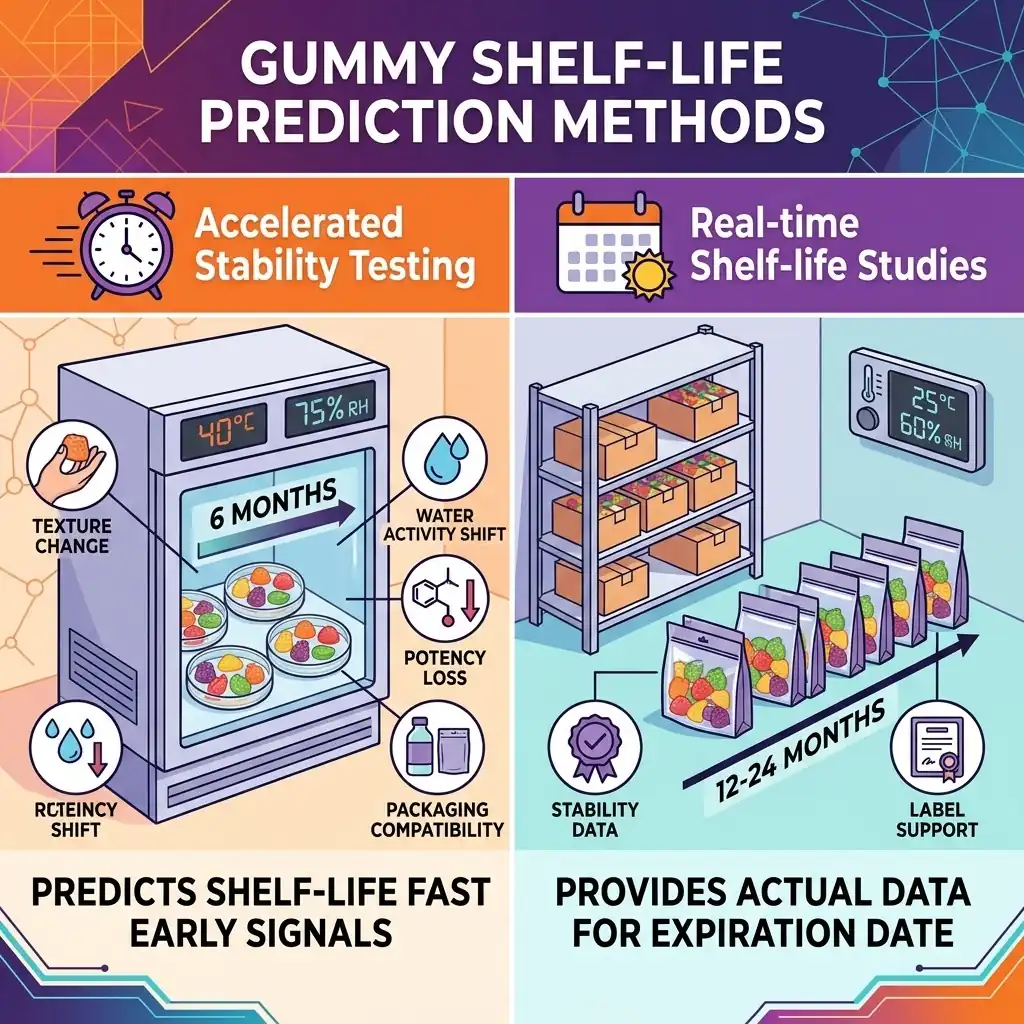
- Accelerated stability, typically 40°C / 75% RH for 3–6 months, plus real-time stability at intended storage conditions
- Microbiological testing on the finished gummy and on the finished pack
- Tamper-evidence validation per destination market regulations
Stability testing must be conducted in the actual commercial packaging configuration, including any inner seal, desiccant, oxygen absorber, cotton filler, and pouch insert. Data from a generic bottle or a generic pouch does not transfer reliably to a custom pack, because headspace volume, desiccant loading, and seal geometry all shift the stability profile.
Supplier Evaluation Criteria
When evaluating a Gummy Manufacturer to produce bottled or pouch-packaged gummies, focus on verifiable capabilities rather than marketing language. Practical questions include the following:
- Do they run bottle-filling and pouch-filling lines in-house, or do they outsource packaging?
- Can they provide stability test data from prior projects, without naming the brand, that match your format and formula class?
- What is the minimum batch size at which they will validate a commercial line for your specific gummy geometry?
- What in-line inspection do they run on seals, counts, and metal contaminants?
- Can they source bottles, caps, desiccants, and pouch films through a controlled supplier, or do they require the buyer to bring packaging?
- What documentation package do they provide for export—Certificate of Analysis, batch records, stability protocols, ISO/GMP/HACCP certificates?
- Do they have export experience with the destination market’s customs and labeling rules?
A capable Gummy Manufacturer will answer these directly, with documents, rather than with promises.
Common Mistakes in Gummy Packaging Selection
- Choosing a packaging format before finalizing the formula, then discovering that the active ingredient needs an oxygen absorber not planned for in the pouch structure
- Skipping stability testing in the commercial pack because the formula passed in a lab container
- Assuming that a generic high-barrier pouch is equivalent to a structure validated for the specific Aw and oxygen sensitivity of the gummy
- Underestimating counter accuracy for large or sticky gummies on high-speed bottle lines
- Not specifying the destination climate in the WVTR requirement, leading to stability failure in humid markets
- Ordering packaging before validating the filling-line capability of the selected Gummy Manufacturer
Avoiding these mistakes costs almost nothing at the specification stage. Recovering from them after mass production costs significantly more in tooling, repackaging, and lead-time risk.
Practical Checklist for Selecting Bottle vs. Pouch
Use this checklist before requesting an OEM/ODM quotation:
- Confirm the finished gummy’s target water activity, oxygen sensitivity, and surface characteristics.
- Define the target serving count, retail format, and destination climate.
- Identify whether the brand positioning benefits more from rigid bottle shelf presence or pouch portability.
- Confirm that the selected Gummy Manufacturer runs the chosen format in-house at commercial speed.
- Request stability test data in the actual commercial packaging configuration.
- Validate counter or weigher accuracy for the specific gummy geometry.
- Confirm seal integrity testing and tamper-evidence compliance for the destination market.
- Compare total landed cost—tooling, packaging unit cost, freight, and shelf-life risk—rather than only per-unit packaging cost.
FAQ
Is bottle or pouch packaging more cost-effective for low-MOQ private label gummy lines?
Pouches are often more cost-effective at low MOQ because custom-printed pre-made pouches carry lower tooling cost than bottle molds and allow faster artwork changeover. For a private label gummy line launching with 10,000–50,000 units, pouches usually win on total project cost. Above roughly 100,000 units per SKU, bottle lines typically reach a lower per-unit cost due to higher line speed and better tooling amortization.
How does water activity affect the choice between bottles and pouches for gummies?
If the finished gummy’s water activity is above 0.65, the packaging must include both desiccant and a low-WVTR barrier. Bottles with desiccant are more forgiving because the rigid headspace holds a stable microclimate. Pouches can match this performance with a foil or metalized barrier layer, but only if seal integrity is validated at production speed and the film’s WVTR is specified for the destination climate.
What packaging format is best for oxidation-sensitive gummy actives like vitamin C or omega-3?
Bottles with induction-sealed foil plus an oxygen absorber are typically the most cost-effective solution for oxidation-sensitive actives. Pouches can also work, but they require a foil or metalized PET layer; PE-only laminates are not suitable. The packaging decision should follow the active ingredient’s degradation pathway, not the brand’s artwork preference.
Can a Gummy Manufacturer run both bottle and pouch formats on the same production line?
No. Bottle filling and pouch filling use different machines, line layouts, and inspection systems. A capable Gummy Manufacturer runs both format families in separate lines within the same facility, allowing format selection to be driven by the formula and the channel rather than by equipment availability. Confirm that both lines exist in-house rather than one being outsourced.
What stability tests should a brand require before approving a gummy packaging format?
Require accelerated stability at 40°C / 75% RH for 3–6 months plus real-time stability at intended storage conditions, both conducted in the actual commercial pack. For pouches, also require pressure-decay or vacuum-bubble seal integrity testing. For bottles, require induction-seal peel-strength verification and counter-accuracy validation for the specific gummy geometry.
How does destination climate affect the choice between bottle and pouch packaging?
High-humidity destination markets require a tighter WVTR specification regardless of format. Bottles with desiccant generally tolerate humid climates more reliably because the rigid headspace buffers short-term moisture ingress. Pouches can perform equally well with a foil or metalized layer, but the film specification must be set for the destination climate, not for a generic global average.
What information should a buyer provide before requesting a packaging-compatible gummy quotation?
Provide the target active ingredient and dosage, target gummy weight and shape, target serving count, finished water activity range if known, destination markets and climates, desired shelf life, and brand positioning. A Gummy Manufacturer cannot recommend a packaging format from a brief alone; the formula and channel drive the structure.
Are there regulatory differences between bottle and pouch packaging for supplement gummies?
Core manufacturing regulations (GMP, HACCP) apply to both formats. Differences arise in tamper-evidence rules, labeling surface requirements, and recyclability claims, all of which vary by destination market. The manufacturer should provide destination-specific documentation rather than a generic certificate pack.
Commercial Next Step
If you are deciding between bottle and pouch formats for a private label gummy line, the most useful next step is to share your formula intent, target serving count, and destination market with a Gummy Manufacturer who runs both formats in-house. Gothink Biotech supports OEM/ODM gummy projects with integrated bottle and pouch packaging lines, in-house stability testing, and full documentation for export. Request a custom formulation review or a packaging-compatible quotation before locking in tooling, so that format selection is driven by the gummy rather than by the catalog.
For broader context on supplier selection and minimum order quantity strategy, see our Knowledge Hub and our sourcing and MOQ guide.
Jack Luo|Senior Technical Advisor, Nutrition Research Center
Representing Gothink Biology, a GMP-certified dietary supplement manufacturer based in Shenzhen, China.