
Direct Answer: Why Collagen Peptide Hydrolysis Breaks Texture in High-Acid Gummies
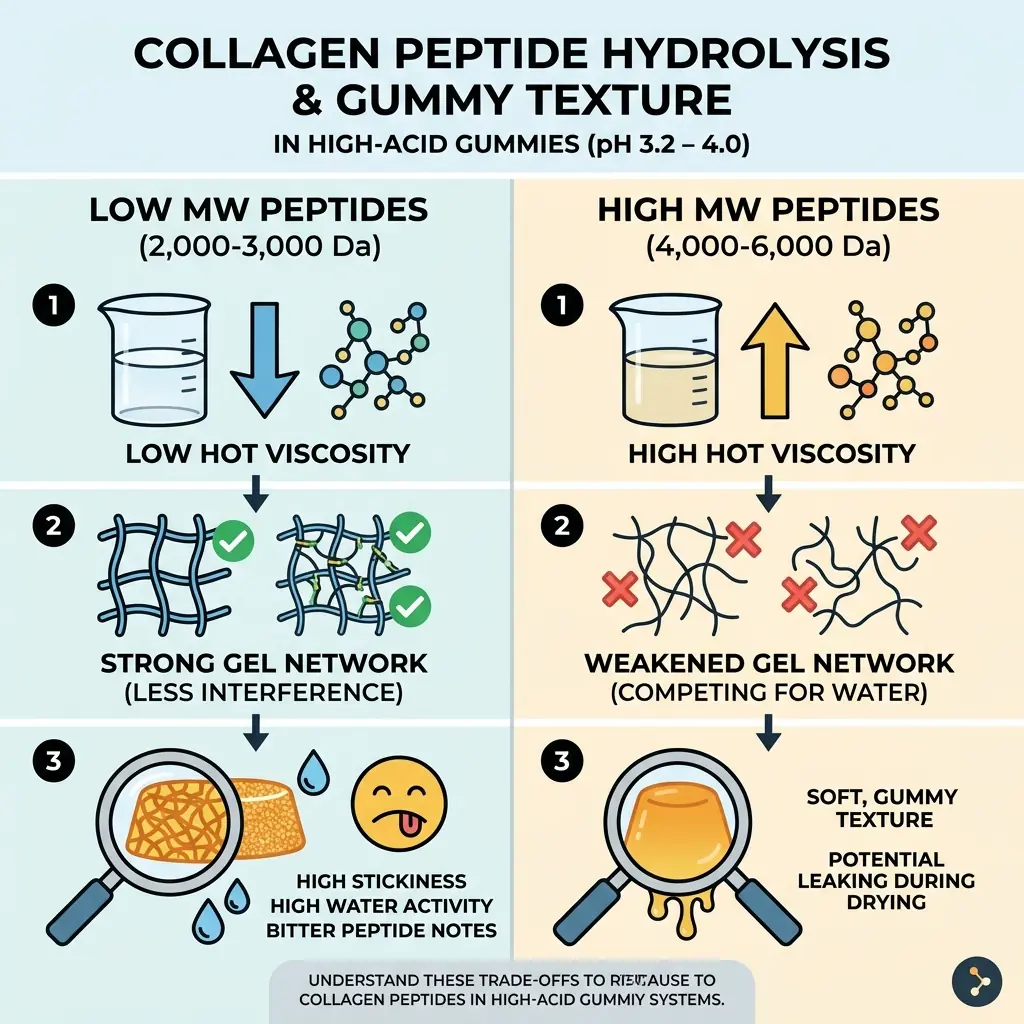
Collagen peptides are already hydrolyzed, but their degree of hydrolysis and molecular weight distribution directly determines viscosity, gel strength, and final chew in a high-acid gummy. In systems at pH 3.2 to 4.0, a low-molecular-weight peptide (2,000-3,000 Da) lowers hot mass viscosity and reduces interference with the gel network, but increases water activity, stickiness, and bitter peptide notes. A higher-molecular-weight peptide (4,000-6,000 Da) increases hot viscosity, competes for water, and weakens gelatin or pectin gels, leading to soft, gummy-to-soft or leaking textures during drying.
For any Gummy Manufacturer working with 500 mg to 1,000 mg collagen per serving, texture control is not about adding more gelling agent. It is about managing peptide MW, solids, pH, addition point, and water activity as a single system. When those variables are not balanced, you get depositing tails, deformed cavities, grainy fracture, or rapid syneresis in high-acid fruit flavors.
Why This Topic Matters for Supplement Brands
Collagen gummies are requested as beauty-from-within SKUs, often combined with vitamin C, hyaluronic acid, or organic acids for flavor. Brand teams want a clear, fruity taste, which pushes formulators to pH 3.4-3.8. That pH range is hostile to both collagen peptides and the gel matrix.
The business question behind the search is: Can we deliver a meaningful collagen dose in a high-acid private label gummy without ending up with an oversized piece, a rubbery or mushy texture, and a 9-month shelf life failure? The answer depends on hydrolysis profile, gel system choice, and process control, not on flavor masking alone.
Collagen Peptide Hydrolysis: What It Means for Gummy Manufacturing
Degree of Hydrolysis and Molecular Weight Distribution
Collagen peptide ingredients are produced by enzymatic hydrolysis of gelatin. The degree of hydrolysis is expressed as average molecular weight and peptide distribution.
- 2,000-3,000 Da: High solubility, low viscosity in solution (15-25 mPa.s at 20% solids), minimal gel interference, but higher hygroscopicity and more pronounced bitter, brothy off-notes at high load.
- 3,000-5,000 Da: Most common for gummies. Balanced solubility and water binding. Viscosity rises to 30-60 mPa.s at 20% solids. Still acts as a non-gelling filler that disrupts gel junction zones.
- >5,000 Da: Closer to gelatin hydrolysate. Contributes some body, but significantly increases hot mass viscosity and competes for water needed for gelatin hydration or pectin dissolution.
From a manufacturing view, two lots both labeled 3,000 Da can behave differently if one has a wide distribution with 15% >6,000 Da fraction. Always request MW distribution and viscosity vs concentration data, not just average MW.
How Peptides Interfere With Gel Structure
Gelatin forms a triple-helix network on cooling. Pectin forms sugar-acid gels or calcium-linked gels. Collagen peptides do not participate in either network. They sit in the interstitial water phase and:
- Reduce effective gelatin or pectin concentration per unit volume.
- Bind free water, slowing gelatin hydration and pectin dissolution if added too early.
- Increase Brix and osmotic pressure, which can inhibit gelatin helix formation.
That is why increasing collagen load from 20% to 30% of dry mass often requires 15-25% more gelatin by weight to maintain the same bloom equivalent, or a shift to a hybrid system.
High-Acid System: The Core Challenge
High-acid for fruit gummies usually means pH 3.2-4.0, titratable acidity 1.0-1.8%, with citric, malic, or tartaric acid plus sodium citrate buffer. Three problems arise with collagen:
1. Gelatin hydrolysis at low pH. Gelatin held above 80°C at pH <3.8 hydrolyzes, losing bloom strength. In continuous cooking, even 5-8 minutes at pH 3.5 can reduce final texture from firm to short and crumbly.
2. Charge and solubility. Collagen peptides have an isoelectric point near pH 5-6. At pH 3.5, they are positively charged and highly soluble, but they can interact with negatively charged pectin, causing localized precipitation if acid is added before the buffer is fully dissolved.
3. Flavor-acid balance. To mask peptide notes, brands push acid and fruit flavors. More acid lowers pH further, weakening the gel and accelerating sucrose inversion, which raises water activity and stickiness.
Viscosity Control in Gummy Manufacturing with Collagen Peptides
Viscosity control is depositing control. Target hot mass viscosity for Mogul depositing is typically 2,500-4,500 cP at 75-85°C. Collagen shifts this range.
Practical Controls That Work at Scale
- Separate hydration. Hydrate collagen peptides at 40-50°C in 30-35% water, not in the main cooker. Adding dry peptide to 100°C+ sugar syrup causes clumping and trapped air that appears as voids.
- Post-cook addition point. Cook sugar, glucose syrup, and gelling agent to target Brix (typically 76-79 for gelatin, 78-82 for pectin). Cool mass to 75-80°C for gelatin or 85-90°C for high-methoxyl pectin, then add peptide solution. This limits thermal degradation and keeps viscosity within depositing window.
- Solids management. A 1,000 mg collagen dose at 3.0 g gummy weight equals 33% active load. If you keep Brix constant, you must reduce glucose syrup solids, which reduces body. Most manufacturers increase gummy weight to 3.5-4.0 g to keep solids balance and maintain a 2-piece serving.
- Buffer system. Use sodium citrate to buffer acid addition to pH 3.6-3.9 before depositing. Add 50-70% of acid as buffered solution at 60-65°C in the final flavor phase, not as dry acid. This prevents pH shock to gelatin and prevents pre-gelation of pectin.
- Low-shear mixing. High shear after peptide addition foams the mass. Foam increases viscosity variability and causes light-weight rejects. Use anchor agitator at 30-50 rpm with vacuum deaeration at -0.6 to -0.8 bar for 2-3 minutes.
| Peptide Profile | Hot Mass Viscosity Impact at 20% Dry Load | Texture Risk | Manufacturing Adjustment |
|---|---|---|---|
| Low MW 2,000-3,000 Da, narrow distribution | -10% to -5% vs control | Sticky, high water activity, bitter aftertaste | Reduce drying time, add 0.2-0.3% masking flavor, check water activity <0.75 |
| Mid MW 3,000-5,000 Da | +15% to +30% | Soft, weak fracture if gelatin not increased | Increase gelatin 20% or add 0.3% low-methoxyl pectin for support |
| High MW >5,000 Da or wide distribution | +40% to +70%, tailing | Deformed pieces, cavity bridging | Use larger nozzle (4.5-5.5 mm), lower depositing temp to 75°C, reduce batch solids 1-2 Brix |
Texture Control: Gelatin, Pectin, and Hybrid Systems
Choice of gel system defines what texture control tools you have. A qualified Gummy Manufacturer will not run collagen + high-acid in a standard gelatin formula without modification.
| Gel System | pH Tolerance | Collagen Load Feasibility | Texture Outcome for High-Acid Collagen Gummy |
|---|---|---|---|
| Gelatin 200-250 bloom, porcine or bovine | Optimal 4.0-5.2, usable down to 3.6 with buffer and fast deposit | Up to 25-30% dry basis with bloom compensation | Chewy, elastic. Risk: softening during shelf life if water activity >0.78 or pH <3.6 |
| High-methoxyl pectin (HM) | Requires 3.2-3.6, needs 55%+ sugar | Moderate, up to 15-20% dry basis | Short, clean bite, better acid stability. Risk: pre-gelation if collagen added too hot |
| Gelatin + LM pectin hybrid (60:40 to 80:20) | 3.5-4.2 with calcium control | 20-28% dry basis, best cost-texture balance | Firm exterior, less sticky, improved shape retention for high dose |
In Gummy Manufacturing, pectin alone often gives better acid tolerance but struggles with 1,000 mg collagen because its gel is sugar-dependent and less tolerant of non-gelling protein load. Hybrid systems allow lower gelatin usage while improving acid stability and reducing cold flow.
For texture validation, use texture analyzer (hardness 800-1,800 g, cohesiveness 0.75-0.85 for chewable collagen) and sensory fracture. Do not rely on visual firmness alone; peptide-heavy gummies can look firm out of Mogul and soften 15-20% after 48-hour conditioning.
Manufacturing Process: Critical Stages for This System
1. Specification Review and Raw Material Testing
Require peptide COA with MW distribution, bulk density, pH 10% solution, heavy metals, microbiology, and turbidity. Incoming QC should check solution viscosity at 20% and 75°C and pH. Wide lot-to-lot variation in viscosity signals hydrolysis inconsistency that will break depositing consistency.
2. Formula Development
Lock gummy weight, serving size, and target collagen per piece before adjusting gel. Model solids: sugar + glucose solids + gelatin/pectin solids + peptide solids + acid buffer solids = 78-82 Brix. If collagen pushes solids above 82 Brix at target weight, increase weight or reduce serving claim.
3. Batch Preparation and Cooking
Cook to Brix in scraped-surface cooker at 106-110°C. Hydrate gelatin at 60-65°C separately. Prepare peptide solution at <50°C. For HM pectin, dissolve pectin at 85°C with sequestrant (sodium hexametaphosphate) before sugar addition.
4. Active Addition and Homogenization
Add peptide solution after cooker, before flavor and color. Hold at 75-80°C for no more than 15 minutes before depositing. Longer hold at low pH reduces bloom equivalent by approximately 5-8% per 10 minutes.
5. Deposition, Cooling, and Drying
Deposit at 70-80°C with starch Mogul or silicone molds. Cool at 18-22°C for 2-4 hours, then condition/dry at 22-26°C, 25-35% RH for 24-48 hours to water activity 0.70-0.76. High-collagen formulas need longer drying because peptide-bound water releases slowly.
6. Coating and Packaging
Oil and wax coating helps reduce surface stickiness caused by low-MW peptides. Avoid heavy carnauba coating if water activity is still >0.75, it traps moisture. Use high-barrier pouch or bottle with induction seal and desiccant only if stability data shows no moisture loss-induced hardening; otherwise desiccant can over-dry gelatin.
Scale-Up Considerations and Equipment
Pilot batches of 10-20 kg hide viscosity issues that appear at 300-500 kg. At scale, holding time in the holding tank extends from 5 minutes to 25-40 minutes. That extended time at pH <4.0 is where gelatin hydrolysis and peptide aggregation occur.
- Use jacketed holding tank with precise temperature control ±2°C and level-controlled discharge to minimize hold time.
- Depositor with positive-displacement pistons and 4.0-6.0 mm nozzles reduces tailing with high-viscosity peptide mass.
- Vacuum deaeration before depositing prevents low-density pieces that cause weight variation.
- Inline pH and Brix measurement, not just batch sheet, for each holding tank.
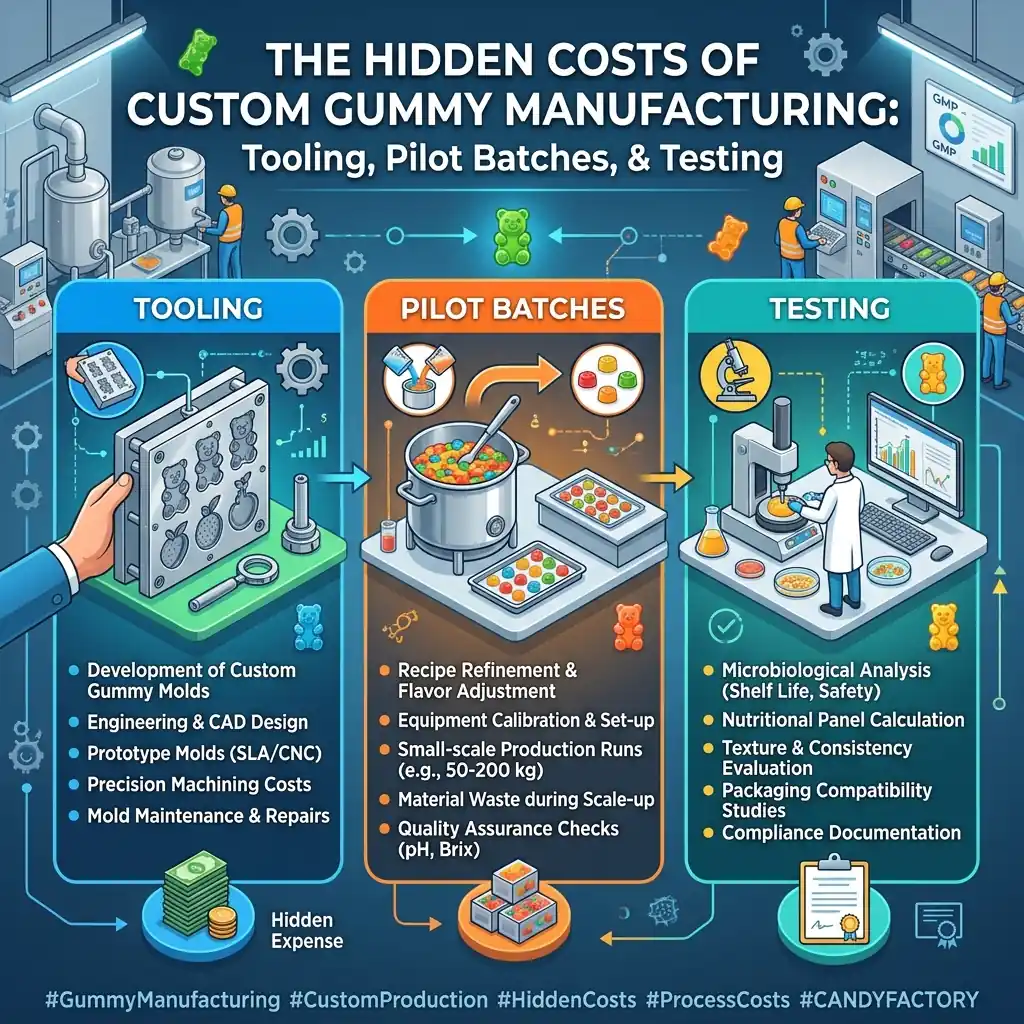
For a private label gummy project, plan 2-3 pilot trials: one to lock gel and pH, one to lock viscosity and depositing parameters, one for stability initiation.
Quality Control and Stability
QC for collagen + high-acid gummies should go beyond standard gummy tests:
- In-process: Hot viscosity (Ford cup or Brookfield), pH of mass before and after acid addition, Brix, deposition weight CV <3%.
- Finished product: Texture analyzer, water activity, pH of finished gummy homogenate, collagen content by hydroxyproline, sugar profile for inversion, color L*a*b*, and sensory for bitterness and acid-peptide aftertaste.
- Micro: Total plate count, yeast and mold, especially if water activity >0.75.
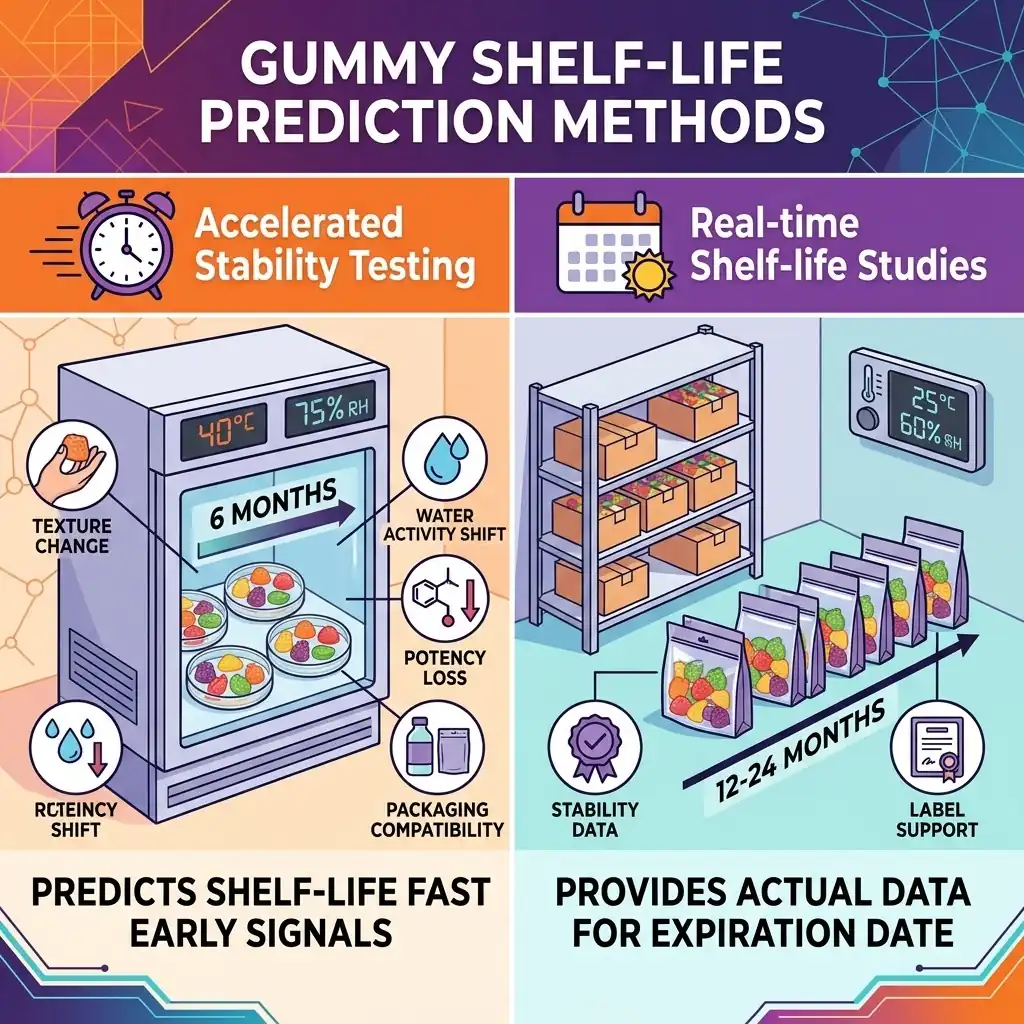
- Shelf-life validation: Accelerated 40°C/75% RH and real-time 25°C/60% RH. Monitor texture hardening/softening, syneresis, and pH drift. Collagen peptides can buffer pH upward over 3-6 months if buffer is weak, reducing microbial protection and altering sourness.
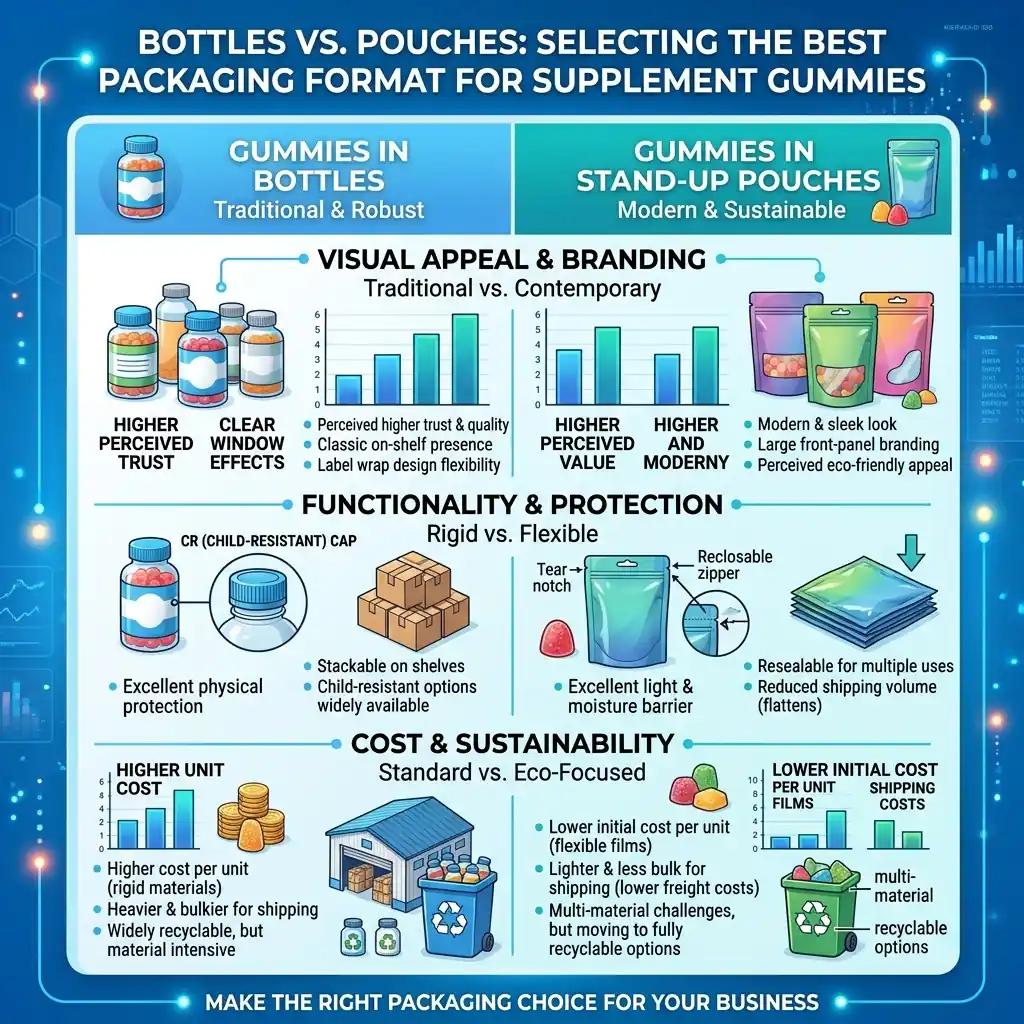
Cost, MOQ, and Packaging Implications
Cost drivers specific to this system:
- Peptide MW and sourcing: Narrow-distribution, low-MW peptides cost more but deposit better and need less rework.
- Gel compensation: 15-25% extra gelatin or pectin to maintain texture increases raw material cost per kilo by 4-8%.
- Gummy weight: Moving from 3.0 g to 3.5 g for 500 mg collagen increases packaging cost and shipping weight by ~16% per bottle of 60.
- Flavor and masking: High-acid fruit plus peptide masking flavors cost more than standard fruit flavors, and higher dosage rate (0.3-0.5% vs 0.15%) is common.
- MOQ flexibility: For custom collagen high-acid gummies, many manufacturers set MOQ at 100,000-300,000 pieces per SKU due to Mogul changeover and stability data. Small 10k test runs often use silicone molds with higher unit cost and different texture than Mogul scale.
Provide the manufacturer with target dose per serving, pieces per day, desired pH/acid profile, gummy weight range, and texture target (chewy vs short). This allows accurate quotation without multiple re-formulations.
How to Evaluate a Gummy Manufacturer for Collagen Peptide High-Acid Systems
When you talk to a Gummy Manufacturer, ask for verifiable capabilities, not general claims:
- R&D data: Can they show viscosity curves for 15%, 25%, 35% peptide loads at 75°C? Do they have pH vs gel strength data for gelatin and pectin with collagen?
- Pilot-to-commercial transfer: Do they run holding-tank hold-time studies? How do they control pH drift between first and last tray?
- Testing: Do they have in-house texture analyzer, water activity meter, and hydroxyproline testing or validated external lab?
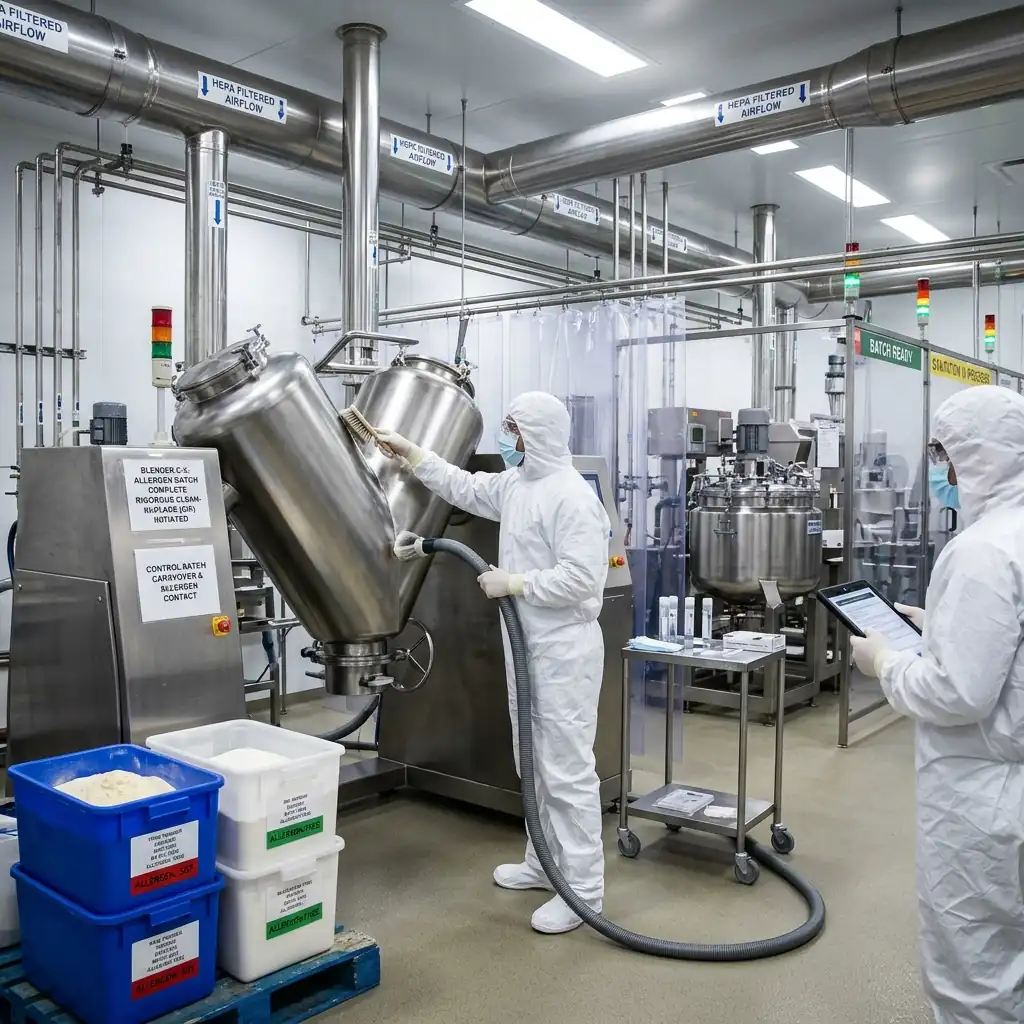
- Process control: GMP-certified facility with 100,000-class cleanroom and documented cooking, depositing, and drying parameters per batch. For example, Shenzhen Gothink Biotech Co., Ltd. operates a GMP-certified facility with 10,000-class R&D laboratory and approximately 16 tons daily capacity, supporting OEM/ODM/CMO/CDMO across gummy, capsule, tablet, powder, liquid, and drop formats.
- Documentation: COA, allergen statement, BSE/TSE for bovine collagen, halal/kosher if needed, and export documentation experience.
- Batch traceability: Ability to trace peptide lot MW distribution to finished gummy lot texture and stability.
Common Mistakes in Collagen Peptide High-Acid Gummy Manufacturing
- Adding collagen peptides into the high-temperature cooker with sugar, causing browning via Maillard and viscosity spikes.
- Adding acid before buffer fully dissolved, causing pectin lumps and peptide-pectin coacervation.
- Targeting pH <3.4 to boost sourness without increasing buffer, leading to gelatin hydrolysis and soft pieces after 2 months.
- Underestimating water activity: low-MW peptides hold water, initial water activity of 0.78 seems acceptable but rises to 0.80 during storage due to inversion.
- Fixing texture by adding more sugar alone, which raises Brix above depositing limit and causes crystallization.
Practical Checklist for Buyers
Send this to your manufacturer before quoting:
- Collagen source (bovine, marine, chicken) and target average MW with distribution spec.
- Dose per gummy and per serving, and pieces per day.
- Target pH and acid type (citric, citric/malic blend).
- Preferred gel system (gelatin, pectin, hybrid) and dietary claims (halal, kosher, vegan – note collagen is not vegan).
- Gummy weight tolerance and texture target (hardness range).
- Packaging format and barrier requirements, target shelf life and storage condition.
- Flavor profile and whether bitterness masking is required.
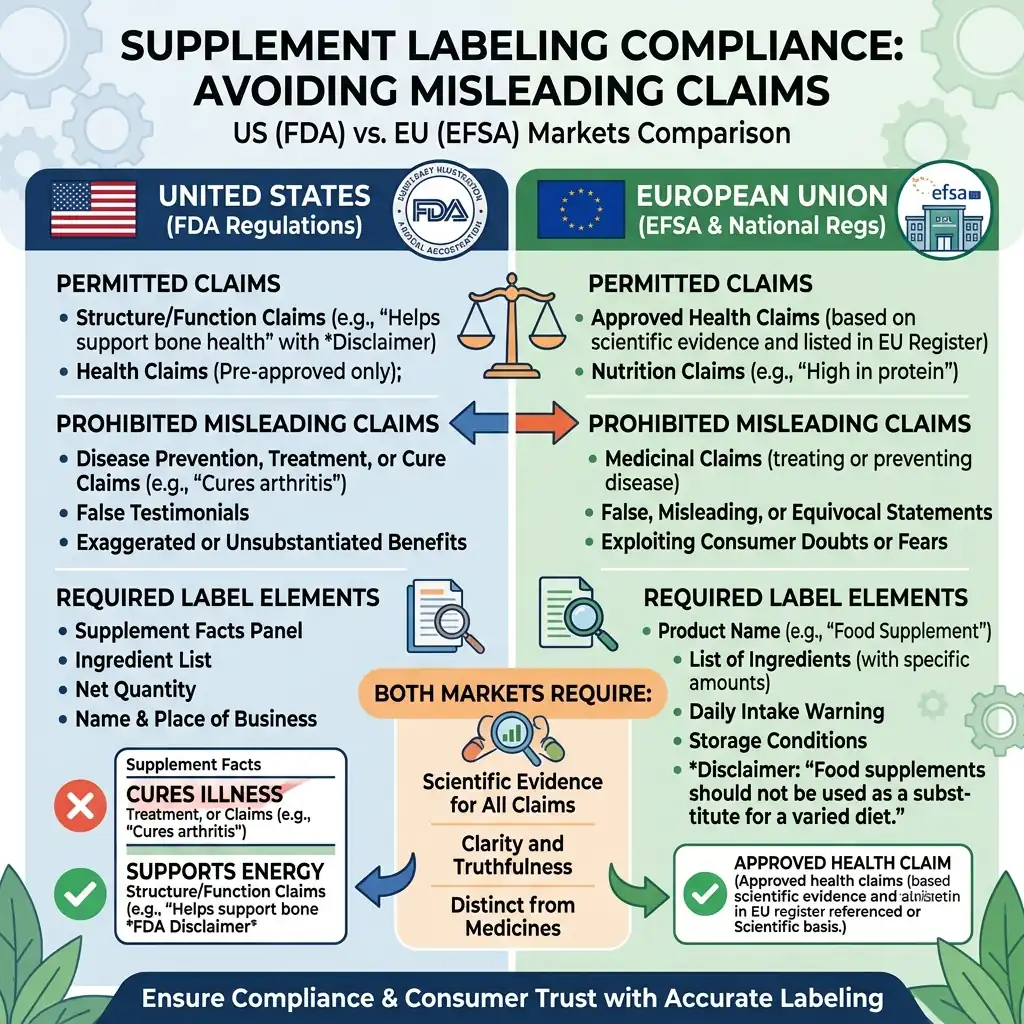
- Regulatory market and documentation needed (FDA, BRC, FSSC 22000, ISO22000, HACCP).
Commercial Next Step
If you have a collagen peptide high-acid concept, start with a specification review, not a sample request. Share your target dose, MW spec, and desired pH with your manufacturer to run a solids and viscosity model. This saves 2-3 weeks of reformulation.
Review manufacturing options for gelatin and pectin systems, compare formulation trade-offs for your dose, and request an OEM/ODM quotation with pilot batch parameters including Brix, pH, depositing viscosity, and target water activity. A structured technical review at this stage prevents oversized gummies, sticky storage failures, and unstable texture.
FAQ
What collagen peptide load is realistic for a 3.0-3.5 g high-acid gummy?
Most commercial formulas run 300-600 mg per 3.0 g piece at pH 3.6-4.0 in gelatin. Above 750 mg per piece, gummy weight typically increases to 3.5-4.0 g and requires hybrid gelatin-pectin or higher bloom gelatin to keep hardness above 1,000 g.
Does lower MW collagen always give better gummy texture?
Not always. Low MW 2,000-3,000 Da reduces hot viscosity and gel interference but raises water activity, hygroscopicity, and bitter notes. It also needs tighter drying and packaging. Mid MW 3,000-5,000 Da with narrow distribution is often the best balance for Gummy Manufacturing at scale.
Can I run collagen peptides in a vegan pectin gummy?
Technically you can process it, but collagen is animal-derived, so the finished product cannot be labeled vegan. If you need vegan positioning, consider alternative proteins. If you need pectin for acid stability, use a non-vegan pectin gummy with collagen and label accordingly.
Why does my collagen gummy soften after 2 months?
Common causes are gelatin hydrolysis at low pH, high water activity above 0.78, and sucrose inversion driven by high acid. Check holding time at low pH, increase sodium citrate buffer to stabilize pH, and ensure water activity 0.70-0.75 after conditioning. Texture tracking at 25°C and 40°C will show the drift.
What information should I provide to a Gummy Manufacturer to get an accurate cost?
Provide peptide spec with MW distribution, dose per piece and per day, target gummy weight, desired pH and acid system, flavor type, gel preference, packaging format, target annual volume, and certifications needed such as ISO9001, ISO22000, HACCP, FDA, HALAL, KOSHER, BRC, FSSC 22000. These drive gel compensation, weight, flavor dosage, testing, and MOQ.
How does private label gummy differ from custom formulation for collagen high-acid?
Private label gummy uses an existing, validated base where MW, pH, and texture are already balanced. Custom formulation starts from scratch to hit a specific dose, acid profile, or texture, and requires 2-3 pilot runs and stability initiation. If your dose and flavor are within the existing base window, private label shortens lead time by 3-5 weeks.
Jack Luo|Senior Technical Advisor, Nutrition Research Center Representing Gothink Biology, a GMP-certified dietary supplement manufacturer based in Shenzhen, China.
Explore more manufacturing insights: Knowledge Hub and Formulation R&D