
Important Compliance Notice
Educational Purpose Only: This article is for B2B informational and regulatory education purposes only. Shenzhen Gothink Biotech Co., Ltd. does not manufacture, sell, distribute, or provide OEM/ODM/CDMO services for cannabidiol (CBD), hemp-derived cannabinoid gummies, or any controlled cannabinoid products. Any mention of CBD or hemp extracts in this article is solely to explain EU Novel Food regulatory status and market access requirements, not to offer such products.
Executive Summary: The Real Question Behind Novel Food and Botanical Gummies
EU Novel Food compliance for gummy supplements is the deciding factor for whether a botanical gummy can legally enter the EU market, not just whether it can be manufactured. For brand owners and procurement teams, the core question is: does this botanical ingredient, in this specific form and plant part, have a demonstrated history of significant consumption in the EU before 15 May 1997, or is it authorized on the EU Union List?
If the answer is no, the product cannot be sold in the EU until a Novel Food authorization or a traditional food notification is obtained. This directly affects formulation choice, raw material sourcing, documentation, lead time, and your OEM/ODM partner selection.
EU Novel Food Compliance for Gummy Supplements: Why It Determines Market Access
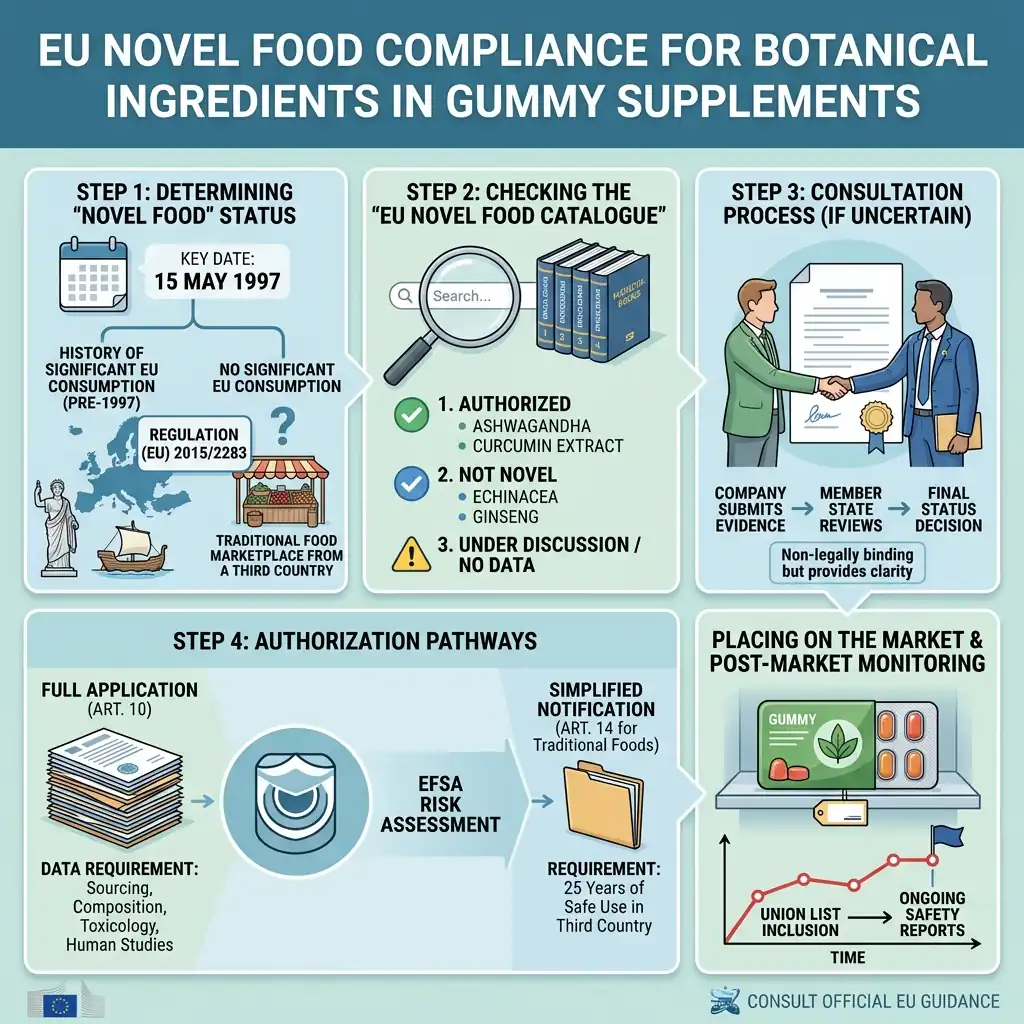
EU Regulation 2015/2283 defines Novel Food as any food not consumed to a significant degree in the EU before 15 May 1997. For botanical ingredients in gummy supplements, compliance is assessed at the level of species, plant part, preparation method, and intended use.
The EU maintains two key references: the Novel Food Catalogue, which is informative but not legally binding, and the Union List of authorized Novel Foods (Regulation 2017/2470), which is legally binding. If an ingredient is on the Union List, you must meet its specific conditions of use, specifications, and labeling requirements.
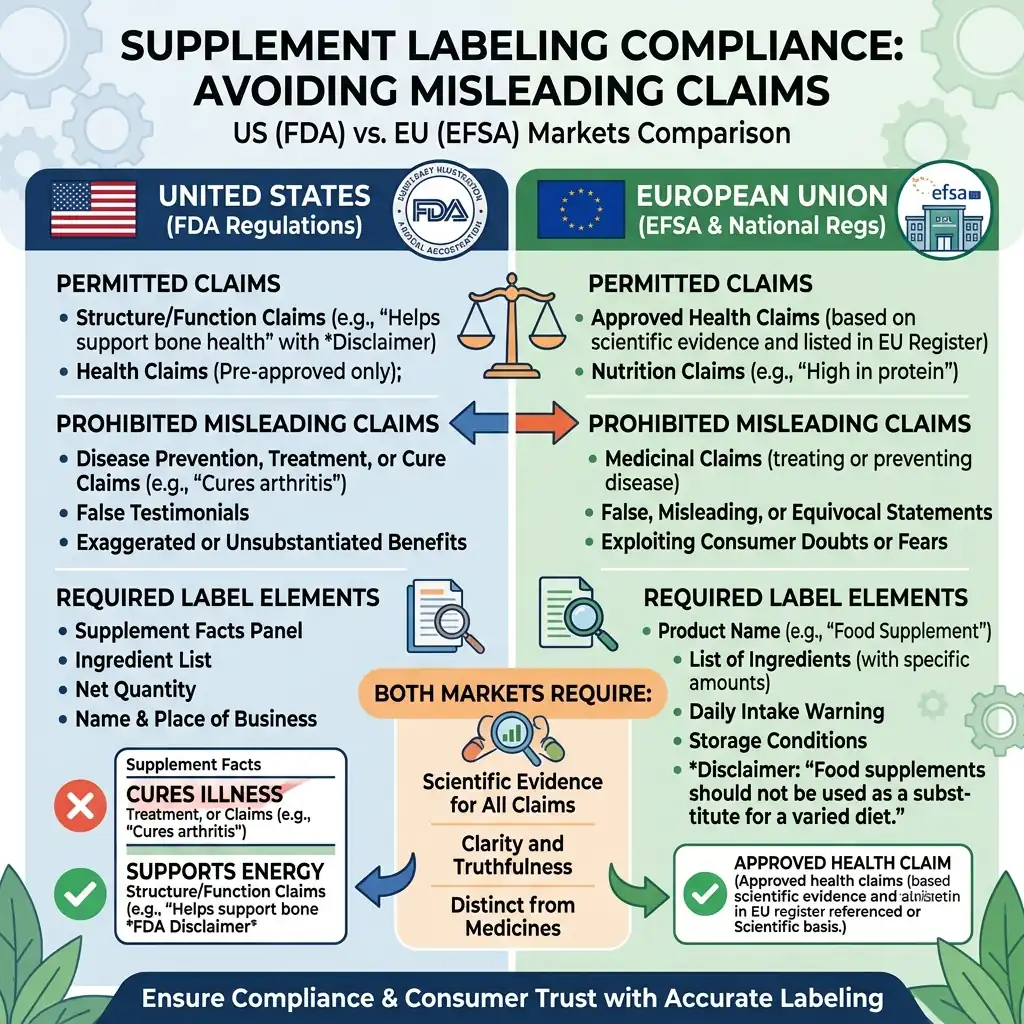
Gummies are classified as food supplements under Directive 2002/46/EC in the EU. This means both food supplement rules and Novel Food rules apply simultaneously.
How to Assess Botanical Ingredients for EU Compliance
1. Identify the Exact Botanical Definition
Document the Latin binomial, plant part, geographical origin, extraction solvent, drug extract ratio (DER), and standardization marker. For example, Panax ginseng root water extract is different from Panax ginseng leaf ethanol extract. A manufacturer cannot confirm Novel Food status from a common name alone.
2. Check History of Consumption
Significant consumption before 15 May 1997 must be verifiable. Many botanicals used in Traditional Chinese Medicine or Ayurveda have long history outside the EU but no documented significant use inside the EU food chain before that cutoff. Medicinal use does not count as food use.
3. Determine the Correct Regulatory Pathway
- Not Novel: Proven EU food use before 1997. Check member-state botanical lists.
- Authorized Novel Food: Listed on the Union List. Must comply with listed specifications and maximum levels.
- Novel Requiring Authorization: No history and no Union List entry. Requires full Novel Food application under Article 10, or consultation under Article 4.
- Traditional Food from Third Country: Article 14 notification if 25-year safe use outside EU can be proven. Only for primary or minimally processed foods.
| Compliance Status | What It Means for Gummy Development | Typical Documentation Needed |
| Not Novel with EU Food History | Proceed with standard development. Check member-state positive/negative lists. | Botanical ID, spec sheet, evidence of pre-1997 use if challenged |
| Authorized on Union List | Formulation must match Union List conditions. Daily dose must stay within maximum levels. | Union List entry reference, CoA meeting Union List specs, dosage calculation |
| Novel / No Authorization | Cannot launch in EU until authorized. Requires reformulation. | Full Novel Food dossier or consultation outcome |
Botanicals That Frequently Trigger Novel Food Review
From a manufacturing perspective, buyers most often encounter issues with these groups. Status can change, always verify current Catalogue and Union List.
- Ashwagandha (Withania somnifera): Root extracts are under scrutiny in several member states. Some extracts are considered novel depending on solvent and standardization.
- Mushroom extracts: Some species like Ganoderma lucidum have history, but mycelium biomass or high-concentration extracts can be novel.
- Exotic berries and leaves: Moringa leaf extract, butterfly pea flower, or kava kava root often lack proven pre-1997 food use.
- Highly purified or new production methods: A botanical that is not novel as dried herb may become novel as a fermentation-derived isolate.
Special Note on Hemp-Derived Ingredients and CBD – Regulatory Context Only
For completeness, hemp and cannabidiol (CBD) are often cited as examples of Novel Food in the EU. Under current EU interpretation, CBD and hemp extracts with elevated cannabinoids are considered Novel Foods and require Union List authorization. This information is provided for regulatory education only.
Gothink Biotech does not produce, process, or offer OEM/ODM services for CBD, cannabidiol gummies, or any hemp-derived cannabinoid products. Brand owners interested in EU-compliant botanical gummies should focus on non-cannabinoid botanicals with established food history or Union List authorization, such as ginger, elderberry, ginseng root, or lemon balm.
Formulation and Manufacturing Impact on Botanical Gummies
Active Loading and Gummy Weight
Botanical extracts vary in bulk density and hygroscopicity. A 300 mg root extract may require two 3.0 g pectin gummies, while a 50 mg standardized extract may fit into one 2.5 g piece. High loading raises water activity and changes packaging and cost per serving.
Heat Sensitivity and Addition Point
Most gummy slurry is cooked to 105-112°C for pectin and 80-90°C for gelatin. Many botanical actives degrade above 85°C. In commercial production, the practical solution is to cool the mass to 80-85°C and add the botanical extract during flavor and acid addition with low-shear mixing. This preserves actives but requires tight control of mixing time to ensure homogeneity.
pH and Gel System Compatibility
Pectin gummies require pH 3.2-3.8. Many botanical extracts shift final pH. If pH drops below 3.0, syneresis occurs. If it stays above 4.0, the pectin network will not set. Gelatin is more pH tolerant but has melting and HALAL/KOSHER considerations.
Moisture Control and Water Activity
Botanical powders are often hygroscopic. Finished gummy water activity should be controlled below 0.75, often 0.60-0.70 for pectin vegan gummies. This requires conditioning at 20-25°C and 30-40% RH for 24-48 hours, plus moisture-barrier packaging.
Documentation and Quality Systems Required for EU Buyers
| Document Type | Why It Matters | What to Request |
| Botanical Identification | Proves exact identity matching Union List or history claim | Latin name, plant part, DER, solvent, standardization, HPTLC ID |
| Contaminant Profile | Botanicals are high risk for PAH, pesticides, heavy metals | Pesticide per EC 396/2005, heavy metals per EC 1881/2006, PAH, pyrrolizidine alkaloids |
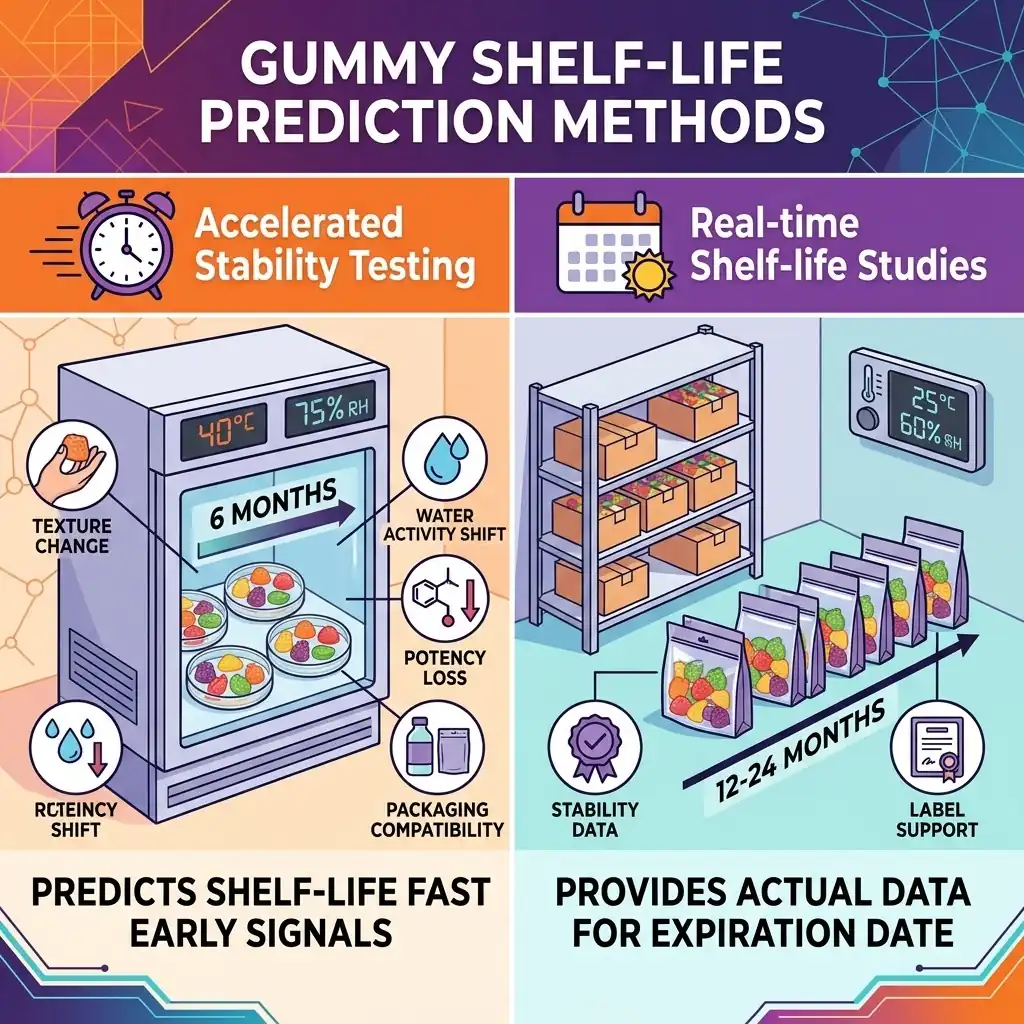
| Stability Data | Shows marker remains within spec in gummy matrix | Accelerated and real-time data for marker, Aw, pH, microbiology |
How to Evaluate a Manufacturer for EU Novel Food Botanical Gummies
- Regulatory distinction: Can they show current Union List and Catalogue checks for your botanical, and distinguish EU status from US GRAS?
- R&D for botanicals in gummy matrix: Experience with pH adjustment, heat-controlled addition, and masking. Ask for Aw below 0.70 data.
- Documentation support: Provides spec sheets with botanical Latin name, plant part, extraction details, and Union List reference when applicable.
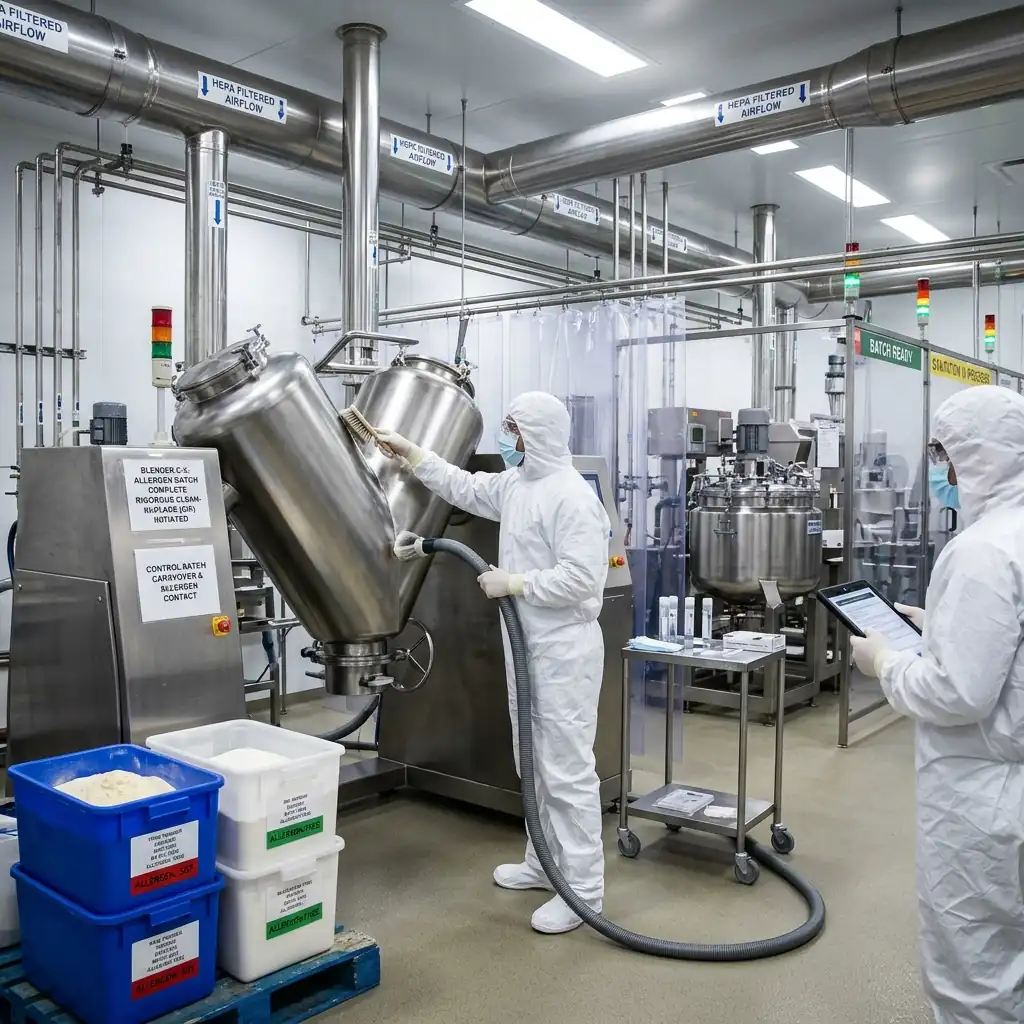
- Quality systems: GMP, ISO22000, HACCP, FSSC 22000, BRC, FDA, HALAL, KOSHER, Vegan. These are manufacturing systems, not automatic market approvals.
FAQ
Does CBD count as a botanical ingredient for gummy compliance?
From EU regulatory perspective, CBD and cannabinoid extracts are treated as Novel Foods and require authorization. This article mentions them only for educational context to explain Novel Food classification. Our company does not manufacture or offer OEM services for CBD products, in line with Google Ads policy and internal compliance policy.
What is the difference between the Catalogue and the Union List?
The Catalogue is informative, not legally binding. The Union List is legally binding and contains authorized Novel Foods with specifications and maximum levels.
Can we use a botanical extract if the dried herb is not novel?
Not automatically. A new solvent, higher concentration, or different standardization can change Novel Food status.
How does Novel Food status affect gummy manufacturing?
It affects raw material selection, dosage per Union List, addition temperature after cooking, pH control, and water activity control.
Do US GRAS approvals mean compliance in the EU?
No. US status has no legal relevance in the EU. EU assessment must be done separately.
Disclaimer for Advertising Platforms: This content is non-promotional technical information. No CBD, hemp-derived cannabinoid, or controlled substance products are offered, sold, or manufactured by Shenzhen Gothink Biotech Co., Ltd. as described in this article.
Jack Luo|Senior Technical Advisor, Nutrition Research Center Representing Gothink Biology, a GMP-certified dietary supplement manufacturer based in Shenzhen, China.
Explore more in our Knowledge Hub and Quality & Compliance.