
Executive Summary: What a Unit Price Does Not Tell You
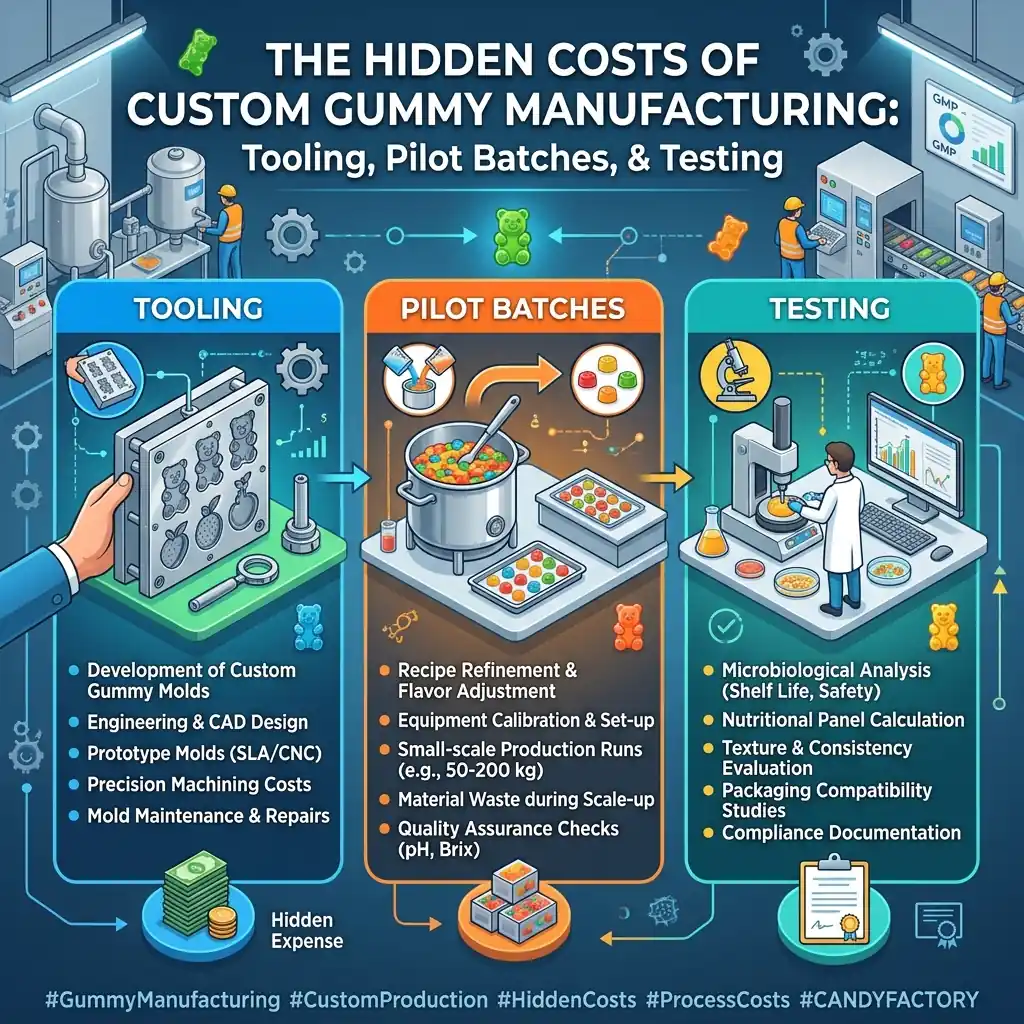
When supplement brands request a quotation from a gummy manufacturer, the per-unit price is only one part of the total project cost. Custom gummy projects typically carry additional costs across tooling, pilot and validation batches, analytical testing, packaging validation, and documentation. These costs are not hidden in a deceptive sense — they are simply outside the per-unit quote and easy to underestimate during early budgeting.
For brands planning a private label gummy launch or a custom formulation, the practical rule is to treat the unit price as roughly 80–90% of the total landed project cost and to budget separately for one-time engineering, validation, and testing items. A manufacturer that voluntarily itemizes these costs in the first quotation usually has stronger project governance and produces fewer change orders later. This article breaks down where the hidden costs sit, why they exist, and what information a buyer should provide to keep them under control.
Why Hidden Costs Matter for Supplement Brands
Most procurement teams build a product cost model using unit price, MOQ, packaging, freight, and duty. That model works for stock-keeping units that are already in production. It breaks down for custom gummy manufacturing projects, because each new formulation, shape, or packaging format requires engineering work before commercial production can begin.
Underestimating these costs creates three concrete problems. The project gets delayed because the buyer has to re-approve a revised quotation. The brand owner ends up paying for rework when a pilot batch fails stability or texture checks that could have been caught earlier. And the relationship with the manufacturer becomes adversarial when change orders arrive after specifications have already been frozen. A clear understanding of cost structure also makes it easier to compare quotations from different manufacturers on a like-for-like basis.
Tooling Costs: Molds, Deposition Tooling, and Ownership
Tooling is the most visible one-time cost in a custom gummy project, and it is also the most often misunderstood. Gummy tooling refers to the molds that define gummy shape, weight, and cavity count per board, plus the deposition nozzles and starch trays or silicone trays used in the depositor line.
Standard vs. Custom Molds
A gummy manufacturer normally carries a library of standard molds — bear, ring, worm, bottle, fruit, and similar shapes in cavity counts that fit common board sizes. Using a standard mold eliminates tooling cost entirely, but it limits brand differentiation. For private label gummy brands that want a unique shape, a custom mold is required.
Custom molds are machined from food-grade stainless steel or hard-anodized aluminum. The cost is driven by board size, cavity count, surface finish complexity, and any embossed logo. A larger gummy weight forces a deeper cavity, which means fewer cavities per board and slower throughput per cycle. Deeper cavities can also lengthen cooling and demolding time, which affects hourly capacity.
What to Clarify in the Tooling Quotation
Buyers should confirm four items before approving tooling: who owns the mold, whether the mold can be transferred to another manufacturer, the expected tool life in production cycles, and whether a duplicate mold is included or priced separately. A reputable manufacturer will state ownership terms in the contract and will not charge storage fees for the buyer’s own tooling.
Pilot Batches: Why They Cost More Than Commercial Units
Pilot batches are small-scale production runs used to validate formulation, process parameters, texture, flavor, color, and active ingredient distribution before commercial production. A typical pilot batch is between 50 and 200 kg, well below the standard commercial batch size.
Pilot batches cost more per kilogram than commercial batches for clear engineering reasons. The cook, deposit, and cooling steps are run at non-optimal throughput because the line is being tuned, not optimized. Operators and quality staff are present for the full batch rather than spread across multiple batches. Active ingredients and flavors are often wasted in line flush and startup. Analytical sampling is denser because every parameter is being validated rather than monitored.
When a Pilot Batch Can Be Reduced but Not Eliminated
If a brand uses the manufacturer’s existing base formula with only a flavor or color change, a small engineering trial may replace a full pilot batch. If the formulation introduces new actives, a new gel system (pectin instead of gelatin, for example), high mineral loading, or hygroscopic botanicals, a full pilot batch is non-negotiable. Skipping it to save cost almost always produces a larger loss at commercial scale when texture, stability, or content uniformity fail.
Testing Costs: Stability, Microbiology, and Active Assay
Analytical testing is the cost category most often under-budgeted by first-time gummy buyers, because it is itemized per test rather than per unit. The main testing blocks are raw material verification, in-process control, finished-product release, stability, and shelf-life validation.
Raw Material and In-Process Testing
Every incoming active ingredient should be verified against its certificate of analysis. For high-value actives such as patented botanical extracts or patented vitamin forms, identity and potency testing at receipt protects both the manufacturer and the brand. In-process testing during cooking and depositing checks Brix, pH, viscosity, and temperature — these are included in the batch record but represent real labor and consumable cost.
Finished Product Release Testing
Release testing for a gummy typically includes active ingredient assay, microbiology (total aerobic microbial count, yeast and mold, and specified pathogens such as Salmonella, E. coli, and Staphylococcus aureus), heavy metals (lead, arsenic, cadmium, mercury), and physical checks (weight variation, texture, appearance). For complex formulations, additional tests such as disintegration or dissolution may be required by the target market.
Stability and Shelf-Life Validation
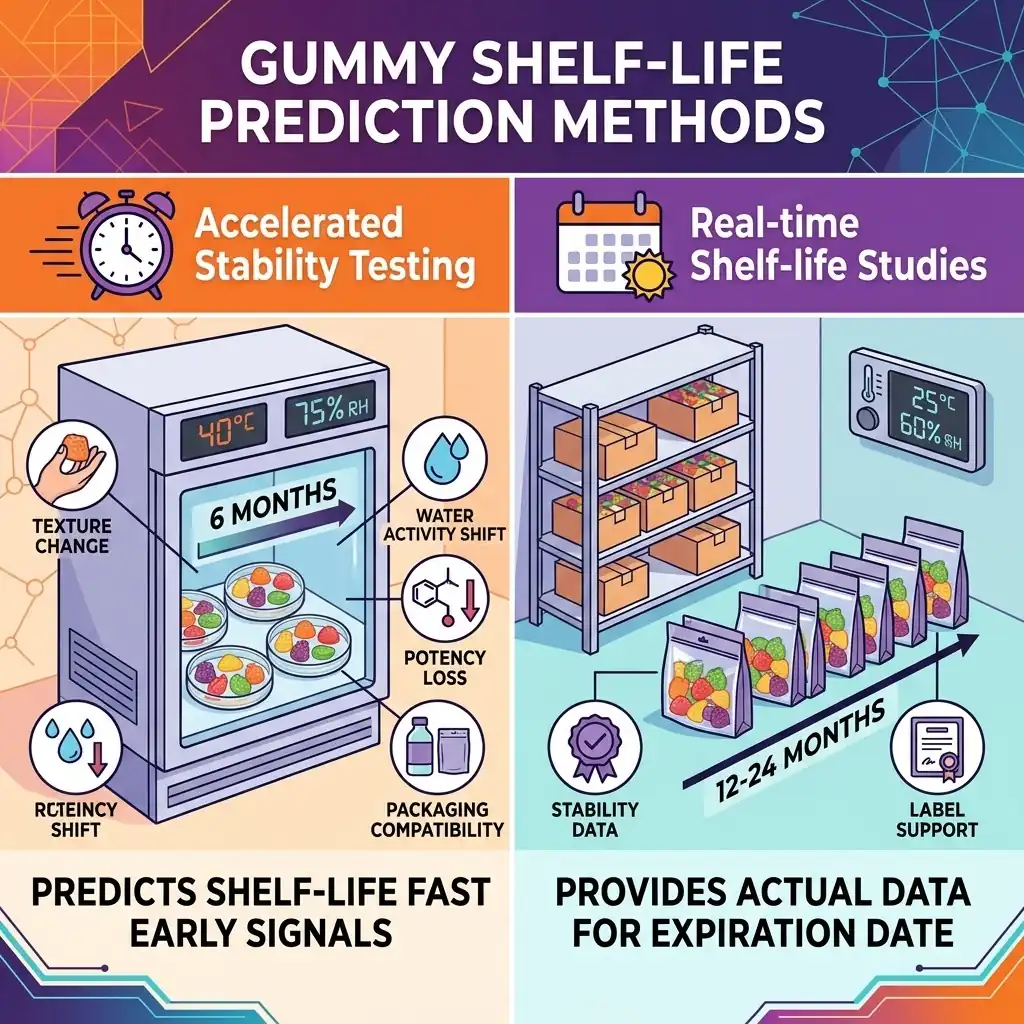
Stability testing is the single largest hidden cost in many custom gummy projects. A standard accelerated stability program runs six months at 40°C and 75% relative humidity, with testing at initial, one, two, three, and six months. A real-time stability program runs 24 months at the recommended storage condition. For a brand targeting a 24-month shelf life claim, both programs are usually required.
Each stability pull point re-runs the full release test panel. With five pull points in accelerated and roughly seven pull points in real-time, the testing cost adds up quickly. Stability chambers also carry storage fees per sample per month. Brands that target a shorter shelf life claim or limit the number of pull points can reduce this cost without compromising regulatory defensibility.
Packaging Validation and Other Often-Overlooked Costs
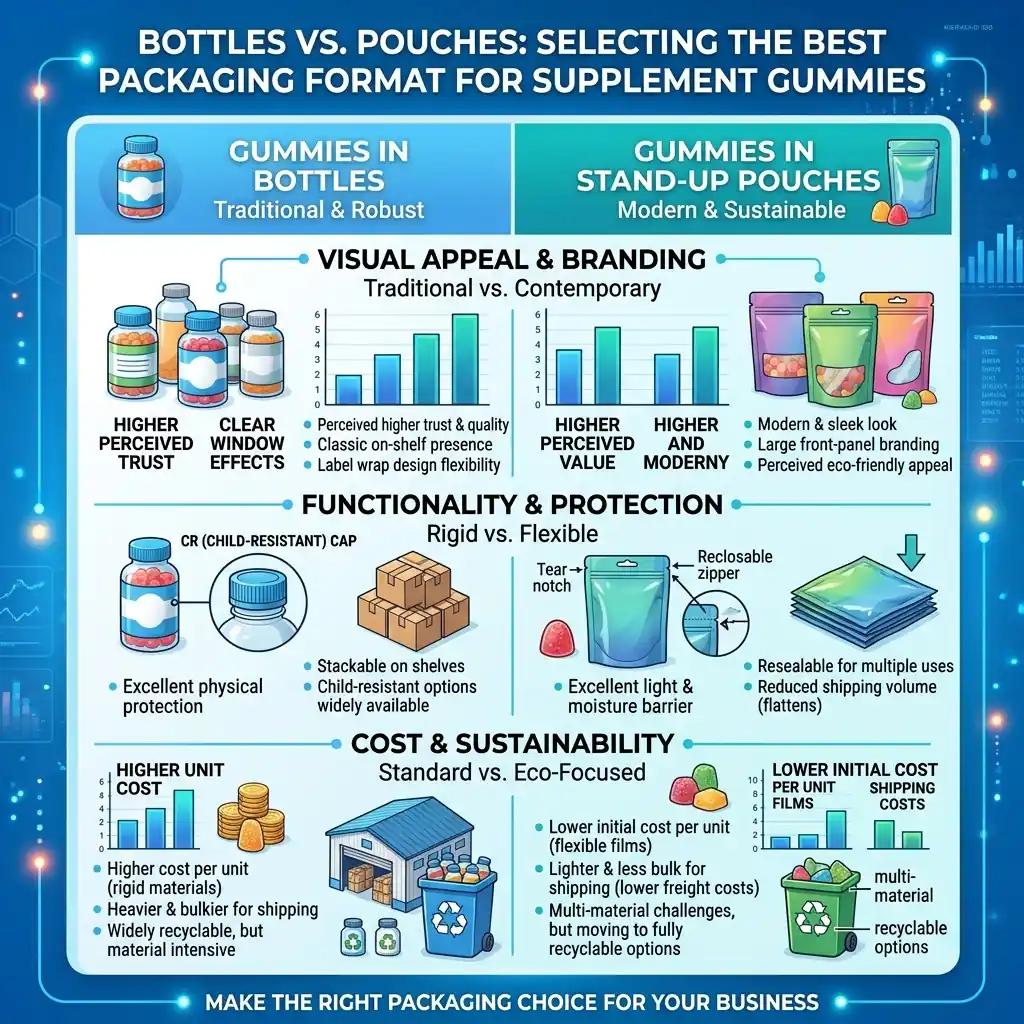
Beyond tooling, pilot batches, and testing, several smaller cost items tend to surface late in the project. Packaging compatibility validation confirms that the chosen bottle, blister, or pouch material protects the gummy from moisture loss, sticking, and active degradation over the claimed shelf life. For pectin-based or high-actives gummies, packaging choice can be the difference between a stable product and a product that fails real-time stability at month six.
Other commonly overlooked items include artwork and printing plate costs for custom-printed bottles or cartons, regulatory documentation packs for export markets, halal or kosher certification fees per SKU, and nitrosamine or solvent residue testing where required by the destination market. None of these are large individually, but together they can add 5–10% to the first-order invoice.
Cost Summary: What to Expect in a First Project
| Cost Category | One-Time or Recurring | Main Cost Driver | Buyer Control Lever |
|---|---|---|---|
| Custom mold tooling | One-time | Cavity count, gummy weight, surface finish | Use standard mold or simplify shape |
| Pilot batch | One-time per formulation | Batch size, number of actives, line time | Limit formula novelty, group variants |
| Release testing | Recurring per batch | Number of actives, target market test panel | Align test panel to actual market requirements |
| Stability testing | One-time per formulation | Shelf-life claim, number of pull points | Shorten shelf-life claim where defensible |
| Packaging validation | One-time per pack format | Pack type, barrier material, artwork | Use validated stock packaging |
| Documentation and certification | Recurring per market | Target market, certification scope | Confirm required docs early |
How to Evaluate a Gummy Manufacturer on Cost Transparency
Cost transparency is itself a useful signal of manufacturing maturity. A capable gummy manufacturer should be able to produce a quotation that separates unit price, tooling, pilot batches, release testing, stability testing, packaging validation, and documentation. If everything is bundled into a single per-unit number, ask for the breakdown.
Practical evaluation criteria include:
- GMP and quality system scope: ISO 22000, HACCP, cGMP, or FDA-registered facility, with audit reports available on request.
- R&D and pilot line capability: in-house lab-scale cooking and depositing equipment, not only commercial lines.
- Analytical testing capability: in-house or contracted HPLC, GC, and microbiology with documented turnaround times.
- Stability chamber capacity: dedicated ICH-condition chambers, not shared storage that may delay pulls.
- Formulation experience: track record with the specific active or gel system the brand wants (pectin, gelatin, agar, plant-based).
- Pilot-to-commercial scale-up protocol: documented transfer process between R&D and production.
- Batch traceability: lot-level traceability of raw materials, in-process parameters, and finished goods.
- Export documentation experience: familiarity with the target market’s required certificates and registration formats.
Common Mistakes That Inflate Project Cost
Several recurring mistakes push custom gummy projects over budget. The first is requesting a custom shape, custom flavor, and custom color in the same project without understanding that each adds a separate validation cycle. The second is skipping the pilot batch to save one or two weeks of timeline, then paying for a full commercial batch that has to be reworked or scrapped. The third is under-specifying the target market test panel at quotation stage, then receiving change orders when the destination market’s regulator requires additional tests.
A less obvious mistake is choosing the cheapest per-unit quotation without comparing what is included. Two manufacturers may quote similar unit prices while one includes release testing and one year of stability, and the other charges these separately. The total project cost comparison should always be done on an itemized basis, not on per-unit price alone.
Practical Checklist Before Placing an OEM/ODM Order
- Confirm the active ingredient specification, including form, potency, and supplier COA.
- Confirm target market, target shelf life, and required test panel.
- Request an itemized quotation covering unit price, tooling, pilot, release testing, stability, packaging validation, and documentation.
- Clarify mold ownership, transfer rights, and storage terms in writing.
- Confirm the pilot batch size and the success criteria for pilot-to-commercial transfer.
- Confirm stability program length, pull point count, and storage condition in writing.
- Confirm which certifications are required and which are included in the quotation.
- Confirm packaging compatibility validation scope and which pack format will be validated.
- Request a project timeline with milestones for formula sign-off, pilot batch, stability start, and first commercial shipment.
- Confirm batch traceability and document retention period.
FAQ
Why does a custom gummy mold cost more than a standard mold?
A custom mold requires 3D CAD design, CNC machining from food-grade stainless steel or hard-anodized aluminum, surface finishing, and validation on the depositor line. A standard mold is amortized across many projects, so the per-project cost is zero. Custom mold cost scales with cavity count, board size, and surface complexity such as embossed logos.
Can the pilot batch be skipped to reduce cost?
For formulations using the manufacturer’s existing base with only flavor or color changes, a small engineering trial may be sufficient. For new actives, new gel systems, high mineral loading, or hygroscopic ingredients, the pilot batch is mandatory. Skipping it typically leads to larger losses at commercial scale.
How long does stability testing take for a gummy?
Accelerated stability under ICH conditions runs six months at 40°C and 75% relative humidity. Real-time stability for a 24-month shelf life claim runs the full 24 months, with pull points typically at 0, 3, 6, 9, 12, 18, and 24 months. Many brands launch after six months of accelerated stability and concurrent real-time data, while continuing the real-time program in parallel.
What testing is included in the per-unit price?
This varies by manufacturer. Some include release testing (assay, microbiology, heavy metals) in the unit price. Others itemize testing separately. Stability testing is almost always a separate line item because it is a one-time project cost, not a per-batch cost.
What MOQ is realistic for a first custom gummy project?
Most commercial gummy manufacturers set a first-order MOQ in the range of 100,000 to 500,000 units, depending on gummy weight, active complexity, and line scheduling. Lower MOQs are sometimes possible for stock formulations using standard molds and existing packaging.
Who owns the custom mold after payment?
If the buyer pays for the mold in full, ownership should be transferred to the buyer in the contract, with the manufacturer holding it on the buyer’s behalf. If the mold is partially subsidized by the manufacturer, ownership terms should specify transfer conditions and minimum order commitments.
What information should a buyer provide to get an accurate quotation?
Target active ingredients and dosage per serving, target gummy weight and shape, target shelf life, target market, packaging format, MOQ, and required certifications. The more specific this brief, the more accurate and complete the quotation will be.
Commercial Next Step
If your team is scoping a custom gummy project, the most useful next step is to convert your product concept into a specification brief and request an itemized quotation that separates tooling, pilot, testing, stability, packaging, and documentation. For broader context on supplier evaluation and MOQ structuring, review our Knowledge Hub and our Sourcing and MOQ Guide.
Jack Luo|Senior Technical Advisor, Nutrition Research Center
Representing Gothink Biology, a GMP-certified dietary supplement manufacturer based in Shenzhen, China.