
Creatine is one of the most researched supplements in history — yet the delivery format buyers actually prefer has shifted from tubs of powder to convenient, great-tasting gummies. Making creatine gummies that hold potency, texture, and shelf life is a genuinely different engineering problem than making vitamin gummies: creatine is a small, crystalline, poorly soluble molecule, and it will push back against your gummy matrix at every stage from formulation to packaging.
This guide covers the entire production path — formulation architecture, step-by-step processing, critical control points, stability management, QC protocols, and cost structure — so you can evaluate a recipe, run a pilot batch, or brief a contract manufacturer with confidence. It consolidates everything a brand needs to make informed decisions, whether you are a supplement startup planning your first 10,000 units or an established label expanding into the creatine category.
1. What Are Creatine Gummies?
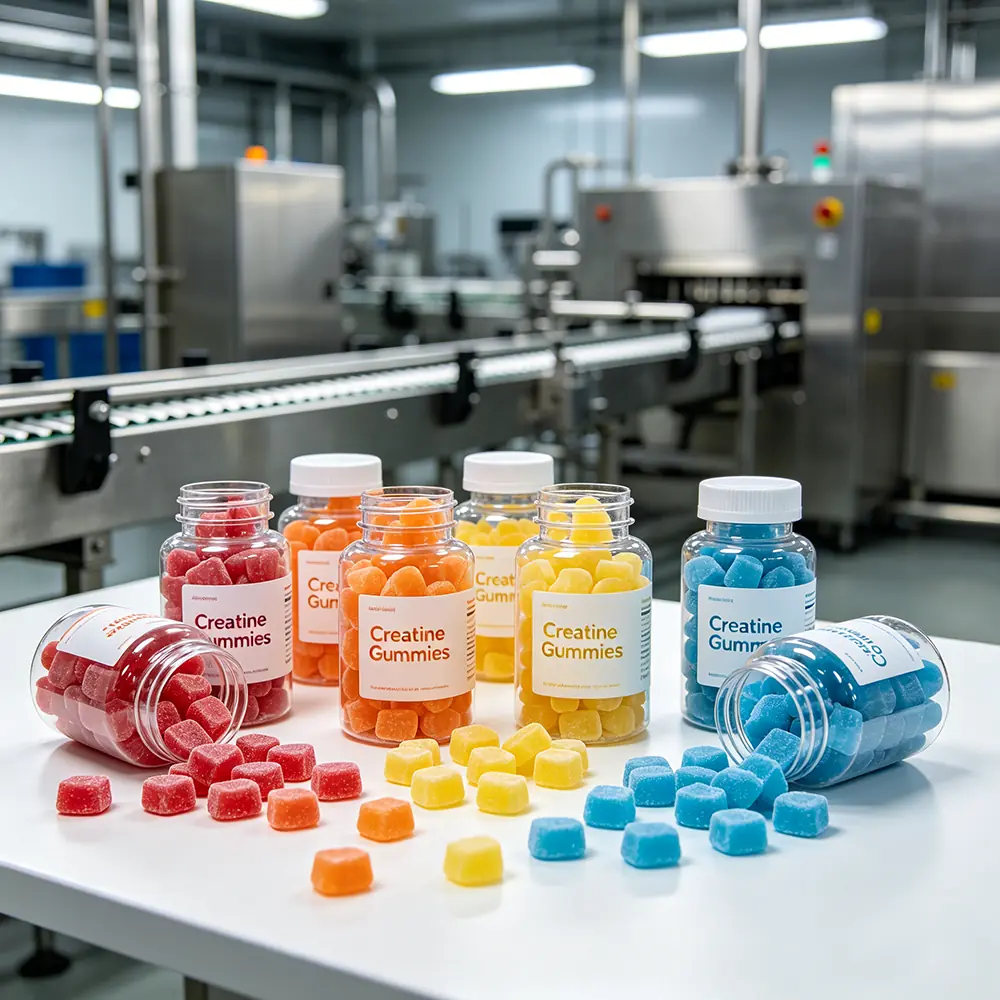
Creatine gummies are chewy, fruit-flavored confections engineered to deliver a clinically meaningful dose of creatine — typically 3–5 grams per daily serving — in a pectin- or gelatin-based gummy matrix. Each gummy weighs 0.5–1.2 g, so a standard serving is roughly 3–5 gummies delivering one full daily dose.
Three engineering targets define a successfully made creatine gummy:
- Dose accuracy — every unit must land within the label claim (industry standard: 90–110% of declared creatine content at end of shelf life).
- Texture integrity — a resilient, elastic, non-gritty chew that does not crystallize, weep, or crust over during storage.
- Stability — creatine does not measurably degrade into creatinine during normal processing or shelf life when the process is controlled (see Section 8).
A creatine gummy is not “a vitamin gummy with creatine stirred in.” The active ingredient alone can represent 25–50% of a gummy’s mass — far higher than in any vitamin or botanical gummy — which is precisely why formulation discipline and thermal control determine whether the final product succeeds or fails.
2. Why Brands Are Moving Into Creatine Gummies
Creatine monohydrate has more than 500 peer-reviewed studies behind it and a decades-long consumer reputation. The gummy format addresses the category’s biggest friction points:
- Convenience and compliance: no scooping, no mixing, no bitter aftertaste. Daily-dose adherence formats have trained consumers to expect “one portion, done” supplement rituals.
- Pre-workout adjacency: creatine gummies slot naturally next to pre-workout and protein products in a brand’s portfolio — and the creatine claim (“strength and lean mass support”) sells itself.
- Premium perception: gummies command higher price-per-serving than powders, with a cost of goods that remains comfortably under the retail price point (Section 12).
- Retail differentiation: a clean-label, low-sugar creatine gummy stands out against shelves of vanilla tubs.
For brands, the category economics are attractive: the per-unit cost sits in the $0.06–0.18 range at commercial scale, while retail pricing typically lands 3–6× materials cost.
3. Creatine Forms Compared: Monohydrate vs. HCl vs. Micronized vs. Buffered
Before writing a formula, decide which creatine to use. The forms are not interchangeable — they differ in solubility, dosing, cost, and evidence base.
Table 1 — Creatine form selection at a glance
Practical guidance
- Default to creatine monohydrate. The evidence base is unmatched, potency input costs are the lowest, and label claims are straightforward.
- Micronize (or buy pre-micronized material ≤50 μm). Raw creatine crystals feel sandy; particle size above roughly 50 μm becomes perceptible as grittiness in a chewy matrix. Micronization is the single cheapest texture upgrade in the formula.
- Consider HCl only when the dose-size story matters — e.g., a single-dose gummy positioned against “bloating” objections. Do not use HCl to cut costs; at typical 1–2 g doses it usually raises them.
- Purity matters more than form. Specify ≥99.9% assay and a low creatinine limit (≤0.5% relative) in your raw material contract, with a CoA per lot.
4. Formulation Architecture: Gelling Systems, Ratios, and pH
The gummy matrix carries roughly half the Gummy’s mass in active creatine while staying elastic and shelf-stable. Two gelling systems dominate commercial production.
4.1 Gelatin vs. pectin
Table 2 — Gelling system comparison
4.2 Reference starter formula (pectin, per 10 kg batch)
This is the working bench formula we use as a starting point for creatine gummies before optimization:
Table 3 — Reference pectin gummy formula, 10 kg batch
4.3 Formulation rules that decide success
- Protect the pectin from premature hydrolysis: citric acid is added only after the bulk cook has ended. Acidifying sucrose-rich syrup at high temperature inverts sugar and depolymerizes pectin — the gel never sets properly.
- Hold the final batch pH at 3.2–3.5. Below pH 3.2, hydrolysis risk and excessive acid bite rise; above 3.5, pectin systems lose set strength and microbiological margin narrows.
- Keep creatine loading within the matrix’s load-bearing limit. Beyond roughly 50% total actives, texture failure (dryness, fracturing) becomes likely regardless of gelling agent; split the daily dose across 4–5 gummies instead of cramming 5 g into one or two units.
- For sugar-free variants, swap sucrose for maltitol syrup / allulose blends and add 0.3–0.6% citric acid for microbiological safety margin — sugar-free matrices need extra attention on aw control (Section 8).
5. Raw Material Specifications
Set these specs in your purchase contracts before your first production run. They prevent 90% of texture and potency failures.
Table 4 — Raw material specification checklist
6. The Manufacturing Process, Step by Step
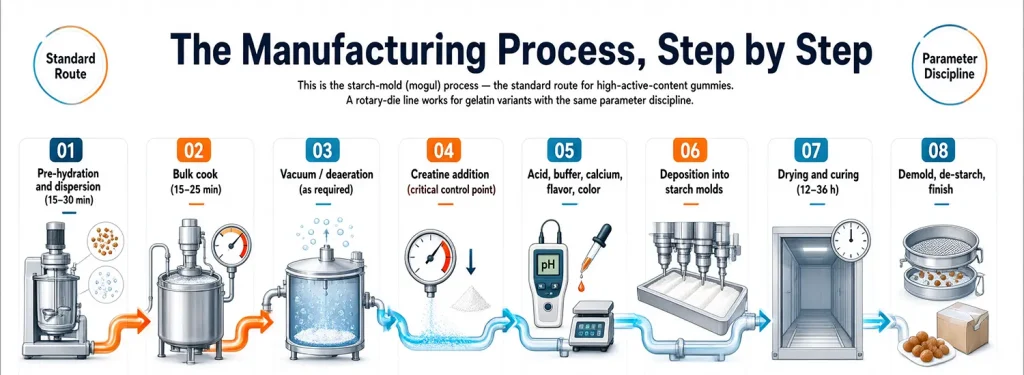
This is the starch-mold (mogul) process — the standard route for high-active-content gummies. A rotary-die line works for gelatin variants with the same parameter discipline.
Step 1 — Pre-hydration and dispersion (15–30 min)
Pre-disperse pectin in 5× its weight of sugar (never into plain water — clumping is near-unavoidable) and hydrate in the water phase at 60–70°C under high-shear mixing. Gelatin systems: bloom gelatin in cold water first, then melt into the syrup phase.
Step 2 — Bulk cook (15–25 min)
Combine water, glucose syrup, and sucrose; cook to 76–80°Brix (≈76–80% solids). Cook temperature follows vacuum/pressure practice; the non-negotiable endpoint is solids, not temperature.
Step 3 — Vacuum / deaeration (as required)
Remove entrapped air for a glossy, translucent gummy and to avoid void defects in starch molds.
Step 4 — Creatine addition (critical control point)
Cool the cooked syrup to ≤60°C before adding creatine. Sustained exposure of creatine to temperatures above roughly 70–80°C accelerates conversion toward creatinine and degrades potency margin over shelf life. Add micronized creatine as a slow, continuous stream under strong agitation to avoid fisheye clumps.
Step 5 — Acid, buffer, calcium, flavor, color
After creatine is fully dispersed, add the buffered citric acid solution, calcium source (for LM pectin), flavor, and color. Mix thoroughly and verify pH lands at 3.2–3.5 before depositing. Adjust with citric acid or sodium citrate — do not dump undiluted acid crystals into the bulk.
Step 6 — Deposition into starch molds
Deposit at 80–90°C (pectin) or 70–80°C (gelatin) into pre-conditioned starch moguls. Weight control target: 0.5–1.2 g per unit, verified by in-line checkweighing at a defined frequency. Typical serving math: 3–5 units × 1.0–1.25 g creatine per unit = 3–5 g daily dose.
Step 7 — Drying and curing (12–36 h)
Cure in drying rooms at 25–50°C, 30–45% RH. Target final moisture 15–20%. Drying curves are recipe-specific; validate by pull-and-test rather than clock alone (Section 9).
Step 8 — Demold, de-starch, finish
Separate gummies from starch (sieve/brush), optionally apply a lightly oiled sugar or sour coating, and cool to room temperature before packaging. Packaging under controlled room humidity (≤45% RH) prevents condensation pickup.
7. Critical Process Parameters and Quality Windows
Print this table and pin it to the batch sheet. Every one of these parameters appears on production records for auditable releases.
Table 5 — Critical process parameters and failure modes
8. Stability, Blooming, and Shelf Life
8.1 What “blooming” is and how to prevent it
Blooming — the white, powdery recrystallized film that sometimes appears on gummy surfaces — is the single most common creatine-gummy defect. It happens when creatine held in the supersaturated matrix migrates to the surface and crystallizes as moisture gradients shift.
Prevention, in order of leverage:
- Control water activity first. Keep finished lots at aw ≤0.62–0.65. Blooming is a moisture-migration phenomenon before it is anything else.
- Micronize to ≤50 μm and disperse fully. Coarse crystals and undisolved clumps become seed sites.
- Avoid thermal cycling. Warm-cold transit swings drive internal moisture movement; specify controlled distribution and warn against unairconditioned trailers in summer.
- Manage syrup anti-crystallization. Adequate glucose-syrup loading interrupts sucrose and creatine crystallization alike.
- Seal properly. Induction seals plus desiccant, HDPE or PET bottles; avoid moisture-permeable pouches.
We cover this topic in more depth in our companion piece on creatine stability in gummy matrices, including shelf-life protocol design.
8.2 Shelf-life protocol
A defensible stability program for a creatine gummy:
- Accelerated: 40°C/75% RH for 1, 2, 3 months — potency, moisture, aw, pH, appearance, texture.
- Real time: 25°C/60% RH for 12, 18, 24 months — same panel.
- Release gates: potency within label claim at every pull; no visible blooming, no syneresis, texture change within specification.
Achievable target shelf life with a controlled formula and correct packaging: 18–24 months, which comfortably covers private-label channel requirements.
9. Quality Control and Testing Protocols
Every released lot should carry a CoA and pass the following panel:
Table 6 — Release testing panel
Batch records must capture the Section 7 parameters; a lot missing temperature or pH records is not releasable, no matter how good the lab numbers look.
10. Scaling from Bench to Full Production
Creatine gummies scale predictably when each step is validated before volume increases. The classic three-stage path:
Table 7 — Scale-up stages and deliverables
Scale-up fails at predictable pinch points. Watch for:
- Mixing turnover time. At pilot volumes the same mixing energy can precipitate creatine instead of dispersing it; re-validate addition temperature and agitation profile at every scale change.
- Drying curve shift. Larger starch beds dry differently — build the curve from moisture/aw endpoints, never from time.
- Deposition weight variance. In-line checkweigher capacity and mogul condition become yield drivers at scale.
- Acid distribution. Buffered-acid addition validated at bench can drift at scale if mixing geometry changes; pH-verify every sub-batch.
A typical private-label program enters production at a 10,000–50,000 unit MOQ per SKU, which aligns with one pilot-to-production transition and a single reference lot for stability work.
11. Small-Batch and DIY Production Guide
This section is for brands testing a concept or formulators running bench work — not for consumer instructions, and not for commercial sale without a licensed facility. (Selling food or supplements requires compliant manufacturing, labeling, and in most jurisdictions facility registration; see Section 13.)
11.1 Bench setup
- Silicone candy molds (food-grade, smooth-finish)
- Refractometer, calibrated pH meter, bench scale
- Small high-shear mixer or immersion blender
- Accurate probe thermometer (calibrated)
- Dehumidified room or drying cabinet at 25–35°C / 35–45% RH
11.2 Bench recipe (≈500 g yield)
Table 8 — Bench recipe, approx. 500 g yield
11.3 Bench procedure
- Hydrate pectin-sugar premix in water at 60–70°C under shear.
- Add glucose syrup and sucrose; cook to 76–80°Brix.
- Cool to ≤60°C, then stream in micronized creatine under strong agitation.
- Add buffered acid solution, calcium, flavor, color; verify pH 3.2–3.5.
- Deposit into molds; cure at 25–35°C / 35–45% RH for 12–24 h.
- Demold, rest 24 h in low-RH air, then package in an airtight container with desiccant.
11.4 Bench pitfalls (learned the hard way)
- Grittiness → creatine too coarse, added too early, or added while the syrup is above 60°C.
- Never sets → acid added during the cook (hydrolyzed pectin) or pH above 3.5.
- Crumbles on demold → under-cooked solids or under-dried units.
- White film within days → drying RH too high and no desiccant in the container.
12. Cost Structure and Unit Economics
At commercial scale, per-gummy cost of goods typically lands between $0.06 and $0.18, driven mainly by actives loading, packaging, and batch amortization. Indicative breakdown:
Table 9 — Indicative cost per gummy
Practical implications for brand planning:
- Retail positioning: at 4–5 gummies per serving, materials and packaging alone sit far below a typical $0.39–$0.79 per-serving retail price — healthy margin room for a premium SKU.
- Cost levers in priority order: (1) actives loading per unit, (2) packaging format, (3) batch size amortization, (4) matrix choice.
- Hidden costs to budget for: stability programs, GC/HPLC lot testing, artwork iterations, and MOQ-driven inventory carry on secondary SKUs.
13. Regulatory, Labeling, and Claims Compliance
13.1 United States
- Creatine is a dietary ingredient sold under DSHEA; no FDA pre-market approval is required for the finished product, but facility registration and adherence to cGMP (21 CFR Part 111) apply to manufacture.
- Labels must carry Supplement Facts, the “dietary supplement” statement, a domestic address or phone number, and an accurate ingredient/declaration list.
- Claims must be structure/function statements only (e.g., “supports strength and lean mass”) — no disease claims. Include the standard DSHEA disclaimer.
- California Prop 65 compliance requires lead/cadmium testing documentation for products shipped into the state.
13.2 EU / UK / other markets
- Creatine is permitted in food supplements in the EU (novel food regulation review settled its status); UK rules now diverge post-Brexit — verify current registration and notification paths before launch.
- Health claims are tightly regulated under the EU Nutrition and Health Claims Register; creatine has authorized claims in specific contexts — use only registered wording.
Since compliance differs by market, treat this section as orientation, not legal advice — confirm jurisdiction-specific requirements with your regulatory counsel or a partner whose regulatory team owns current registrations (our creatine gummies manufacturer page outlines how Gothink Biotech handles documentation and label review for US, EU, and AU/NZ programs).
14. Choosing a Creatine Gummy Manufacturing Partner
Most brands do not need to own production — they need to brief a manufacturer precisely enough to avoid the failure modes above. The diligence checklist we recommend before you request a quote:
- Creatine-specific experience — ask what their typical actives loading is and how they control addition temperature (the ≤60°C answer you want to hear).
- Moisture and aw capability — do they run calibrated aw testing on every lot, or only at release? Ask to see a sample CoA.
- Format flexibility — vegan pectin vs. gelatin, sugar-free, sour-coated, single-dose vs. multi-dose bottles.
- MOQ and pilot support — can they run a 20–50 kg pilot before you commit 50k units?
- Documentation — CoA per lot, stability protocol support, allergen and heavy-metal documentation, label-review workflow.
- Scalability — validated transition from pilot to production without re-engineering your formula.
Gothink Biotech manufactures creatine gummies with validated ≤60°C addition control, micronized creatine sourcing, and aw-verified packaging — you can review capabilities, MOQs, and program timelines on our creatine gummies manufacturer page, and browse the rest of our R&D coverage in the knowledge center.
FAQ
Q1: What is the ideal creatine dose per gummy?
The clinically supported daily dose is 3–5 g. We design 3–5 gummies per serving at 1.0–1.25 g creatine per unit — keeping each Gummy chewable and within the matrix’s load-bearing limit.
Q2: Can I use creatine HCl instead of monohydrate?
Yes, and HCl’s higher solubility can simplify dispersion, but the evidence base is thinner and typical per-dose input costs are higher. Monohydrate remains the reference standard for cost and research support.
Q3: Why did my gummies turn gritty or powdery over time?
Almost always one of three causes: creatine particle size above ~50 μm, addition while the syrup was above 60°C, or uncontrolled water activity. Blooming is a moisture-migration problem before it is a formulation problem — verify aw ≤0.62–0.65 first.
Q4: What water activity do creatine gummies need?
Finished lots should test ≤0.62–0.65 aw. This is the single most predictive shelf-stability and anti-blooming parameter.
Q5: Can creatine gummies be made vegan?
Yes — use an LM pectin system (1.5–2.5%) instead of gelatin. Expect a slightly softer, more tender texture and 2–3× higher matrix cost.
Q6: How long do creatine gummies last?
A controlled formula with aw-controlled packaging typically achieves 18–24 months. Skip desiccant, induction seals, or humidity-controlled drying and expect to lose most of that margin.
Q7: Is heat dangerous for creatine during production?
Sustained high temperature is. Add creatine only when the bulk has cooled to ≤60°C, and avoid prolonged re-cooking; otherwise, slow conversion to creatinine erodes the potency margin.
Q8: What should the CoA include?
Creatine assay (90–110% of label claim), creatinine ratio, moisture, water activity, pH, microbiological panel, and heavy metals. Any released lot should be reproducible from its batch record plus CoA alone.
Q9: What is the typical OEM minimum order quantity?
Most private-label programs start at 10,000–50,000 units per SKU, often preceded by a 20–50 kg pilot batch for process validation and stability sampling.
Q10: Do I need FDA approval to sell creatine gummies in the US?
No pre-market product approval is required under DSHEA, but you are responsible for facility cGMP compliance (21 CFR Part 111), an accurate Supplement Facts label, compliant structure/function claims, and Prop 65 documentation for California.