
Direct Answer: What HS Code Applies to Exported Functional Gummies?
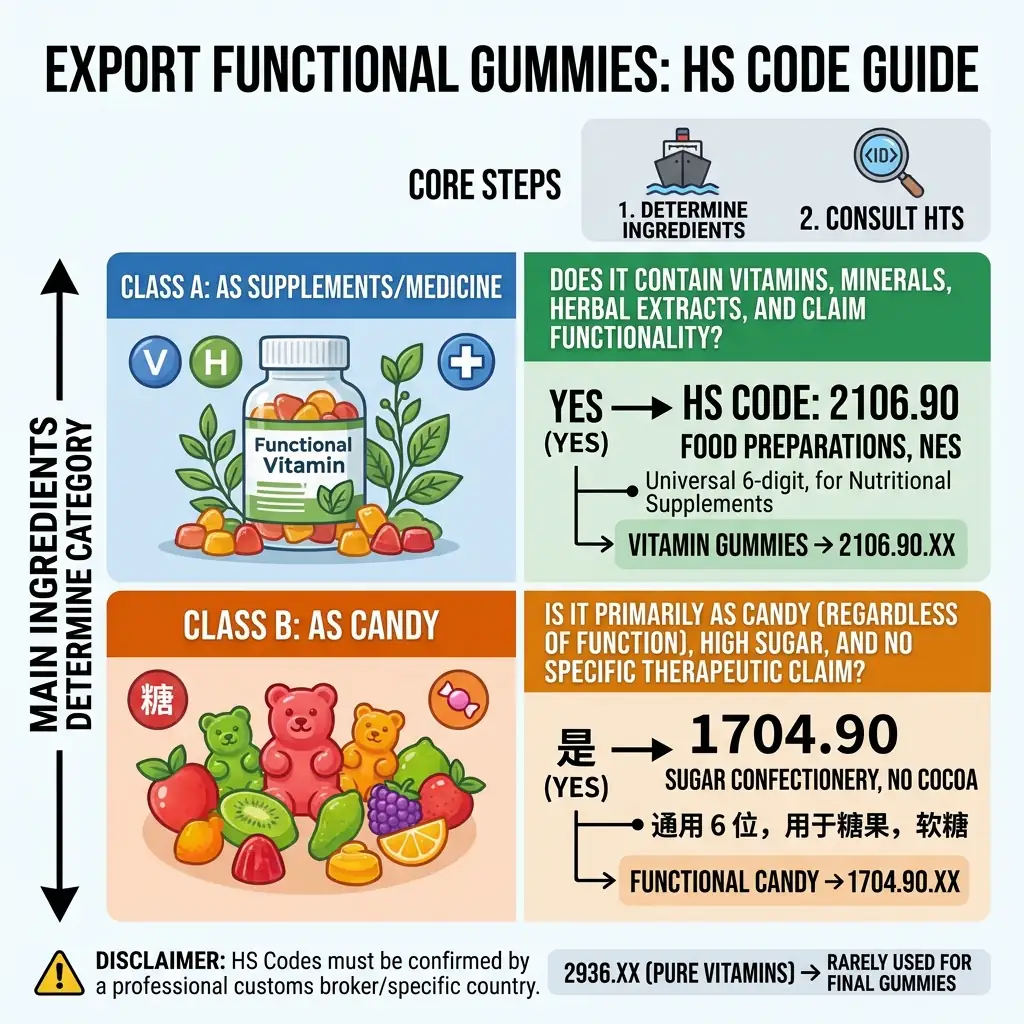
For most global markets, exported functional gummies are classified as food preparations, not sugar confectionery. The prevailing HS codes are 2106.90.98 in the EU and UK, 2106.90.99xx in the US HTS (e.g., 2106.90.9998), and 2106.90.90 in China for export. Classification as 1704.90 (sugar confectionery) is incorrect when the product contains a functional dose of vitamins, minerals, botanicals, or other actives and is presented as a supplement to maintain general health.
As a Gummy Manufacturer exporting to the US, EU, and Australia, we see customs authorities apply General Rules of Interpretation 1 and 6 plus Chapter Notes. If a gummy has lost the character of confectionery due to its active content, dosage labeling, and functional purpose, it moves to heading 2106. This distinction directly affects duty rate, VAT treatment, and whether the shipment is flagged for food supplement controls rather than confectionery controls.
Why HS Classification Matters for Supplement Brands
The question behind this topic is not academic. A brand owner searching this wants to avoid customs holds, unexpected duty increases, and reclassification penalties.
For functional gummies, the HS code determines three commercial outcomes:
- Duty and tax rate: 1704.90 often carries higher sugar-related duties and additional sugar quotas in the US. 2106.90 is typically 3-10% globally but varies by free trade agreement.
- Regulatory path: 2106.90 triggers food supplement checks (FDA prior notice in the US, EFSA labeling rules in EU, TGA considerations in Australia). 1704.90 triggers confectionery standards.
- Supply chain risk: A misdeclared gummy shipment can be delayed 2-4 weeks for laboratory analysis, especially if the commercial invoice says “candy” while the label says “dietary supplement”.
Understanding classification early helps you set landed cost accurately and provide correct documentation to your freight forwarder and importer of record.
Core HS Codes Used for Exported Functional Gummies
Functional gummies sit at the intersection of food and supplements. Customs does not classify by shape alone. It classifies by composition, function, and presentation for retail sale.
| HS Heading | Typical Application for Gummies | Why It Is Applied | Commercial Implication |
|---|---|---|---|
| 2106.90 – Food preparations not elsewhere specified | Vitamin gummies, mineral gummies, botanical gummies, melatonin, fiber, probiotic gummies presented as supplements | Product contains functional actives at 10-100% RDA per serving, with dosage instructions and health-maintenance positioning | Most accepted for dietary supplements; requires supplement labeling |
| 1704.90 – Sugar confectionery not containing cocoa | Candy gummies with incidental vitamins, low active level, marketed as candy | Sugar and glucose syrup dominate, no clear daily dose, no RDA statement | Higher duty in many markets, sugar quota risk in US; incorrect for true functional products |
| 2936 – Provitamins and vitamins, unmixed | Pure vitamin raw materials, not finished gummies | Applies only to single chemically defined vitamins over ~98% purity | Not applicable to finished gummies; sometimes misused by new exporters |
| 3004 – Medicaments | Therapeutic products treating specific diseases | Functional gummies that maintain general well-being do not meet Chapter 30 Additional Note 1 requirements | Classification rejected in EU and US for general wellness gummies |
2106.90 vs 1704.90: The Critical Divide
EU Regulation 2023/1131 clarified this for vitamin gummies in the form of orange bears averaging 3g each, with malt syrup 54.3%, sucrose 35%, plus vitamins A, B3, B6, B7, C, D, E and selenium. Despite high sugar content, the product was ruled 2106.90.98 because vitamin content meant it had lost the character of sugar confectionery of heading 1704.
The same logic appears in US CBP rulings NY N333261 and NY D86952, where food supplements in gummy form were classified under 2106.90.9998. For a Private Label Gummy brand, the label is decisive. If you state “one gummy per day, provides 50% RDA of Vitamin D”, customs reads it as a supplement. If you state “enjoy anytime as a tasty treat”, customs may revert to confectionery.
How Formulation Design Influences Tariff Classification
From a manufacturing standpoint, formulation choices directly create the evidence customs uses.
- Active ingredient loading: High-dose actives (e.g., 500 mg Vitamin C, 1000 IU D3, 200 mg magnesium citrate) increase gummy weight and affect texture. A gummy over 3.5-4.5g to accommodate minerals signals a supplement, not candy. Customs will ask for quantitative formula.
- Sugar and syrup base: Standard pectin or gelatin gummies contain 50-60% glucose syrup and 25-35% sucrose. When sugar exceeds 65% by dry weight and actives are trace, classification risks shifting to 1704. Sugar-free systems using maltitol or erythritol with low sugar content help demonstrate non-confectionery intent, but must be declared accurately.
- Gel system and pH: Pectin requires pH 3.2-3.8 and sodium citrate buffering for setting. Gelatin requires lower cooking temperature to protect heat-sensitive vitamins. Acidic actives like Vitamin C or citric acid affect gel strength. These process details support that the product is formulated for stability of actives, not just sweetness.
- Heat-sensitive ingredients: Vitamins A, D, B12, probiotics, and some botanical extracts degrade above 90-100°C. Commercial production adds them after cooking at 80-85°C during mixing and homogenization. Documenting this addition point proves functional intent.
- Hygroscopic and mineral challenges: Calcium, zinc, iron, and magnesium citrates are hygroscopic and cause bitter or metallic notes. They require flavor masking, higher pectin dosage, and tighter water activity control (aw 0.65-0.75). High mineral load is rarely seen in candy and strengthens 2106.90 classification.
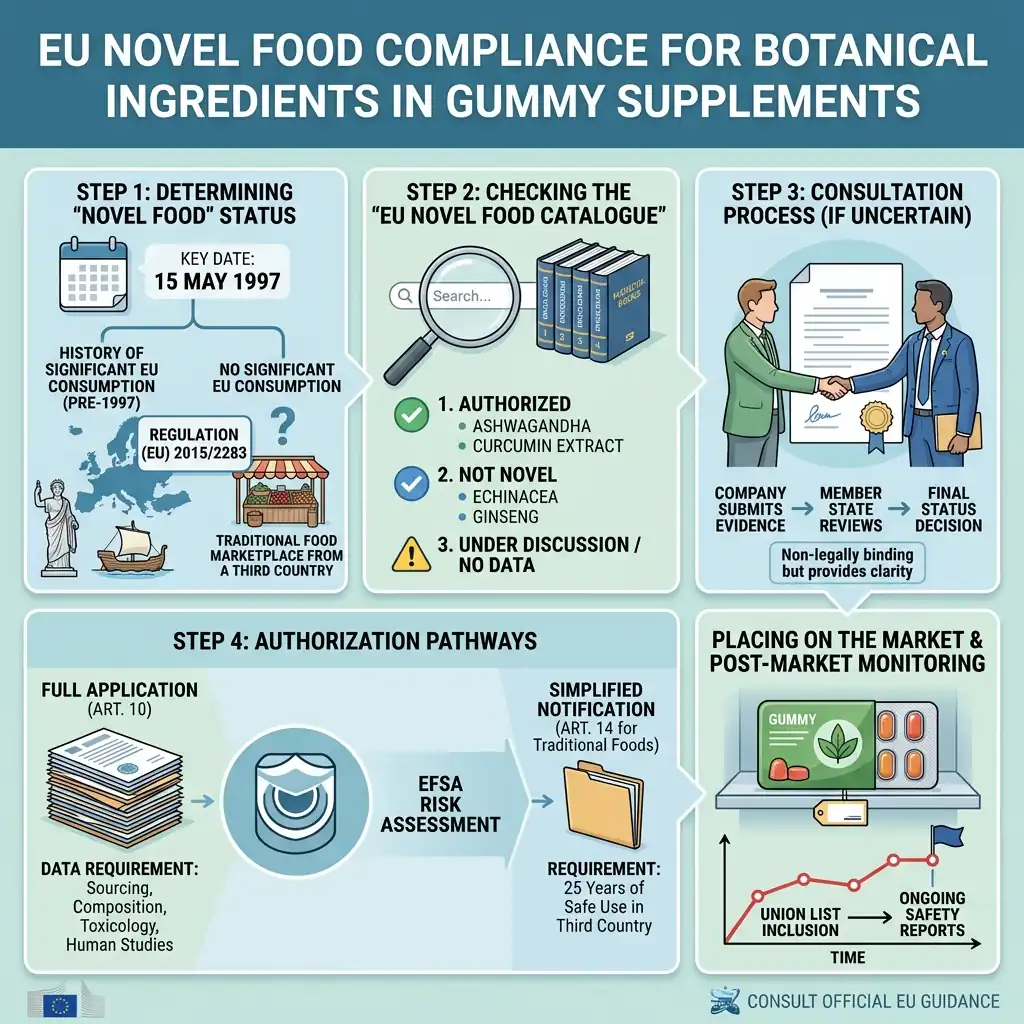
- Botanical extracts: Ashwagandha, elderberry, or ginseng extracts introduce color variation and polyphenol interactions. They also trigger additional documentation in EU and UK. Their presence at a functional dose (e.g., 100-300 mg extract per serving) supports supplement classification.
- Retail presentation: Dosage unit, serving count (e.g., 60 count bottle), Supplement Facts panel, and directions “take 2 gummies daily” are classification evidence. Bulk gummies without retail labeling are more likely to be questioned.
Country-Specific Classification Practices for Functional Gummies
While WCO provides the first six digits, national extensions differ. Your Gummy Manufacturer should prepare country-specific invoices.
| Market | Common HTS / CN Code | Authority and Note | Documentation Trigger |
|---|---|---|---|
| United States | 2106.90.9998 | CBP rulings classify dietary supplements in gummy form under food preparations. Form does not create a medicament under 3004. | FDA Prior Notice, Supplement Facts, sugar content >10% dry weight triggers Additional US Note 3 quota check |
| EU | 2106 90 98 | EU Tariff Notice 6, Regulation 2023/1131. Product loses confectionery character due to vitamin content. | EU Food Supplement Directive labeling, novel food status for CBD, melatonin restrictions vary by member state |
| UK | 2106 90 98 99 | Post-Brexit alignment with EU TARIC but requires UK-specific binding tariff info for certainty | UK Food Supplements notification |
| China (export) | 2106.90.9090 | Export tax rebate 9-13% depending on formulation; VAT 13% | CIQ inspection, CoA, ingredient breakdown for rebate claim |
| Australia | 2106.90.90 | After Customs Tariff Amendment 2021, vitamin gummies distinguished from medicaments | TGA listed medicine vs food determination |
Documentation Your Gummy Manufacturer Should Provide for Customs
Correct HS code is only defensible with supporting technical documents. Buyers should request these before shipment:
- Quantitative formula: Percentage by weight of syrup, sugar, gelling agent, acids, and each active. Indicates whether sugar exceeds functional character.
- Certificate of Analysis (CoA): Assay of active per gummy, moisture, water activity, pH. Shows dosage consistency.
- Manufacturing flow chart: Highlights active addition temperature and mixing step, cooling and drying stages, and how stability is maintained.
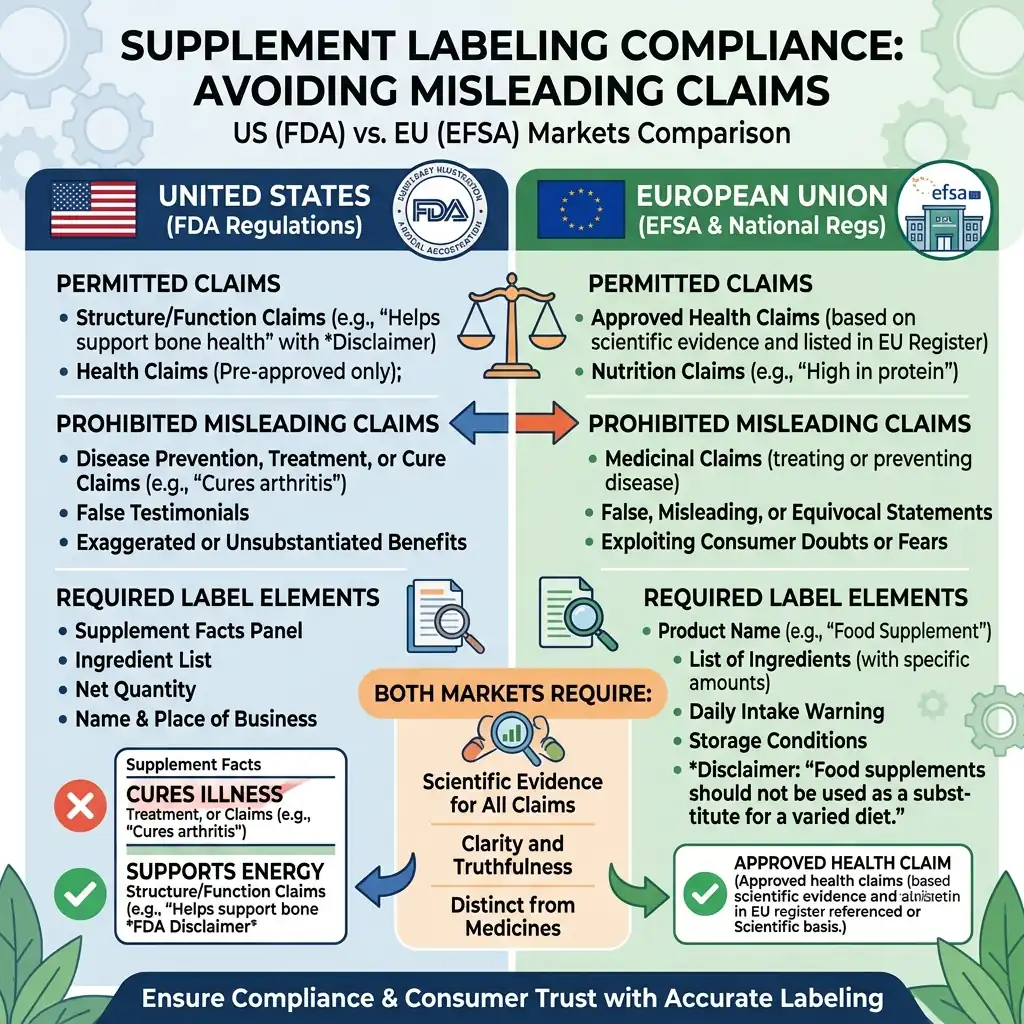
- Label artwork and Supplement Facts: Daily dose, RDA %, and functional positioning statement. This is primary evidence for 2106.90.
- Allergen, GMO, and vegan status statements: Relevant for pectin vs gelatin systems and for markets requiring Halal or Vegan certification.
- Binding Tariff Information (BTI) if available: Some manufacturers or importers hold advance rulings. While not mandatory, a BTI reduces inspection risk.
Manufacturing Process Points That Affect Classification
Not every production stage is relevant to HS codes, but these stages create classification evidence:
- Concept and specification review: Manufacturer reviews target market, intended claim (general well-being vs disease treatment), and dosage form. This sets the HS path from the start.
- Raw material testing: Sugar content measured by refractometer and active potency by HPLC. These values appear on customs documents.
- Batch preparation and cooking: Syrup cooked to 105-115°C for pectin systems, lower for gelatin to limit water. Overcooking degrades vitamins, so process records prove functional handling.
- Active addition and homogenization: Vitamins and minerals added post-cook under controlled shear. For probiotic gummies, additional low-temperature depositing and anaerobic handling are needed, further distinguishing from candy.
- Deposition, cooling, and drying: Water activity reduced to 0.65-0.75 for microbiological stability and texture. Drying time affects final gummy weight, which customs may verify against declared weight.
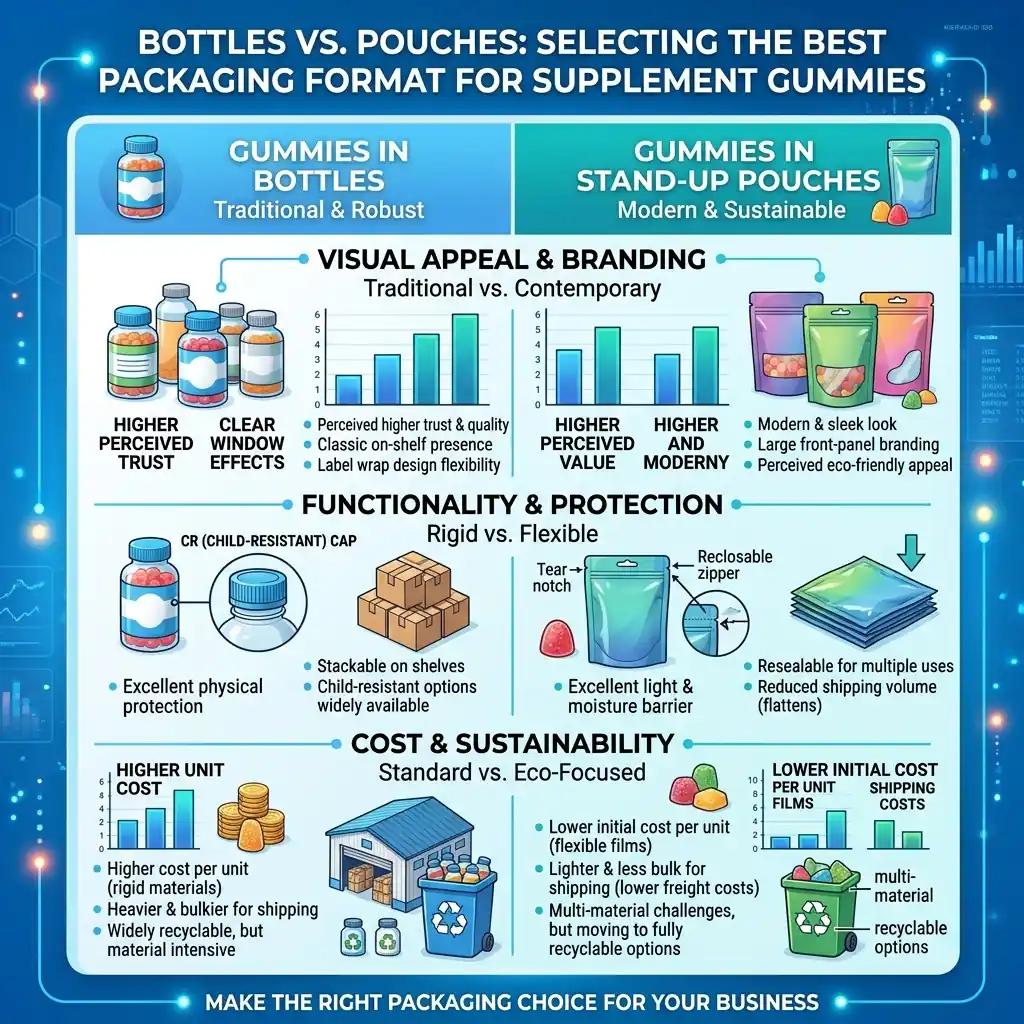
- Packaging and release testing: Bottles or pouches with oxygen barrier and desiccant protect actives. Finished-product testing includes active assay, not just sensory checks used for confectionery.
Cost, Duty, and MOQ Implications
HS classification directly influences landed cost modeling.
- Duty rate delta: A 5% difference between 1704.90 and 2106.90 on a $50,000 shipment is $2,500 before VAT. In the US, misclassification into sugar quota headings can trigger additional duties under 1704.90.74.
- VAT treatment: In EU, food supplements under 2106.90 may have different VAT rates than confectionery depending on member state.
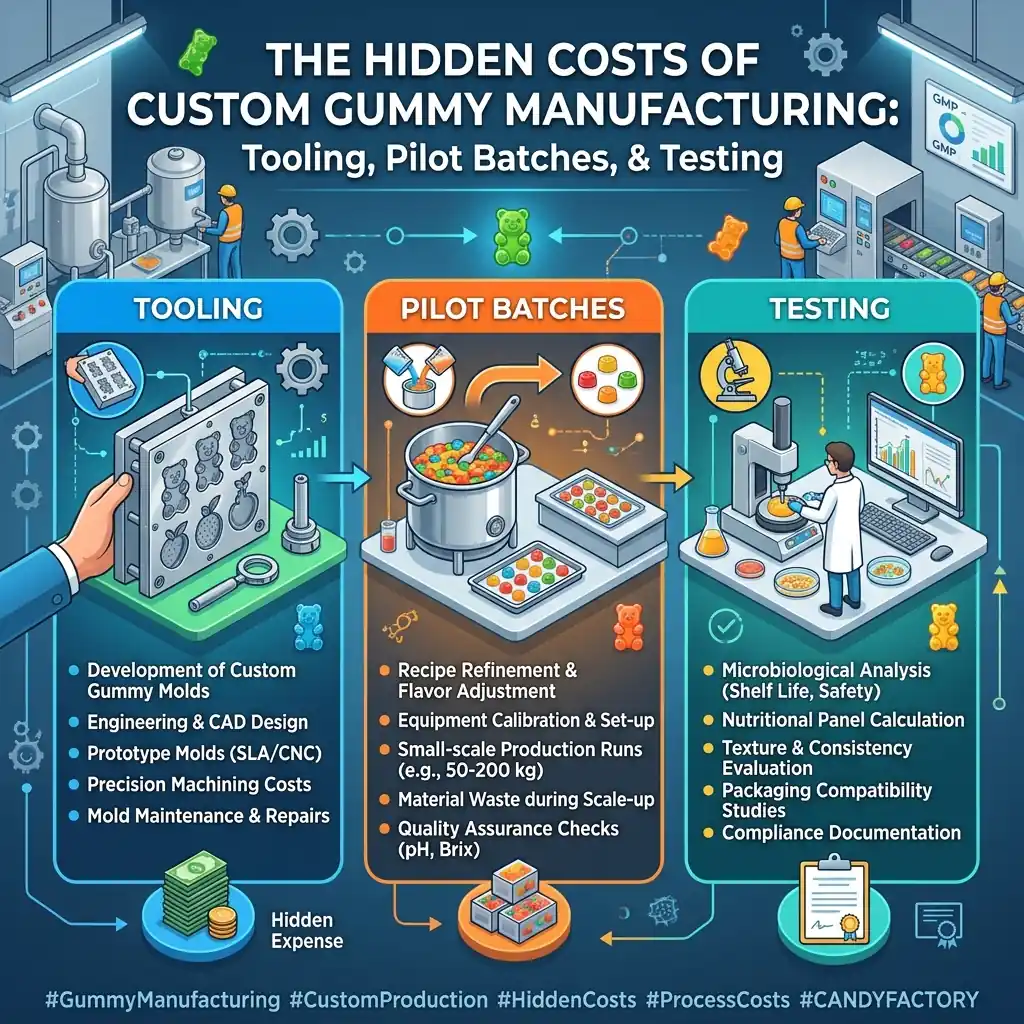
- MOQ and packaging economics: Gummies with high active load require larger molds (e.g., 4g vs 2.5g) and stronger packaging for moisture protection. Private Label Gummy MOQs often start at 30,000-50,000 gummies per SKU for custom formulation to cover mold and stability validation. Changing HS code mid-project because of formulation change may require new labels and new customs paperwork, adding lead time.
- Supply chain: If your manufacturer declares 1704.90 on export documents while your importer declares 2106.90, the mismatch triggers manual review. Align codes at quotation stage.
How to Evaluate a Gummy Manufacturer for Export Documentation
Beyond price and flavor, evaluate export competence on measurable criteria:
- Export experience: Does the manufacturer regularly ship functional gummies to your target market under 2106.90? Ask for redacted customs invoices or BTI examples.
- Quality systems: GMP, ISO22000, HACCP, BRC, FSSC 22000. These support food supplement status and audit readiness.
- R&D capability: Can they adjust pH, water activity, and gel strength to keep active stability while maintaining classification evidence?
- Testing and QC: In-house HPLC for vitamin assay, water activity meter, microbiological testing, and metal detection logs. Active assay is not required for candy but is for supplements.
- Documentation support: Ability to provide quantitative formula in percentage, CoA with RDA alignment, manufacturing flow chart, allergen and Halal/Kosher statements.
- Pilot-to-commercial scale-up: Consistent gummy weight and active uniformity from lab (5 kg) to commercial (500 kg+) batches. Weight variation over 7-8% raises customs weight verification issues.
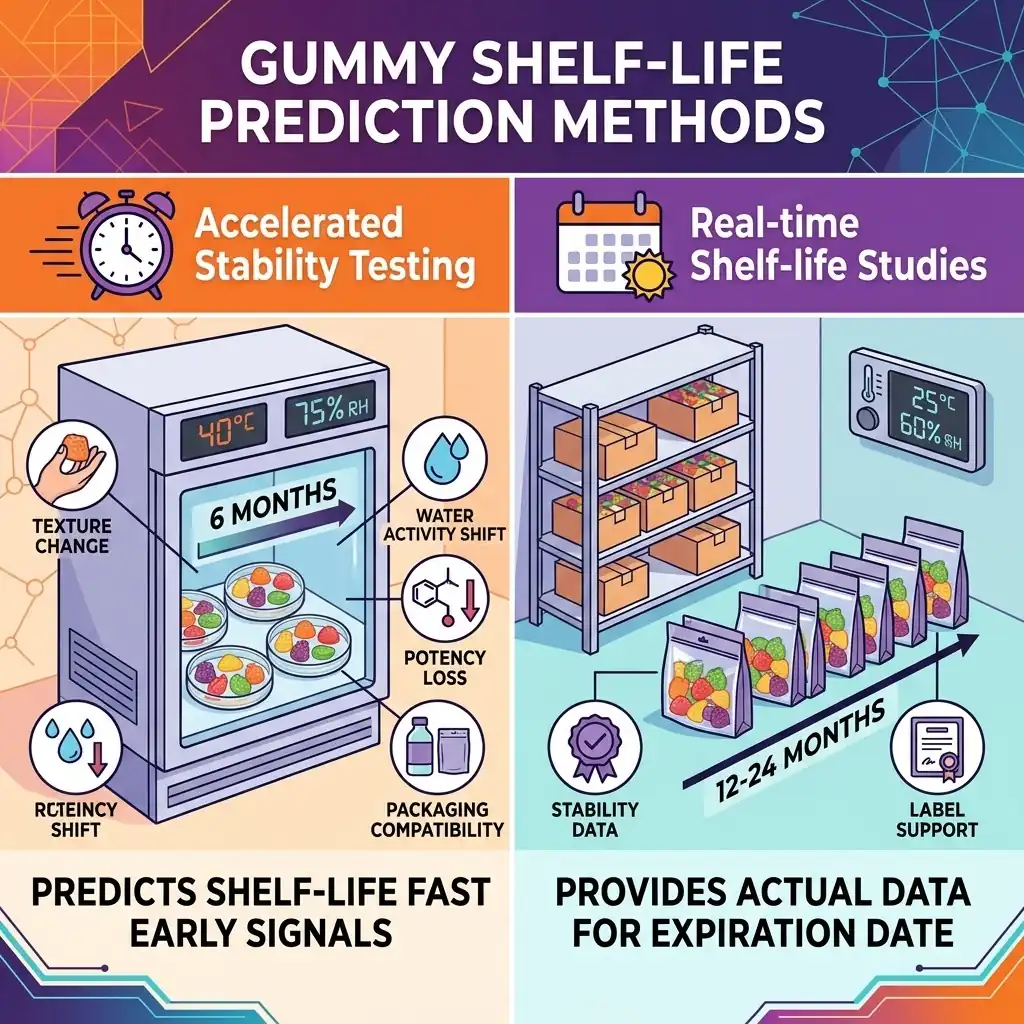
- Packaging compatibility: Bottles with induction seals, pouches with barrier films, and stability data for shelf-life validation (typically 18-24 months for pectin gummies).
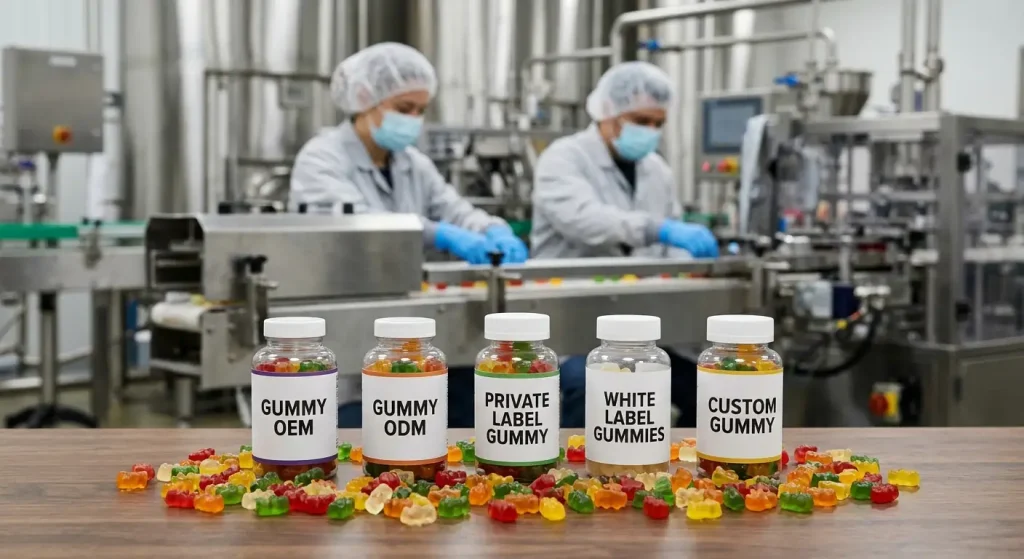
Shenzhen Gothink Biotech Co., Ltd. operates a GMP-certified facility with a 100,000-class cleanroom and 10,000-class R&D laboratory, with approximately 16 tons daily capacity. The company maintains ISO9001, ISO22000, HACCP, FDA, HALAL, GMP, KOSHER, BRC, FSSC 22000, and Vegan systems and supports OEM/ODM/CDMO across gummy, capsule, tablet, powder, liquid, and drop formats. For functional gummies, this includes formulation development that balances active loading, gel structure, and moisture control to meet both stability and export documentation requirements.
Common Mistakes That Cause Customs Holds
- Using candy HS code for functional products: Declaring 1704.90 to avoid supplement controls often backfires when label shows Supplement Facts.
- Inconsistent descriptions: Invoice says “sugar candy”, packing list says “vitamin gummies”, label says “dietary supplement”. Customs will hold for clarification.
- Missing active percentage: Stating “contains Vitamin C” without percentage weight makes it impossible to prove loss of confectionery character.
- Treating 2936 as finished product code: 2936 is for unmixed pure vitamins. Finished gummies with syrup and gelling agents do not qualify.
- Ignoring sugar quota notes: In US HTS, Additional US Note 3 to Chapter 17 affects products over 10% sugar by dry weight under certain subheadings including 2106.90.78 and 2106.90.95. Proper breakdown avoids unexpected quota allocation.
- Not aligning private label claims: Marketing copy claiming disease treatment pushes product toward 3004 medicament, which has stricter import licensing and may be rejected for functional gummies.
Practical Checklist Before Shipment
- Confirm target market HS code with importer and freight forwarder: 2106.90.98 for EU/UK, 2106.90.9998 for US, 2106.90.90 for China export.
- Provide quantitative formula with sugar content by dry weight and active dose per gummy with RDA reference.
- Ensure label shows serving size, daily dose, and functional positioning for general health, not therapeutic claims.
- Request manufacturer to issue CoA, allergen statement, and manufacturing flow chart matching invoice description.
- Check packaging: barrier properties, net weight consistency, and batch traceability.
- Validate duty and VAT with official tariff database (EU TARIC, US ITC HTS search, UK Trade Tariff Tool).
- If shipping sugar-free pectin gummies, document sweetener system and water activity to support non-confectionery status.
FAQ
What is the correct HS code for private label vitamin gummies exported from China?
Most vitamin and functional gummies exported as dietary supplements are classified under 2106.90.90 in China for export, which corresponds to 2106.90.98 in EU and 2106.90.9998 in US HTS. The classification depends on active dose, sugar content, and retail presentation as a supplement. Your Gummy Manufacturer should provide a quantitative formula to support this.
When would a gummy be classified as 1704.90 instead of 2106.90?
When sugar and glucose syrup dominate, active levels are negligible or incidental, and there is no dosage instruction or RDA statement. Products marketed as candy with vitamins added for marketing but without functional dosing are more likely to be treated as sugar confectionery.
Does sugar-free formulation change HS classification?
Sugar-free alone does not automatically change heading, but it helps demonstrate loss of confectionery character. Customs still looks at active content, dosage labeling, and intended use. Sugar-free pectin gummies with functional actives at 10-100% RDA per dose are typically still 2106.90, with exclusion notes for Chapter 17 also supporting non-1704 treatment.
Can functional gummies be classified as medicaments under 3004?
Generally no for wellness products. Heading 3004 requires the product to meet criteria for medicaments for therapeutic or prophylactic uses for specific diseases and meet Additional Note 1 to Chapter 30. Functional gummies that maintain general health or well-being do not meet this threshold and are classified in 2106.90.
What documents does customs ask for to confirm 2106.90 for gummies?
Customs typically requests ingredient breakdown in percentage by weight, CoA showing active per gummy, label artwork with Supplement Facts and daily dose, and manufacturing method showing active addition after cooking. A Binding Tariff Information letter, if held, further reduces inspection.
How does active loading affect cost and HS risk?
High-dose minerals or botanicals increase gummy size, affect pectin or gelatin texture, and require flavor masking. They also increase raw material cost and may push gummy weight above 4g, which strengthens supplement status but increases shipping weight. Low-dose actives with high sugar look more like confectionery and increase reclassification risk.
What should I ask a Private Label Gummy supplier before placing an order?
Ask for export experience to your market under 2106.90, sample CoA with assay method, water activity and pH specifications, stability data for shelf-life, packaging barrier data, and whether they can provide quantitative formula and manufacturing flow chart for customs. Also confirm MOQ per SKU and mold availability.
Commercial Next Step
If you are evaluating a new functional gummy concept, align HS classification at specification stage, not after production. Share your target market, active dose per gummy, sugar or sugar-free preference, gel system (pectin or gelatin), and intended label claims with your manufacturer.
A technically capable Gummy Manufacturer can adjust formula design to protect both stability and customs evidence, recommend packaging that supports shelf-life validation, and provide export documentation that matches your importer’s declaration. For formulation options and export documentation templates, review the gummy manufacturing process overview and discuss your specifications for an OEM/ODM quotation.
Explore related manufacturing and sourcing guidance in our Knowledge Hub and our detailed guide on MOQ and sourcing considerations.
Jack Luo|Senior Technical Advisor, Nutrition Research Center Representing Gothink Biology, a GMP-certified dietary supplement manufacturer based in Shenzhen, China.