
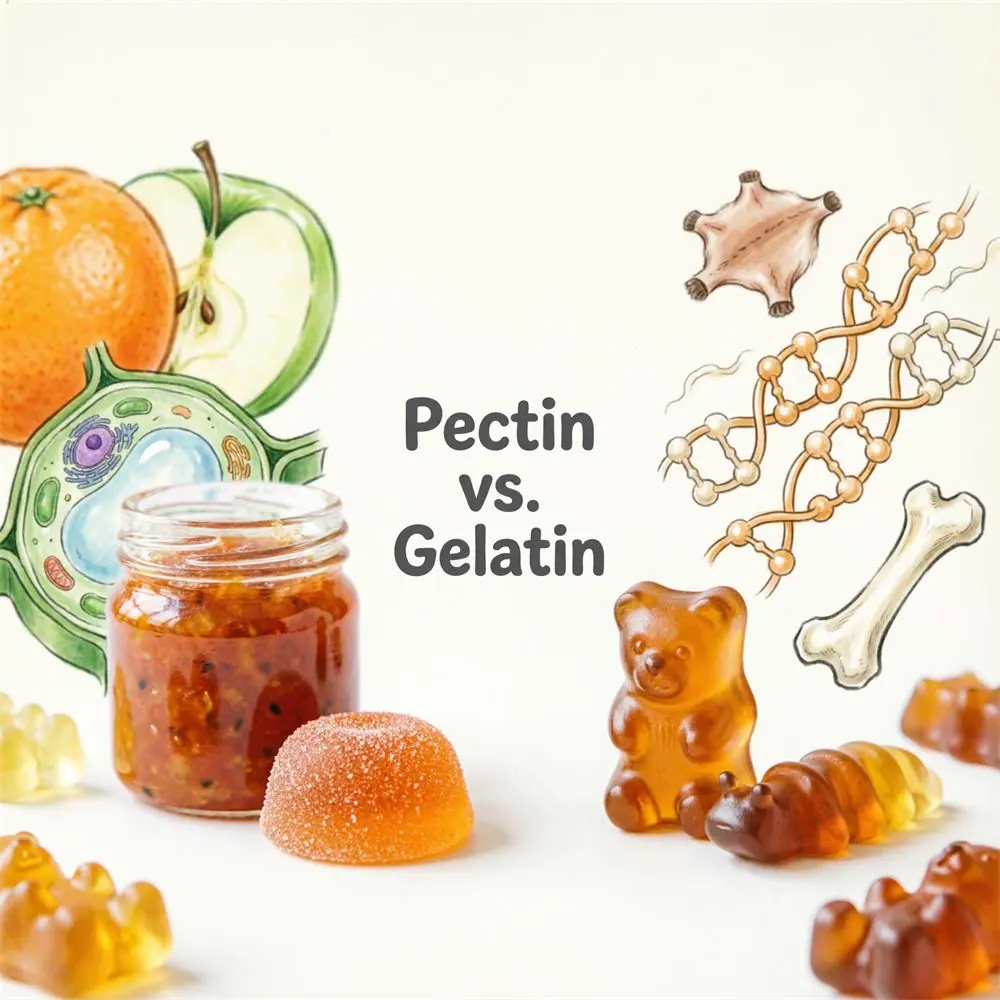
Selecting pectin or gelatin is not a texture preference, it is a decision that locks your thermal process, depositor parameters, curing time, and label eligibility before a single commercial batch is made.
Brands that choose the wrong hydrocolloid for their actives or market often discover at 500 kg scale that viscosity, water activity, and active retention no longer match bench results.
Key Takeaways / Technical Summary
- Gelation Window: High-methoxyl (HM) pectin requires 75-78° Brix and pH 3.2-3.6 at a cook of 106-112°C to form a thermo-irreversible network; gelatin (150-250 Bloom) gels on cooling below 35°C and deposits at 55-70°C, forming a thermo-reversible network that melts at 30-35°C.
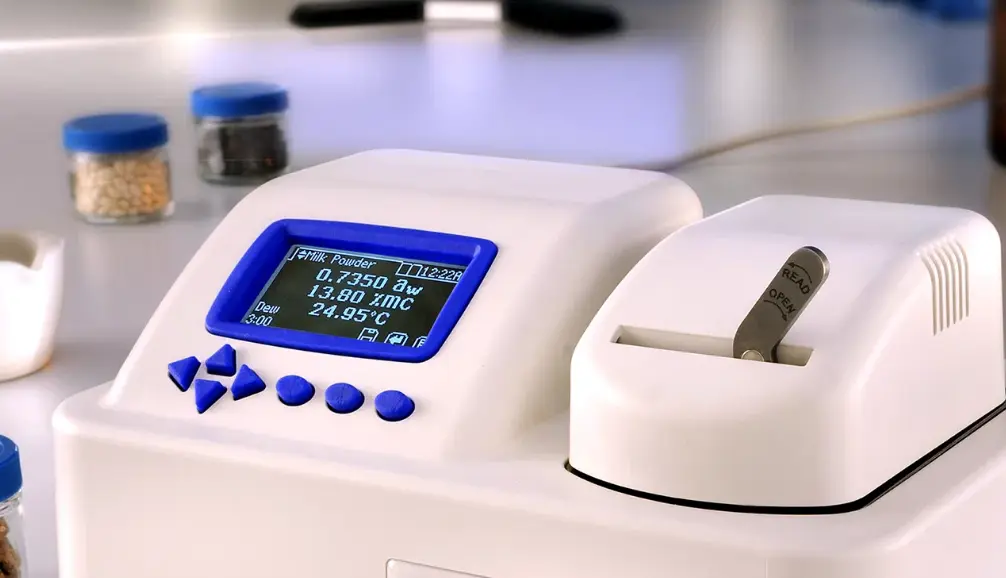
- Process Control: Pectin must be deposited at 95-105°C within 30-60 seconds of acid addition to prevent pre-gelation and tailing; gelatin requires controlled cooling and 24-48 hour curing at 25-30% RH to drive water activity from 0.75 to target 0.58-0.62 aW.
- Active Compatibility: Pectin tolerates high-acid actives and 85-90% lower moisture but is sensitive to calcium and high-protein inclusions; gelatin tolerates oil-soluble and mineral loads better but requires 5-15% potency overage for heat-sensitive vitamins due to prolonged low-temperature drying.
- Stability Trade-off: Pectin achieves final aW 0.55-0.65 without starch mogul drying, enabling faster throughput and vegan claims; gelatin requires barrier packaging with WVTR <2.5 g/m²/day to prevent cold flow and surface sweating when aW exceeds 0.65.
Why the Base Hydrocolloid Defines Your Entire Process Window
As part of our continuous research in Manufacturing & Processing, we treat the gummy base as a process system, not an ingredient.
Gelation Mechanism and Thermodynamic Reality
HM pectin, degree of esterification >50%, gels through hydrophobic interaction and hydrogen bonding in a high-solids, low-pH environment. Sugar competes for water, reducing solvent availability, while pH suppression at 3.2-3.6 reduces charge repulsion between galacturonic acid chains. This creates a rapid, thermo-irreversible gel once solids reach 75-78° Brix. The practical effect: once pectin sets, it will not re-melt on reheat, which gives heat stability to 80-90°C but leaves zero rework window. If acid is added too early at >105°C, you get premature gelation in the holding tank, leading to high depositing pressure, broken necks, and weight variation >5%.
Gelatin gels by coil-to-helix transition. At 80-90°C you fully hydrate and denature the protein, then upon cooling to 20-30°C, triple helices re-associate and trap water. Bloom strength defines rigidity: 150 Bloom gives soft chew and faster set, 200-250 Bloom gives firm bite and higher tensile strength but requires higher solids to avoid rubberiness. This network is thermo-reversible. Above 30-35°C it melts, which explains why gelatin gummies suffer cold flow and deformation during summer logistics if aW is not controlled below 0.62. The advantage is rework: scrap can be remelted at 70-80°C without significant loss of gel strength, improving commercial yield.
Impact on Texture, Melting Point, and Consumer Experience
Pectin delivers short, clean bite with low elastic recovery. Instrumental texture analysis shows lower cohesiveness and higher fracturability compared to gelatin at equal solids. It does not stick to teeth, which is critical for high-dose botanicals where bitterness masking is needed. It also remains stable in the mouth without melting, releasing flavor quickly.
Gelatin delivers long, elastic chew with high springiness. This masks oily or mineral off-notes better because the protein matrix emulsifies lipids and slows flavor release. However, the melt-in-mouth property at body temperature becomes a defect in tropical markets. If your brand targets vegan, halal, or kosher positioning, gelatin creates an immediate label barrier that cannot be fixed by formulation tweaks.
Technical Comparison: Pectin vs. Gelatin at Production Scale
| Parameter | HM Pectin (Vegan) | Gelatin (Type A/B, 150-250 Bloom) |
|---|---|---|
| Gelation Driver | Sugar + Acid, DE >50%, thermo-irreversible | Temperature + Cooling, thermo-reversible |
| Cook Temperature | 106-112°C to reach 75-78° Brix | 80-90°C slurry hold, no high Brix boil needed |
| Depositor Nozzle Temp | 95-105°C, <60 sec after acid dosing | 55-70°C, controlled viscosity 2,500-4,000 cP |
| pH Target | 3.2-3.6 (citric buffer); below 3.0 causes syneresis | 3.8-4.5 for most actives; <3.5 hydrolyzes gelatin over shelf life |
| Curing / Drying | 12-24 hr ambient set or 8-12 hr at 25-30% RH; often starch-free silicone depositing | 24-48 hr at 20-25°C, 25-30% RH in curing rooms; starch mogul or silicone + drying |
| Final aW | 0.55-0.65 | 0.58-0.62 after cure; >0.65 risks microbial growth per USP 61/62 |
| Heat Stability | Stable to 80-90°C | Melts at 30-35°C, deforms in transport |
| Label Claim | Vegan, pectin-based, non-GMO capable | Not vegan; halal/kosher only with certified bovine/fish gelatin |
Manufacturing Control Points That Separate Lab Success from Commercial Yield
Brix, pH, and Temperature Control for Pectin
In lab, you can achieve 78° Brix by slow evaporation. In continuous cooking, you must hit Brix within ±1° in a vacuum cooker or scraped-surface heat exchanger. If Brix is low at 73-74°, pectin network is weak and you get sticky, low-demit gummies that fail demolding. If Brix is high at 80°+, viscosity exceeds 6,000 cP at 100°C, causing air entrapment and inconsistent dosing. The cause-and-effect chain: higher Brix raises boiling point, which requires higher cook temperature, which accelerates inversion of sucrose to glucose/fructose, which lowers pH further and can push final pH below 3.0, leading to pre-gel lumps and syneresis after 2 weeks.
Acid dosing must be isolated. In a typical commercial setup, pectin, sugar, and water are cooked, cooled to 95-105°C, then citric acid solution 50% and flavor are injected inline via static mixer immediately before depositor. Buffering with sodium citrate is critical to hold pH 3.2-3.6. Without buffer, natural acidity from Vitamin C or apple cider vinegar shifts pH by 0.3-0.5 units, collapsing gel strength by 20-30%.
Bloom Strength, Depositing, and Curing Control for Gelatin
Gelatin success depends on hydration time and thermal history. Under-hydrated gelatin (less than 30 min soak at 60°C) leaves fisheyes that block depositor nozzles. Overcooked gelatin held above 85°C for >4 hours loses Bloom by thermal hydrolysis, reducing gel strength 10-15% per hour. At depositing, slurry temperature control within ±2°C is essential. At 50°C, gelatin viscosity climbs rapidly, causing tails and cap defects. At 75°C, setting time doubles, leading to feathered edges in molds.
Curing is where many scale-ups fail. Gelatin gummies leave depositor at aW 0.72-0.78. They must lose 10-15% moisture in curing rooms at 25-30% RH with laminar airflow 0.3-0.5 m/s. If RH is too low <20%, case hardening occurs: surface forms a dry crust with aW 0.45 while core remains at 0.70, leading to moisture migration, sugar crystallization, and later microbial risk. If RH is too high >40%, drying curve flattens and gummies remain above 0.65 aW after 48 hr, failing USP 61 total aerobic count and yeast/mold limits. Continuous monitoring of aW, not just weight loss, is required for release.
Active Ingredient Compatibility and Thermal Decay Management
Lab-bench success does not guarantee commercial depositor yield because heat exposure time differs. In bench, active is exposed to 90-110°C for 2-3 minutes. In production, hold tank residence can be 30-90 minutes. This changes overage strategy. For example, Vitamin C in pectin: degradation follows first-order kinetics above 100°C at low pH. We typically apply 12-20% overage for pectin if cook is <110°C and depositing is fast. For gelatin, Vitamin C degradation is lower at 60°C, but prolonged curing at 25°C for 48 hr with oxygen exposure causes oxidative loss, requiring 8-12% overage plus sodium ascorbate form and opaque packaging.
Low-methoxyl (LM) pectin introduces another variable. LM pectin gels via calcium bridges, ideal for low-sugar 45-55° Brix formulas. However, if your formula contains calcium carbonate, magnesium citrate, or dicalcium phosphate as actives, free calcium triggers premature gelation even before acid addition. The result is gritty texture and calcium pectate precipitation. In such mineral-heavy formulas, HM pectin or gelatin is more robust. Similarly, high-protein actives like collagen peptides at >10% compete with gelatin for water and reduce gel strength, requiring Bloom adjustment to 240-250 or pectin substitution.
Quality verification must be built in. HPLC active assay potency should be performed on post-cure samples, not just slurry, to capture thermal and curing loss. ICP-MS for heavy metals must account for pectin source variability, as citrus-derived pectin can carry higher background aluminum. Microbial testing per USP 61/62 is sensitive to aW: a batch at 0.63 aW may pass initially but fail accelerated stability at 30°C/65% RH if barrier packaging WVTR is inadequate.
Stability, Water Activity, and Packaging Interdependency
Water activity and packaging cannot be designed in isolation. Pectin gummies reach target aW faster and tolerate higher initial solids, so they can use simpler polypropylene pouch with WVTR 5-8 g/m²/day if shelf life is <12 months. Gelatin gummies at 0.60 aW will absorb moisture rapidly if WVTR is >3 g/m²/day, especially with hygroscopic actives like elderberry or sodium ascorbate. That drives need for high-barrier stand-up pouches with metallized PET or Alu-Alu blisters with WVTR <1.0 g/m²/day.
Oil migration is another cause-and-effect often missed. Gelatin matrix holds oil droplets up to 8-10% via emulsification with its protein. Pectin does not emulsify; oil separates above 4-5% unless you add modified starch or gum arabic as secondary stabilizer. Without it, you see oiling out at the gummy base after 4-6 weeks, accelerating oxidation of omega-3 or MCT-based actives.
Regulatory and Market Positioning Trade-offs
From a cGMP 21 CFR Part 111 perspective, both bases are compliant, but audit focus differs. For gelatin, auditors scrutinize animal origin documentation, BSE/TSE statements, and halal/kosher certification chain, plus gelatin allergen handling. For pectin, focus shifts to pH and Brix logs as critical control points for identity and strength, plus verification of vegan claim substantiation and pectin supplier specification for degree of esterification and galacturonic acid content.
Market claim also drives base selection. North American and EU vegan supplement markets require pectin, agar, or modified starch. Gelatin remains dominant for traditional nutraceuticals where cost-per-kg and chew elasticity are priorities and vegan claim is not needed. In sugar-free positioning, LM amidated pectin allows 30-40% sugar reduction with erythritol or allulose, while gelatin sugar-free versions suffer from off-taste masking issues due to slower flavor release.
Decision Matrix: How to Choose Based on Your Formula and Business Model
| Your Formula / Business Need | Recommended Base | Why |
|---|---|---|
| High-acid actives: Vitamin C >200 mg, ACV, citric-based botanicals | HM Pectin | Tolerates pH 3.2-3.6; gelatin hydrolyzes below 3.5 and loses chew over shelf life |
| Mineral-heavy: Calcium, Magnesium, Zinc >20% DV | Gelatin 200-250 Bloom | Avoids calcium-induced pre-gelation seen with LM pectin; better oil/mineral suspension |
| Vegan / Halal / Kosher mandatory, heat-stable logistics | HM Pectin | Thermo-irreversible, stable to 80°C, label-compliant, no animal BSE/TSE docs |
| Oil-based: Omega-3, MCT, fat-soluble vitamins >5% oil | Gelatin + emulsifier system | Protein emulsification prevents oiling out; pectin needs secondary colloid |
| Low-sugar / Sugar-free positioning | LM Amidated Pectin | Gels at 45-55° Brix with calcium, compatible with polyols; gelatin sugar-free texture is rubbery |
Industrial Solutions: Scaling the Right Base
Once you lock pH, Brix, and Bloom, the next failure point is scale translation. Depositor trials should validate weight variation CV <2%, tail length <1 mm, and aW convergence within 0.02 across three consecutive commercial batches. For pectin, run a hold study: keep slurry at 98°C for 90 minutes and deposit every 15 minutes to map pre-gelation window. For gelatin, run a curing profile: track aW every 6 hours to build drying curve and prevent case hardening.
Formulation engineering also includes packaging integration. Test WVTR against your target aW and actives under accelerated 30°C/65% RH for 3 months with HPLC potency verification and texture profile analysis. A pectin formula that passes at 25°C can still soften and grow yeast at 30°C if aW is 0.66 and packaging WVTR is high.
To translate this base selection into validated commercial output, explore our scalable pectin and gelatin gummy production platform where we run side-by-side HM pectin and 150-250 Bloom gelatin lines with inline Brix, pH, and aW controls and cGMP audits under 21 CFR Part 111. This allows you to benchmark depositing yield, curing time, and active retention before committing to tooling.
Frequently Asked Questions
Why does my HM pectin batch gel in the holding tank and cause tails?
This is classic pre-gelation. Cause: acid added too early or holding temperature below 90°C, or pH dropped below 3.1 while solids are still above 75° Brix. Fix: keep pre-acid slurry at 95-105°C, inject acid and flavor inline via static mixer within 30-60 seconds of depositing, and buffer with sodium citrate to hold pH 3.3-3.5. Verify depositing viscosity stays at 3,500-5,000 cP.
My gelatin gummies sweat and stick together after 2 months at warehouse. What controls aW creep?
Sweating indicates aW migration from core to surface or moisture ingress. Root cause is incomplete cure where core aW remains 0.68-0.72 despite surface at 0.60, or packaging WVTR too high. Check curing room RH is 25-30% with airflow not directly on trays, and cure to aW 0.58-0.62 measured at core, not surface. Then specify pouch WVTR <2.5 g/m²/day and add anti-caking with oil-based polishing only after aW is stable.
Can I use LM pectin for a calcium carbonate gummy?
Not recommended without reformulation. LM pectin requires free calcium 20-40 mg/g pectin to gel. Calcium carbonate as active provides uncontrolled free calcium, causing instant gelation and grainy calcium pectate. If low-sugar is required, switch to HM pectin with polyol bulking and accept 75° Brix, or move to gelatin 220 Bloom which tolerates calcium better, and control pH at 4.0-4.3 to avoid gelatin hydrolysis.
How does Bloom strength change my depositor yield?
150 Bloom gelatin sets slower, giving longer depositing window but softer demold and higher risk of deformation, requiring longer curing. 250 Bloom sets faster, improves shape retention and chew firmness, but raises viscosity at same solids, increasing nozzle pressure and tail risk if slurry drops below 60°C. For high-dose gummies >1,000 mg actives, 200-220 Bloom offers balance: stable viscosity 2,800-3,500 cP at 65°C and clean demold after 24 hr cure.
Author Bio: Jack Luo|Senior Technical Advisor, Nutrition Research Center. Representing Gothink Biology, a cGMP-certified dietary supplement manufacturer based in Shenzhen, China.