
Direct Answer: How Probiotics Survive Gummy Manufacturing
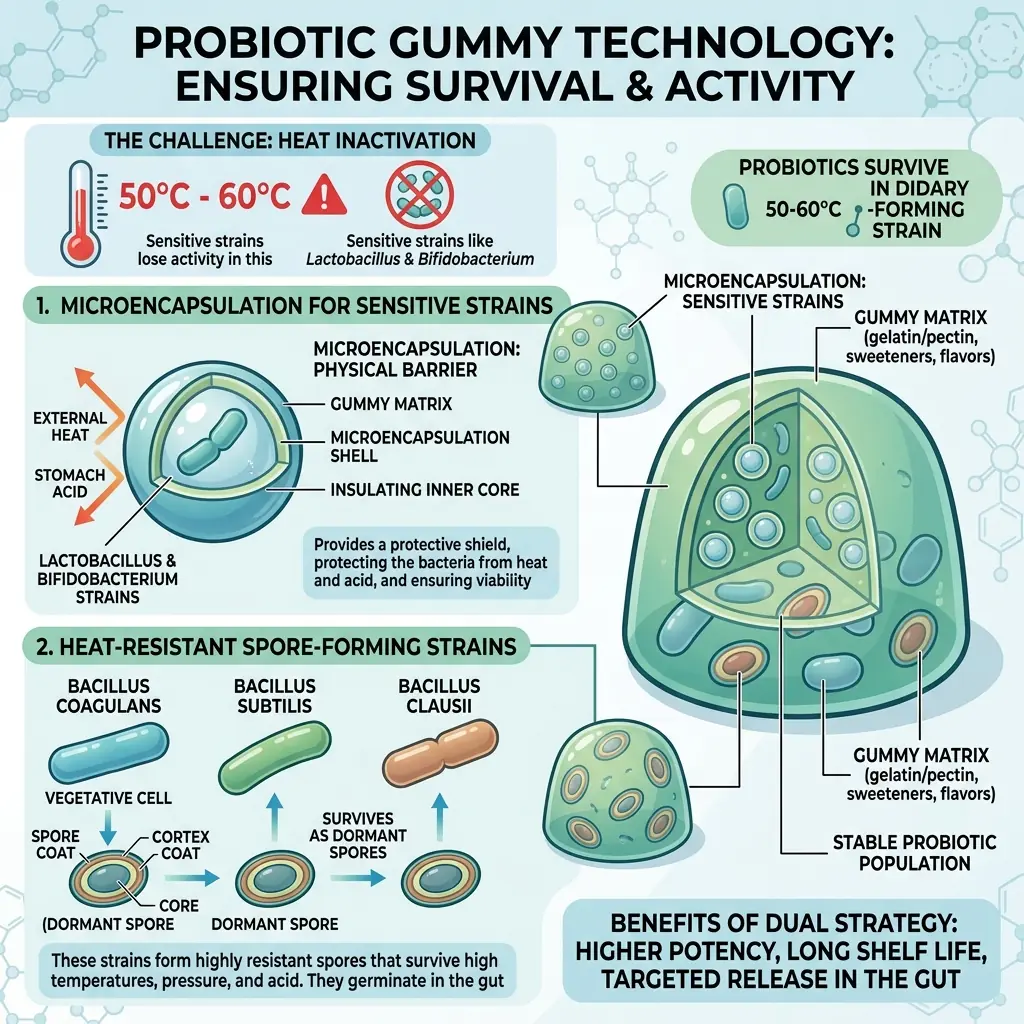
Probiotic survival in gummies depends on limiting heat, moisture, acidity, and oxygen exposure from cooking through shelf life. No standard gummy process is probiotic-friendly by default, because gummy mass is typically cooked at 85-110°C, while most vegetative probiotics lose viability rapidly above 50-60°C.
Two commercially proven strategies are used to solve this: microencapsulation, which puts a physical barrier around sensitive strains like Lactobacillus and Bifidobacterium, and heat-resistant spore-forming strains, primarily Bacillus coagulans, Bacillus subtilis, and Bacillus clausii, which survive as dormant spores.
Microencapsulation preserves strain diversity and consumer-familiar species but adds ingredient cost and requires careful water activity control. Heat-resistant spores offer much higher process survival and longer shelf stability, but limit you to spore-forming species and require different documentation for label claims.
Why Probiotic Survival Is the Core Challenge in Gummy Manufacturing
If you are sourcing probiotic gummies, working with the right Gummy Manufacturer is critical because viability, not just texture, determines whether the product meets its label claim at end of shelf life. Buyers often focus on flavor and shape, but the real failure mode is CFU loss during production and storage.
In Gummy Manufacturing, three factors kill probiotics. First, high-temperature cooking needed to dissolve gelatin or activate pectin. Second, high water activity (aw) and low pH in the finished gummy. Third, oxygen and prolonged drying that triggers premature germination or cell damage.
Most gummy bases leave the cooker at 80°C or higher and are deposited at 70-80°C. Even when cooled to 50°C for active addition, the mass still carries residual heat and moisture. For a private label gummy with a 12-18 month shelf life, the challenge is not just surviving deposition, but staying alive at 25°C / 60% RH in a distribution chain.
The Two Main Strategies Used by a Professional Gummy Manufacturer
A capable Gummy Manufacturer will not treat probiotics like a vitamin. Vitamins degrade chemically; probiotics die biologically. The process logic is different. You either protect the cell or use a cell that does not need protection.
1. Microencapsulation for Probiotic Protection
Microencapsulation coats individual probiotic cells or small clusters with a protective matrix. Common systems in gummy use include lipid-based coatings (hydrogenated oils, waxes), protein-based systems (whey protein, sodium caseinate), and enteric-type polymers such as cellulose derivatives.
The coating logic is straightforward. It creates a low-moisture, low-oxygen microenvironment that insulates cells from heat during the short mixing window and from acidity and water in the gummy matrix. Lipid coatings melt at specific temperatures, so they remain intact during storage but release in the gut.
From a formulation view, microencapsulated powders are easier to disperse in gummies than freeze-dried free cells, but they are larger particles (often 100-300 microns) and can affect mouthfeel if loading is high. They also require validation that the encapsulant does not interfere with gel setting. Over-encapsulation can lead to gritty texture, while under-encapsulation offers little protection.
2. Heat-Resistant and Spore-Forming Strains
Heat-resistant strains are not truly heat-proof. They are spore-formers. In spore form, Bacillus species dehydrate their core and build protective layers that resist heat, acid, and low water activity. They remain dormant in the gummy and germinate after ingestion.
For gummy production, this changes the process window. Spore counts remain relatively stable during mixing at 55-65°C, which would destroy most Lactobacillus rhamnosus or Bifidobacterium lactis. This allows more flexible depositing and shorter cooling holds, which improves batch consistency at commercial scale.
The trade-off is strain choice and labeling. If your marketing requires Lactobacillus or Bifidobacterium species, spores will not meet that brief. If your brief prioritizes guaranteed CFU at end of shelf life and robust manufacturing, Bacillus coagulans is the most widely used option for gummies in the US and Asia markets.
Comparison: Microencapsulation vs. Heat-Resistant Strains
| Factor | Microencapsulation | Heat-Resistant Spore Strains |
| Definition | Physical coating around vegetative cells | Naturally dormant spores of Bacillus species |
| Process Survival | Moderate; highly dependent on addition temperature and aw control | High; spores tolerate short exposure at 60-75°C |
| Strain Options | Broad: L. rhamnosus, L. acidophilus, B. lactis, L. paracasei | Narrow: B. coagulans, B. subtilis, B. clausii |
| Gel Compatibility | Needs low-acid handling; pectin at pH 3.2-3.6 is more aggressive | Better tolerance to pectin acidity and gelatin processing |
| Texture / Flavor Impact | Can create slight waxy or gritty notes at high loading | Neutral; low impact on flavor and chew |
| Cost Structure | Higher ingredient cost, moderate overage | Lower ingredient cost, lower overage, more stable supply |
| Shelf-Life Risk | Sensitive to aw >0.65 and temperature abuse | Stable at aw 0.60-0.70 when packaging is moisture-proof |
| Best Fit For | Brands needing specific Lactobacillus / Bifidobacterium label claims | Brands prioritizing stability, scale-up, and cost-efficient private label gummy programs |
How Gummy Manufacturing Process Affects Probiotic Viability
Probiotic gummies fail when process design ignores biology. Below are the stages that matter most, and why each is controlled differently than in standard vitamin gummy production.
Cooking and Cooling
Gelatin and pectin bases must be cooked to achieve solids and set. Gelatin bases are typically cooked at 85-95°C, pectin bases at 95-110°C. Probiotics cannot be present at this stage. The mass must be cooled in a holding tank or vacuum cooker to a target addition window.
For vegetative encapsulated strains, the target is usually 42-50°C. Below 40°C, gelatin viscosity rises sharply and causes deposition defects. For spore strains, manufacturers can add at 55-65°C, which keeps viscosity low and improves line speed. The reason cooling matters is time-at-temperature, not just peak temperature. A 5-minute hold at 60°C is more damaging than a 30-second exposure.
Active Addition Point
Probiotics are added post-cook with gentle low-shear mixing. High shear generates localized heat and damages microcapsules. Pre-mixing probiotics with a small portion of oil or dry carrier helps dispersion and avoids clumping in the gummy mass.
Batch size matters here. In pilot batches, you can hand-fold probiotics quickly. At 500 kg+ commercial scale, mixing time extends, and temperature uniformity becomes critical. A manufacturer needs jacketed holding tanks with precise temperature control to keep the mass within a 3-5°C window during addition.
Deposition, Setting, and Drying
Deposited gummies go through cooling tunnels to set the gel structure. Gelatin requires cold setting at 15-20°C, pectin sets by temperature drop and pH. This stage is generally safe for probiotics if earlier steps were controlled.
Drying or conditioning is the hidden risk. Many gummy lines dry at 20-25°C with controlled humidity for 24-72 hours to reach target aw. Extended drying raises oxygen exposure and allows moisture migration from core to surface, which can reactivate vegetative cells prematurely. For probiotic gummies, manufacturers shorten conditioning time and target aw 0.55-0.65 rather than the 0.70-0.75 typical for standard gummies.
Water Activity and pH Control
| Process Stage | Risk to Probiotics | Control Strategy |
| Cooking | Lethal heat >70°C | No probiotic addition; cook base separately |
| Cooling / Mixing | Time-at-temperature, shear damage | Cool to 42-50°C for encapsulated, 55-65°C for spores; low-shear mixing |
| Deposition | Temperature drop inconsistency | Jacketed depositor, rapid deposit to reduce hold time |
| Drying / Conditioning | Oxygen and moisture activation | Shorten drying, target aw 0.55-0.65, control humidity |
| Packaging | Moisture ingress, heat in storage | High-barrier pouch or bottle, desiccant, nitrogen flush where applicable |
Formulation Trade-Offs Brands Should Understand
Probiotic gummies are a multi-variable balance between CFU load, gummy weight, gel system, and stability. A common mistake is specifying high CFU in a small gummy without accounting for particle load.
- Active loading: A 2.5-3.5 g gummy can carry 1-5 billion CFU of spores easily. Encapsulated Lactobacillus at the same CFU requires larger particle mass, which pushes gummy weight up or forces a 2-gummy serving.
- Gel system: Gelatin offers neutral pH (4.8-5.5) and is gentler on probiotics, but is not vegan. Pectin requires acid (pH 3.2-3.6) to set, which accelerates die-off of vegetative strains. If you need vegan and Lactobacillus, microencapsulation quality becomes non-negotiable.
- Sugar and polyols: High sugar solids reduce water activity, which helps stability. Sugar-free polyol systems can be more hygroscopic and raise aw if not formulated carefully.
- Flavor and acids: Citric acid for sour coating directly contacts probiotics on the surface. Many manufacturers add probiotics to the core and keep coating acids separate or use non-acidic oil coating.
- Oxygen sensitivity: Bifidobacterium is more oxygen-sensitive than Lactobacillus. If your formula includes B. lactis, packaging oxygen barrier becomes more important than for Bacillus-only formulas.
Stability, Overages, and Shelf-Life Validation
CFU claims in probiotic gummies are based on end of shelf life, not at manufacture. That means overage design is essential. The overage is the extra CFU added to compensate for expected loss.
For spore-based gummies stored in high-barrier packaging at 25°C, manufacturers often design with 30-100% overage based on accelerated data. For microencapsulated vegetative strains, overages are typically higher and must be validated with real-time studies because aw and temperature sensitivity vary by encapsulant.
Shelf-life validation should include water activity tracking, plate count at 0, 3, 6, 9, 12 months, and accelerated 37°C data for risk assessment. Water activity should be tested per batch. If aw drifts above 0.65 during storage, vegetative probiotics will decline faster than predicted.
Quality Control and Testing Requirements
A Gummy Manufacturer running probiotics needs microbiological controls beyond standard gummy QC. This includes incoming strain identity verification, total plate count of the probiotic raw material, and finished product CFU enumeration using validated methods for the specific strain type.
Spore counts and vegetative counts use different sample preparation. Spore products require heat activation before plating; vegetative encapsulated products require capsule disruption without killing cells. Method mismatch leads to false low results and incorrect overage decisions.
Additional controls include environmental monitoring of the cleanroom during addition, metal detection after conditioning, and packaging integrity testing. Batch traceability from probiotic lot to finished gummy lot is required for GMP and for export documentation.
Cost, MOQ, and Commercial Considerations for Private Label Gummy Projects
Cost drivers for probiotic gummies differ from vitamin gummies. Ingredient cost is driven by CFU per gram, encapsulation type, and strain royalty. Process cost is driven by slower depositing speeds when addition temperature is low and by shorter, more controlled drying.
Microencapsulated Lactobacillus / Bifidobacterium ingredients cost more per billion CFU than Bacillus coagulans spores. They also often require refrigerated raw material storage and faster inventory turnover, which affects procurement planning.
MOQ becomes commercially important because probiotic raw materials have limited open-pack stability once exposed to air. Ordering small batches with frequent changeovers increases material loss. Most manufacturers set higher MOQs for probiotic gummies (often 100k-300k gummies minimum) to maintain temperature control and reduce line clearance risk.
Packaging format affects both stability and cost. Bottles with induction seals and desiccants provide better moisture protection than standard zip pouches. Nitrogen flushing adds cost but can reduce oxygen-related die-off for oxygen-sensitive strains.
How to Evaluate a Gummy Manufacturer for Probiotic Gummies
Not every gummy line can handle probiotics. When evaluating a supplier for this category, focus on verifiable capabilities rather than generic claims.
- Temperature-controlled addition: Does the facility have jacketed holding tanks and low-shear mixers capable of holding 42-65°C within ±2°C?
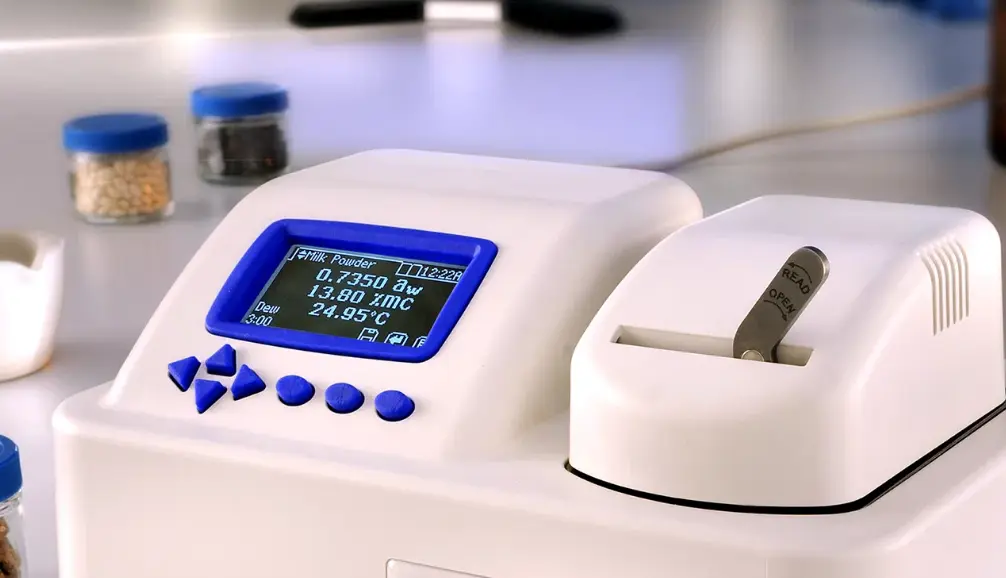
- Water activity control: Can they measure aw in-process and target 0.55-0.65 consistently? Ask for historical aw data from probiotic runs.
- Probiotic handling experience: How many commercial probiotic gummy batches have they produced? Ask for strain-specific experience, not just general gummy experience.
- QC methods: Do they have validated methods for spore vs. vegetative enumeration? Can they differentiate between Bacillus and Lactobacillus methods?
- Cleanroom and GMP: Look for GMP-certified manufacturing, 100,000-class cleanroom, and documented allergen and cross-contamination controls.
- Pilot to scale-up: Can they run pilot batches of 20-50 kg to validate survival before committing to commercial MOQ?
- Packaging capability: High-barrier film, bottle desiccant insertion, and nitrogen flush capability on site.
- Documentation: Strain identity, COA with CFU, allergen statements, and stability support for export markets.
Shenzhen Gothink Biotech Co., Ltd. operates a GMP-certified facility with a 100,000-class cleanroom and 10,000-class R&D laboratory, with approximately 16 tons daily capacity. The R&D team supports custom formulation for spore and microencapsulated probiotic systems across gelatin and pectin platforms, with in-house aw, pH, and microbiological testing to support pilot-to-commercial scale-up.
Common Mistakes That Reduce Survival Rates
- Adding probiotics to the cooker or at >70°C to speed up production.
- Using high-acid pectin without adjusting addition timing or encapsulation level.
- Specifying 10B CFU of Lactobacillus in a 2 g gummy, which forces excessive particle load and texture defects.
- Extending drying to improve texture, which raises oxygen exposure and aw instability.
- Using standard zip pouches without moisture barrier for vegetative strains.
- Counting CFU only at release, without designing overage for end-of-shelf-life compliance.
Checklist: What to Provide to Your Manufacturer
To get an accurate feasibility assessment and quote, provide:
- Target strain(s) and CFU per serving at end of shelf life
- Desired gummy weight, serving size, and gel preference (gelatin, pectin, vegan)
- Target shelf life and storage condition (25°C, 30°C)
- Flavor direction and whether sour sanding is required
- Packaging preference (bottle vs. pouch) and market destination
- Any claim requirements: vegan, non-GMO, allergen-free
- Whether you need Lactobacillus / Bifidobacterium specifically or can accept Bacillus
FAQ
What survival rate should we expect for probiotics in gummy manufacturing?
Survival varies by strain type and process control. Vegetative Lactobacillus without encapsulation can lose significant viability if added above 55°C. Well-encapsulated strains added at 42-50°C and kept at aw below 0.65 retain much higher counts, while spore-forming Bacillus strains show high survival even at 60-65°C addition. Each formula requires its own validation; do not rely on generic survival claims.
Can we use Lactobacillus and Bifidobacterium in gummies without microencapsulation?
Technically possible in very low-heat, short-hold processes, but commercially risky for a 12-month shelf life. Without encapsulation, these strains are sensitive to heat, acid from pectin, and moisture. Most stable commercial products using Lactobacillus or Bifidobacterium use microencapsulation and low-aw formulation.
Is Bacillus coagulans considered a probiotic for label claims?
Bacillus coagulans is widely used as a probiotic ingredient in dietary supplements and is listed in many markets as a probiotic. Regulatory acceptance varies by country. Your Gummy Manufacturer should provide strain identity, documentation, and compliance support, but final label claim approval depends on your target market regulations.
How much overage should we add for probiotic gummies?
Overage is based on stability data, not a fixed rule. Spore gummies typically require lower overage than vegetative encapsulated gummies because spores are dormant. Overage design should account for addition loss, drying loss, and storage loss at your target temperature. Request real-time and accelerated data from your manufacturer to set it.
Does pectin or gelatin work better for probiotics?
Gelatin is gentler due to higher pH and lower cooking temperature. Pectin is vegan but requires acidification to pH 3.2-3.6, which is harsher on vegetative cells. If you need vegan plus Lactobacillus, invest in high-quality microencapsulation and stricter aw control. For vegan plus stability, many brands choose pectin with Bacillus coagulans.
What water activity target should we set?
For probiotic gummies, aim for finished product aw 0.55-0.65. Below 0.60 helps keep vegetative cells dormant. Above 0.70 increases risk of CFU loss and texture issues. Water activity should be measured for each batch and tracked during stability studies.
What documentation should we ask from a Gummy Manufacturer?
Ask for probiotic strain ID and source, COA with CFU enumeration method specified, aw and pH data from pilot batches, stability protocol, allergen and GMO status, GMP certificate, and packaging barrier specifications. For private label gummy export, also request export experience and market-specific documentation support.
Next Step: From Formulation Concept to Production Quote
Choosing between microencapsulation and heat-resistant strains is not just a scientific decision, it is a commercial one that affects cost, label claims, texture, MOQ, and scale-up risk. If your brand requires consumer-familiar Lactobacillus species, plan for encapsulation, tighter process controls, and higher-barrier packaging. If your priority is robust manufacturing and guaranteed CFU at end of shelf life, spore-forming Bacillus offers a more forgiving production window.
For your next project, share your target CFU at end of shelf life, gel preference, and packaging format with your manufacturing partner early. A pilot batch with aw monitoring and CFU testing at 0 and 1 month provides more useful data than any theoretical survival table.
To compare formulation options or request a custom probiotic gummy formulation, contact the technical team with your specifications. Review related process insights in the Knowledge Hub and Manufacturing & Processing Center before finalizing your RFQ.
Jack Luo|Senior Technical Advisor, Nutrition Research Center Representing Gothink Biology, a GMP-certified dietary supplement manufacturer based in Shenzhen, China.