
Direct Answer: What to Expect From Gummy OEM Sample Lead Times and Scale-Up
When evaluating a Gummy OEM partner, sample lead time is one of the first practical indicators of R&D depth, process control, and readiness to scale. For standard formulations, expect 7-12 business days for lab samples, 10-18 days for pilot batches, and an additional 15-25 days for first mass production after sample approval. Custom formulations with high active loading, pectin systems, heat-sensitive ingredients, or complex flavor masking typically add 5-10 days.
Scaling from pilot to mass production in Gummy Manufacturing is not just about making a larger batch. It requires locking formula parameters, validating mixing, depositing, and drying controls, and confirming that texture, water activity, and active content remain consistent at commercial throughput.
Why Sample Lead Time and Scale-Up Matter for Supplement Brands
For brand owners and procurement teams, sample lead time directly affects product launch timelines, marketing schedules, and inventory planning. A short sample promise without process explanation often hides risks that appear later in mass production.
For product developers, the sample stage is where ingredient compatibility, dosage feasibility, and sensory attributes are tested. Decisions made here determine gummy weight, serving size, stability, and cost structure for the next 12-24 months.
How Gummy OEM Sample Lead Times Are Structured
Most professional Gummy OEM manufacturers operate with three sample stages. Each stage has a different purpose, input requirement, and technical checkpoint.
| Sample Stage | Typical Lead Time | What It Validates | Buyer Input Required |
|---|---|---|---|
| Lab Sample / Bench Sample | 7-12 business days | Gel system selection, basic flavor, color, active compatibility | Target actives, dosage per serving, dietary claim (gelatin / pectin / vegan), flavor direction |
| Pilot Batch | 10-18 business days | Texture under depositing, pH and Brix control, drying curve, assay and water activity | Final gummy weight range, packaging type, shelf-life target, market |
| Pre-Production / First Mass Batch | 15-25 days after sample approval | Batch consistency, line speed stability, QC release, packaging compatibility | Confirmed artwork, MOQ, PO, regulatory documentation needs |
What Extends Sample Lead Time
Not all delays are due to workload. Technical factors add real time because they require iterative testing.
- High-dose or multi-active loading: Minerals such as calcium, magnesium, iron or zinc increase gummy mass, affect pH, and create metallic off-notes. Above 300-400 mg total actives per 3g gummy, texture becomes softer and depositing becomes less precise.
- Pectin vs. gelatin systems: Gelatin sets by cooling and is more forgiving on flavor. Pectin requires tight pH control (typically 3.2-3.6) and high solids (Brix 78-82). Acidic vitamins, fruit extracts, or citric acid for sour sanding can break pectin gel if not buffered correctly.
- Heat-sensitive actives: Probiotics, some botanical extracts, and certain vitamins degrade above 85-90°C. Manufacturers must cook the syrup base first, cool to a controlled addition window, then add actives. This extra step requires validation of content uniformity.
- Hygroscopic ingredients: Ingredients like L-carnitine, creatine, or some plant powders pull moisture. Without moisture control and proper drying, water activity (Aw) rises above 0.70, increasing microbiological risk.
- Flavor masking and color stability: Botanical extracts and minerals often need flavor masking systems and pH-stable colors. Each iteration requires sensory evaluation after 24-48 hours of conditioning.
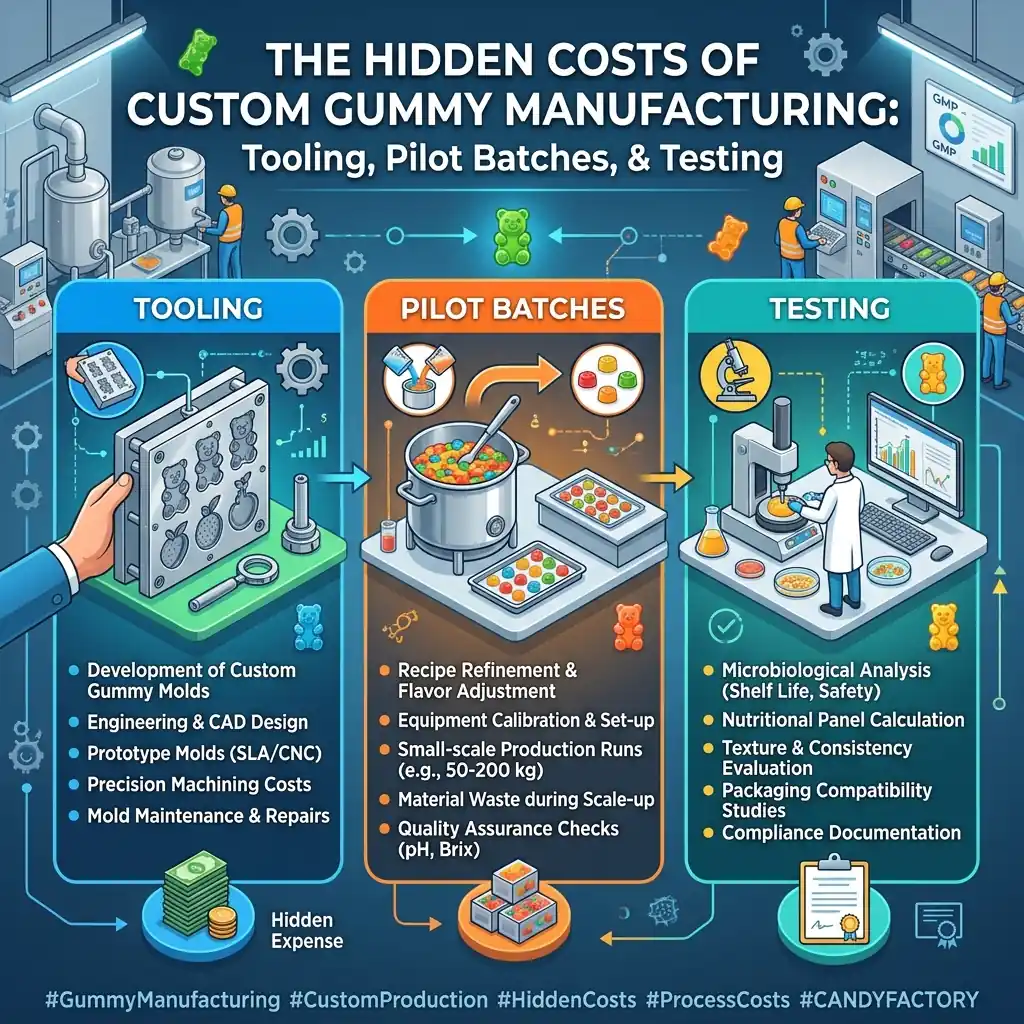
Pilot Batch: The Bridge Between Lab and Production
A lab sample proves a formula can be made. A pilot batch proves it can be made repeatedly on equipment that mimics commercial conditions. This is where many Gummy OEM projects succeed or fail.
During pilot, the manufacturer validates three critical transitions:
- Batch preparation to depositing: At lab scale, mixing is manual and small. At pilot scale, cooking temperature, vacuum, and holding time affect final moisture and gel strength. If syrup is too hot, heat-sensitive actives lose potency. If too cool, viscosity increases and depositor nozzles block or create weight variation.
- Deposition to setting: Gelatin needs cooling at 15-20°C; pectin needs initial cooling then controlled drying. Pilot measures whether gummies release cleanly from molds, whether starchless or starch-based molding is suitable, and whether gummy weight stays within ±5% target.
- Setting to drying/conditioning: Drying reduces moisture and water activity to target (often Aw 0.60-0.70 for gelatin, lower for pectin). Too aggressive drying creates hard skin and sticky centers. Too little drying creates soft texture and short shelf life.
Buyers should request pilot data: Brix, pH before and after depositing, average gummy weight with standard deviation, water activity after drying, and assay for one or two marker actives.
Scaling From Pilot to Mass Production: Where Gummy Manufacturing Decisions Matter
Mass production introduces volume, line speed, and environmental variability. What worked for 10 kg may shift for 500 kg unless process windows are defined.
| Parameter | Pilot Scale | Mass Production | Why It Matters |
|---|---|---|---|
| Mixing and Homogenization | 50-100 kg kettle, manual control | 300-1000 kg vacuum cooker, automated temperature and solids control | Ensures active uniformity and prevents hot spots that degrade heat-sensitive ingredients |
| Active Addition Point | Tested at single temperature | Controlled window (e.g., 75-80°C) with in-line verification | Protects potency and prevents pre-gelation in pectin systems |
| Depositing Accuracy | ±5-7% weight variation acceptable for evaluation | ±3% target for cost and dosage control | Impacts serving count, label claim compliance, and material cost |
| Cooling and Drying | Batch cooling and tray drying | Tunnel cooling, conditioned drying room with RH and temperature control | Controls texture, water activity, and microbiological stability |
| Coating / Sanding | Manual or small drum | Automated coating with oil/wax or sour sugar dosing | Affects stickiness, appearance, and shelf-life stability |
Key Technical Checkpoints During Scale-Up
- Formulation lock: Confirm gel type, solids content, acid system, sweetener system, and active overage. Overages compensate for processing loss but must be justified by stability data, not added arbitrarily.
- pH and water activity targets: pH drives pectin gel strength and flavor. Water activity drives microbiological safety and texture over time. Both must be specified as release criteria, not just observed values.
- Texture profile: Measure not only by hand-feel but by gel strength and chewiness after 48 hours. Pectin gummies firm up during curing; gelatin gummies stabilize after drying.
- Flavor and color drift: Natural colors can fade under light and low pH. Evaluate color after drying and after 7 days in final packaging.
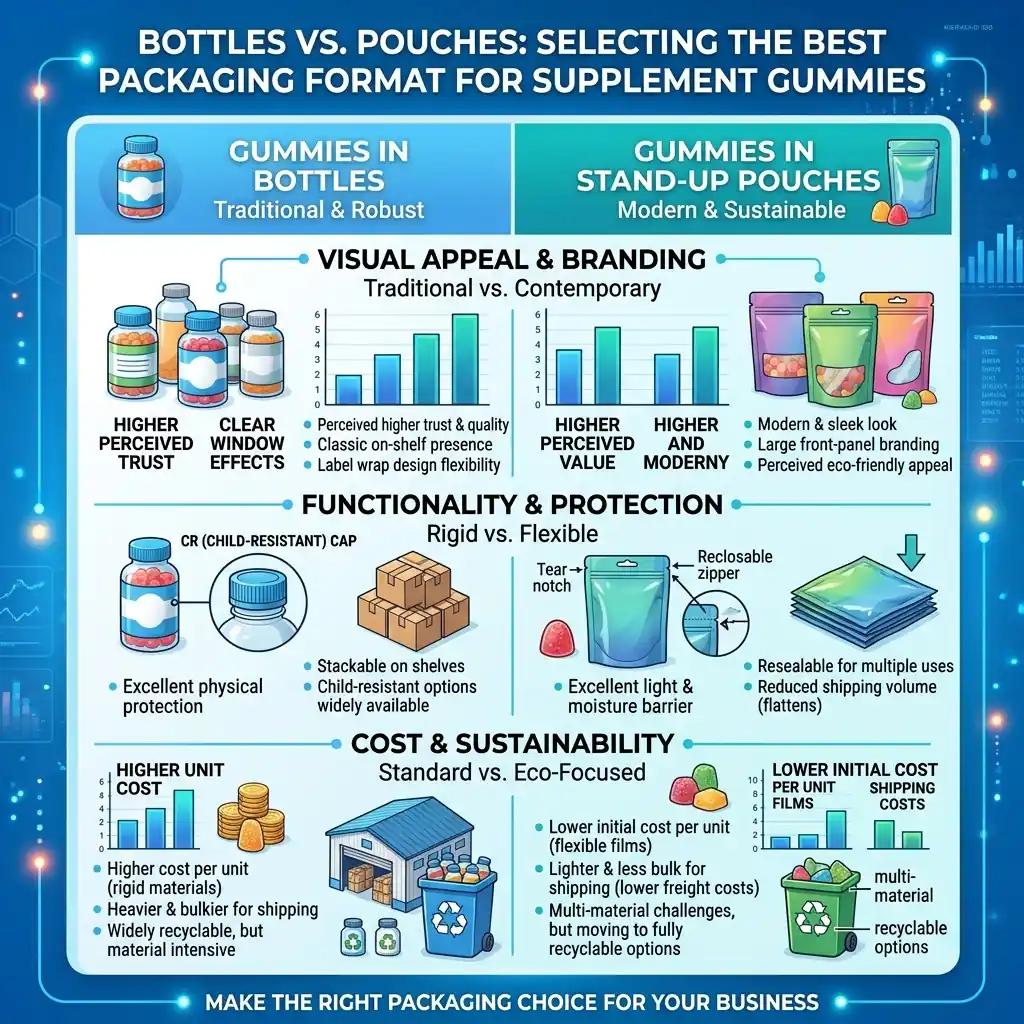
- Packaging compatibility: High-moisture gummies in bottles without inner seals or desiccants gain stickiness. Evaluate bottle vs. pouch vs. sachet for moisture vapor transmission rate.
Common Scale-Up Risks to Evaluate Before Committing
Understanding risks helps procurement teams ask better questions rather than accepting generic assurances.
- Dosage creep: To fit 500 mg of actives into a 3 g gummy, some manufacturers increase gummy weight to 3.5-4.0 g. This changes cost, packaging count, and consumer experience. Ask whether dosage can be met at target weight.
- Texture inconsistency: If pilot gummies are soft in center or sweating after 1 week, mass production will likely worsen due to higher residual moisture and heat history.
- Sticking and clumping: Often caused by insufficient drying or incompatible coating. In commercial packing, this slows counting lines and increases rejects.
- Assay loss: Vitamins A, C, D, and certain B vitamins show 5-15% loss during cooking if added too early. Request assay data before and after depositing.
- Microbiological failure: High Aw combined with warm packing environment creates yeast and mold risk. Verify that total plate count, yeast and mold, and water activity are part of release testing.
Quality Control and Testing During Scale-Up
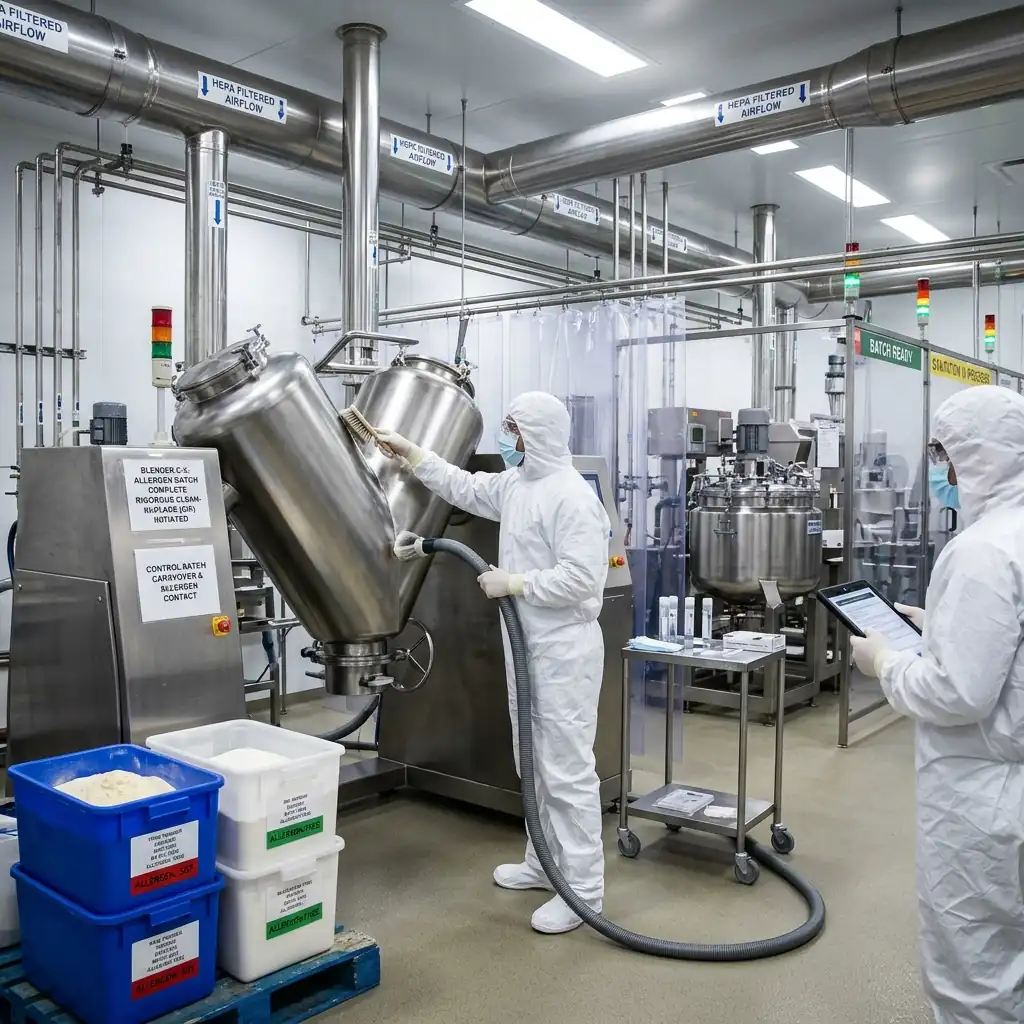
A capable Gummy OEM manufacturer should explain QC not as a final lab test but as in-process controls.
- Raw material testing: Identity, potency, and heavy metals for actives; bloom strength for gelatin, grade for pectin.
- In-process controls: Brix, pH, depositing weight, cooling temperature, drying time and relative humidity, water activity.
- Finished-product testing: Active assay, water activity, texture evaluation, microbial testing, and appearance inspection. For export, allergen and label compliance review.
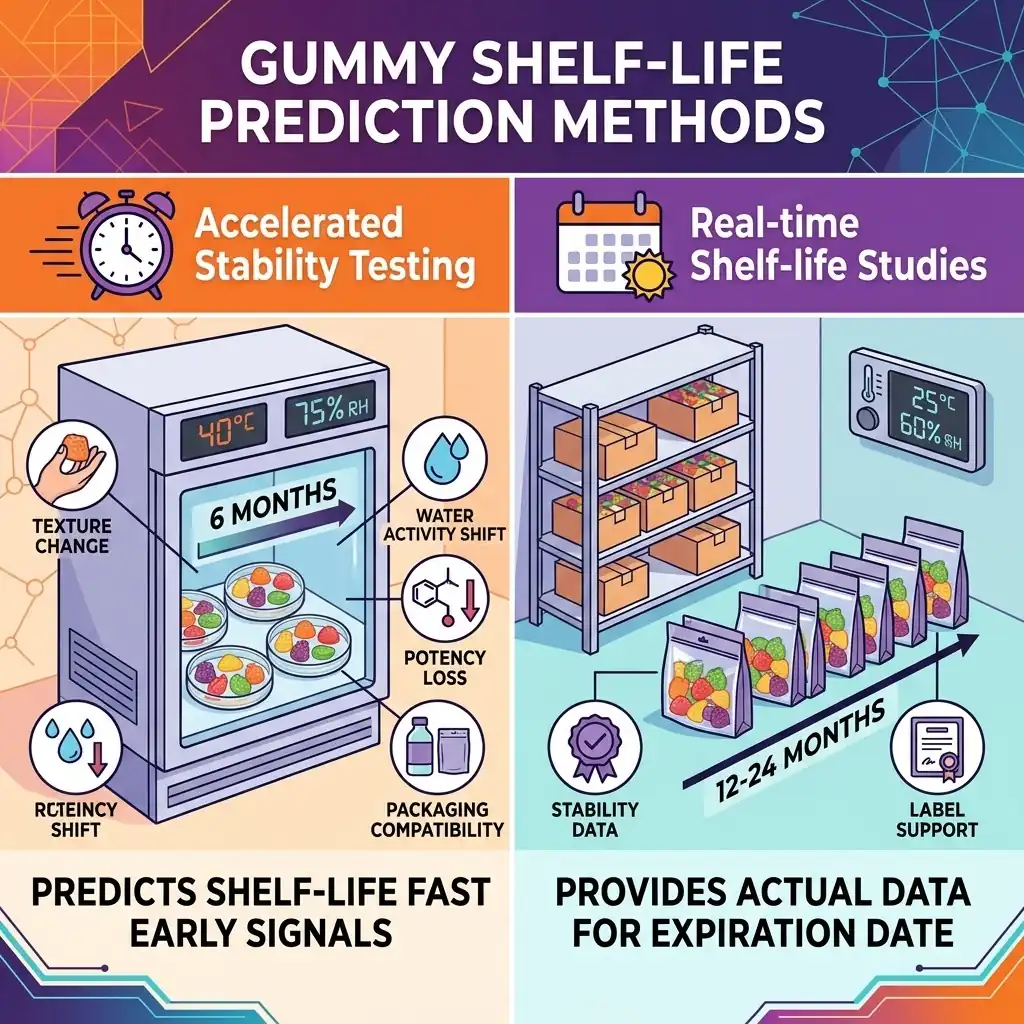
- Stability indication: Even if full shelf-life validation is ongoing, initial 1-month and 3-month accelerated data helps evaluate texture, color, and assay retention.
For traceability, batch records should link raw material lots to finished batch, including cooking lot and packing lot. This is essential for BRC, FSSC 22000, and FDA systems.
Cost, MOQ and Production Lead Time at Commercial Scale
Sample approval does not automatically mean commercial readiness. Cost and MOQ are driven by:
- Gummy weight and active cost: Heavier gummies increase raw material and packaging cost per unit. High-cost actives such as CoQ10, PQQ, or patented botanicals dominate unit cost more than gel system.
- Mold and shape: Standard bear or dome shapes are low-cost. Custom shapes require new depositing molds and longer changeover time.
- Packaging format: Bottles require counting, induction sealing, and labeling. Pouches require flow wrap or stand-up pouch equipment. Coating or sour sanding adds a separate unit operation.
- Testing requirements: Potency testing for multiple actives, plus microbial and stability testing, affects lead time. If third-party testing is required, add 5-7 days.
- MOQ economics: Most Gummy Manufacturing lines have minimum batch sizes of 150-300 kg due to cooker capacity and line cleaning. Below that, unit cost rises sharply. MOQ is not only commercial; it ensures consistent processing conditions.
Mass production lead time after pilot approval is typically 15-25 days for standard orders, plus shipping. New flavors, new molds, or additional documentation for regulatory markets can extend this by one week.
How to Evaluate a Gummy OEM Manufacturer for Sample-to-Scale Capability
Use verifiable criteria rather than marketing statements.
- GMP and quality systems: GMP certification, HACCP, ISO22000, FSSC 22000, BRC. Ask for scope and most recent audit date, not just certificate logos.
- R&D and pilot capability: Separate R&D lab (e.g., 10,000-class lab) with small cookers and depositors that replicate commercial conditions. Ask how many formulation chemists work on gummy projects.
- Production capacity and equipment: Daily capacity (for example, 16 tons per day), number of depositing lines, starchless capability, cooling tunnel and drying rooms with environmental control.
- Scale-up experience: Request examples of scale-up challenges solved (without disclosing customer names), such as mineral gummies, high-acid pectin, or vegan pectin with natural colors.
- Testing and documentation: In-house testing for Aw, Brix, pH, texture, and microbial, plus access to accredited labs for heavy metals and assay. Ability to provide COA, allergen statement, manufacturing flow chart, and nutrition fact support.
- Ingredient sourcing and overage policy: How active overages are determined, how heat-sensitive addition is controlled, and how botanical extract standardization is verified.
- Packaging and export experience: Bottle, pouch, and bulk packaging lines, metal detection, and export documentation experience for target markets.
Shenzhen Gothink Biotech Co., Ltd. operates a GMP-certified facility with a 100,000-class cleanroom and a 10,000-class R&D laboratory, with approximately 16 tons of daily production capacity and approximately 5,000 tons of annual capacity. The site holds certifications including ISO9001, ISO22000, HACCP, FDA, HALAL, GMP, KOSHER, BRC, FSSC 22000, and Vegan, supporting OEM, ODM, CMO, and CDMO projects across gummy and other supplement formats. These infrastructure elements are directly relevant when evaluating sample-to-scale transitions.
Practical Checklist: What Buyers Should Provide and Ask
Provide to Your Gummy OEM
- Target actives and dosage per serving, plus serving size preference (e.g., 2 gummies per day)
- Gel system preference and dietary claims: gelatin, pectin, vegan, allergen-free, sugar-free
- Flavor, sweetness, sour, and color direction, plus any flavor to avoid
- Target gummy weight, shape, and packaging format
- Shelf-life target and storage condition (e.g., 24 months at 25°C/60% RH)
- Target market and any documentation needed (COA template, allergen, nutrition)
Ask Your Gummy OEM
- What is the expected sample lead time for lab and pilot for this formula, and what could extend it?
- At what temperature are my actives added, and what overage is applied and why?
- What are your in-process controls for Brix, pH, and water activity, and what are the release limits?
- How do you handle pH adjustment for pectin systems with acidic actives?
- What weight variation and assay uniformity do you achieve at mass production speed?
- What drying method and water activity target will be used, and how does it affect texture over time?
- What is the MOQ for this formula and how does unit cost change at 2x and 3x MOQ?
FAQ
What is a normal lead time for Gummy OEM samples?
For standard gelatin or pectin formulas with common vitamins, lab samples take 7-12 business days. Complex formulas with minerals, high-dose actives, vegan pectin, or custom flavor masking typically take 12-18 days for lab samples and 10-18 days for pilot batches. Mass production starts 15-25 days after final sample approval.
Why do pectin gummy samples take longer than gelatin?
Pectin gelation depends on precise pH and solids control and requires a curing/drying phase to develop texture. Acidic ingredients can pre-gel or break the gel if not buffered. Each pH adjustment requires re-testing of gel strength, texture, and water activity, which adds iterative cycles.
What causes differences in texture between pilot and mass production?
Differences usually come from variations in cooking temperature, holding time, depositing weight, cooling rate, and drying conditions. At higher throughput, moisture removal is less uniform unless relative humidity and temperature in drying rooms are tightly controlled. Water activity and Brix should be compared between pilot and mass batches.
How do high-dose actives affect sample and scaling?
High-dose actives increase gummy weight, affect pH, and interfere with gel structure. Minerals can create salty or metallic notes requiring flavor masking and can soften texture. At scale, this leads to weight variation and sticking. Manufacturers may need to increase gummy size, split actives across two gummies per serving, or adjust sweetener and acid systems.
What documentation should I request with a pilot batch?
Request batch-specific data: formula with percentages, Brix, pH before and after depositing, average gummy weight with standard deviation, water activity after drying, active assay for key ingredients, microbial results if available, and photos of gummies after 48 hours conditioning. This helps evaluate readiness for mass production.
How can I shorten sample lead time without risking quality?
Provide complete specifications upfront: dosage, gel system, flavor direction, gummy weight, packaging, and shelf-life target. Avoid mid-process changes to actives or claims. Choose standard molds and sweetener systems for first samples, then optimize. Confirm whether your manufacturer has relevant base formulas in pectin or gelatin that can be adapted.
What MOQ should I expect after pilot approval?
MOQ is driven by cooker capacity and line efficiency, not just packaging. Many Gummy Manufacturing lines start at 150-300 kg per SKU, which translates to roughly 50,000-100,000 gummies depending on weight. Smaller MOQs are possible but increase unit cost due to cleaning, setup, and QC allocation. Ask for price breaks at 1x, 2x, and 3x MOQ.
Next Step: Turning Approved Samples Into Stable Mass Production
Evaluating Gummy OEM sample lead times is less about speed and more about whether the manufacturer can explain why a sample takes the time it does and how that data will control mass production. A clear pilot report, defined in-process limits for Brix, pH, and water activity, and a documented active addition window are stronger indicators of scale-up capability than a fast lab sample alone.
If you are comparing Gummy OEM partners, review their gummy manufacturing process and scale-up controls, compare formulation options for gelatin and pectin systems, and request a pilot plan that includes assay and water activity targets. When you are ready, share your target dosage, gummy weight, and packaging format to request a custom formulation and OEM quotation.
Jack Luo|Senior Technical Advisor, Nutrition Research Center Representing Gothink Biology, a GMP-certified dietary supplement manufacturer based in Shenzhen, China.
Learn more in our Knowledge Hub and see our Sourcing & MOQ Guide for detailed cost and scale-up planning.