
Direct Answer: Which Line Wins for High-Volume OEM?
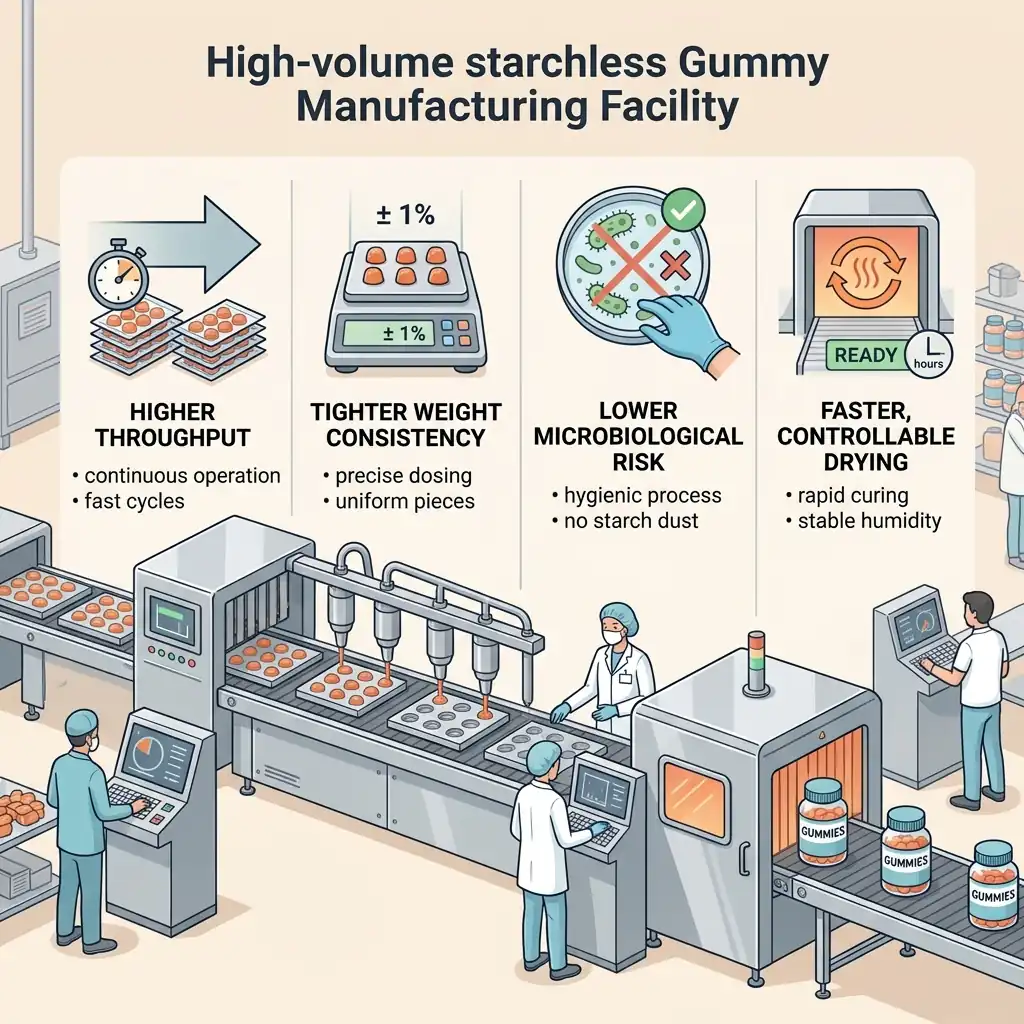
For high-volume OEM orders, starchless molding is the better platform for most supplement gummy programs. It delivers higher throughput, tighter weight consistency, lower microbiological risk, and faster, more controllable drying, which translates into lower unit cost and more predictable lead time once tooling is approved.
Starch mogul molding still has a role for very small batches, highly custom confectionery shapes, or when a buyer wants to avoid silicone mold investment. For a Gummy Manufacturer running daily tonnage, however, the closed starchless system is the standard for scalable Gummy Manufacturing.
Why Molding Technology Matters for OEM Buyers
Buyers often focus on formula and flavor first, but the molding platform determines what formulas are actually feasible at scale. The choice affects gummy weight tolerance, water activity, texture stability, active ingredient retention, cleaning validation, and allergen control.
For a Gummy OEM project over 500 kg per batch or multiple batches per month, small process variations compound. A 3% weight variation on a mogul line can shift active content per piece and force wider label overages. Longer curing in starch adds 24 to 48 hours to the cycle and increases exposure to moisture pickup and cross-contamination.
How Each System Works
Starch Mogul Molding: Traditional Confectionery Approach
Definition: Starch mogul creates molds by stamping shapes into trays of conditioned starch. The gummy mass is deposited into those starch cavities.
- Batch preparation and cooking: Gelatin or pectin, sugars, and water are cooked to target Brix, then cooled slightly before acids, flavors, and actives are added.
- Starch conditioning: Molding starch is dried to 5-8% moisture, sifted, and leveled in trays. Starch temperature and moisture affect cavity definition.
- Depositing: Mass is deposited into starch impressions at 70-90°C depending on gel system.
- Curing: Trays sit in a curing room at 20-25°C and 30-40% RH for 24-48 hours. Starch draws moisture and supports shape setting.
- De-starching and finishing: Gummies are separated from starch via air and brushing, then oiled or sanded, and dried further if needed.
The logic behind starch is historical. Starch acts as a flexible, low-cost mold that allows almost any shape without hard tooling. The downside is an open, powder-handling process that is harder to control under supplement GMP.
Starchless Molding: Closed, High-Speed Supplement Line
Definition: Starchless uses reusable silicone or metal molds on a continuous line with depositing, cooling tunnel, and automated demolding.
- Cooking and active addition: Mass is cooked in a closed cooker with vacuum control, then actives are added downstream at lower temperature to reduce heat exposure.
- Depositing into solid molds: A servo-driven depositor fills silicone cavities with ±1-2% weight accuracy. Mold release is controlled without starch.
- Cooling and setting: Gummies pass through a cooling tunnel at 2-8°C for 15-30 minutes. Gel structure sets quickly and uniformly.
- Demolding and conditioning: Gummies are demolded by air or mechanical ejection, then conditioned in a drying room to target water activity, typically Aw 0.65-0.75 for supplement gummies.
- Coating and inspection: Oil, wax, or sanding is applied inline, followed by metal detection and vision inspection.
The engineering logic is control. No starch means no powder circulation, faster cycle time, and direct control of temperature, moisture, and water activity at each stage.
What a Gummy Manufacturer Considers When Choosing a Molding Line
When evaluating lines for high-volume OEM, a Gummy Manufacturer looks at seven factors that directly affect cost and quality.
- Throughput and labor: Starchless lines run 10,000-40,000+ pieces per hour per line with 2-4 operators. Mogul throughput is limited by tray handling, curing room space, and manual de-starching.
- Weight and dosage consistency: Starchless gives tighter piece-to-piece weight control, which is critical when active loading is high. Mogul cavities change slightly as starch moisture shifts.
- Water activity and drying control: Starchless conditioning allows precise Aw control. Starch can add variability because starch moisture transfers back into the gummy during curing.
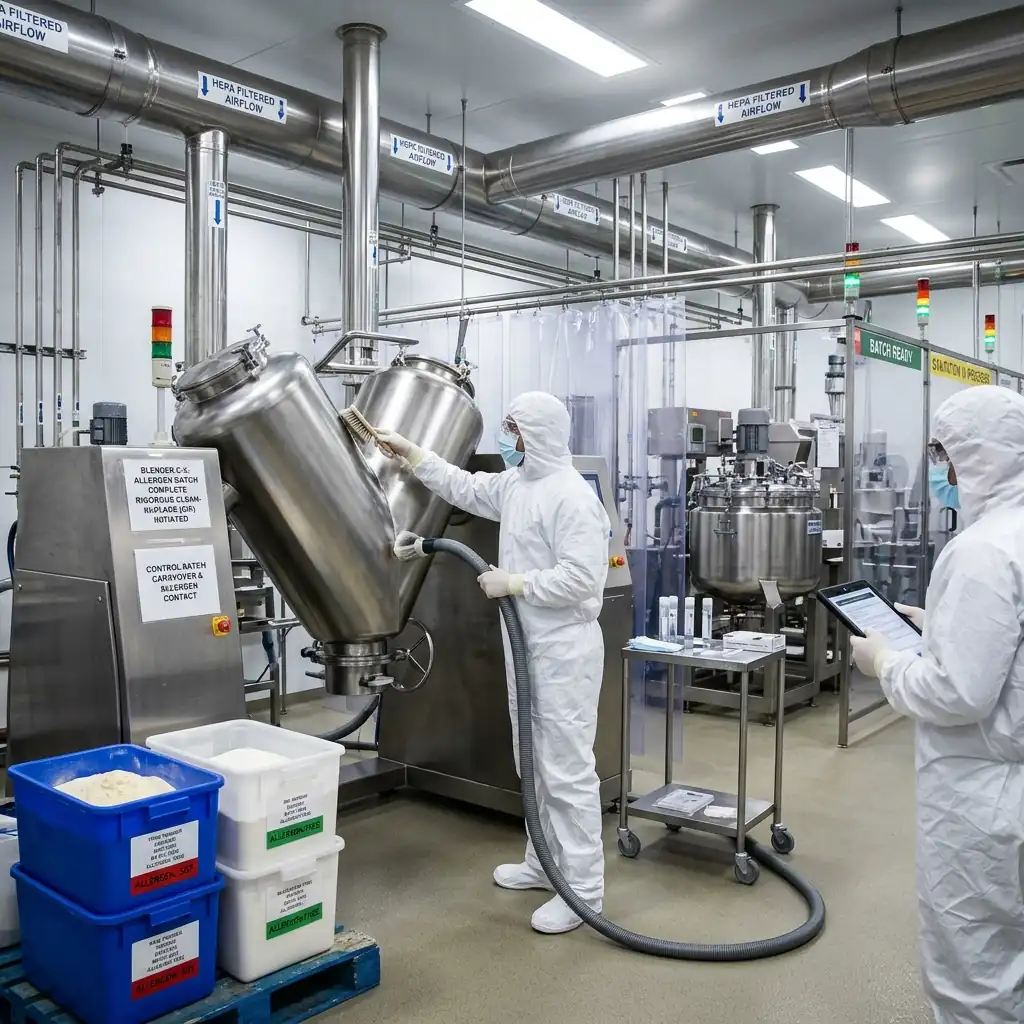
- Hygiene and microbiological risk: Starch is an organic powder that must be dried, sifted, and monitored for total plate count and yeast/mold. A closed starchless line simplifies environmental monitoring and allergen cleaning validation.
- Texture and gel performance: Pectin requires fast, low-temperature setting to avoid pre-gelation. Starchless cooling tunnels achieve this. Gelatin works on both platforms, but starchless gives better clarity and chew uniformity.
- Mold flexibility vs. cost: Mogul can stamp a new shape in starch in hours. Starchless requires silicone mold fabrication, typically 3-4 weeks and higher upfront cost, but amortizes quickly over high volumes.
- Changeover and cross-contamination: Starchless molds are washed and validated. Starch mogul requires starch reconditioning and more extensive air handling to prevent carryover of allergens, colors, and flavors.
| Factor | Starch Mogul Line | Starchless Line |
|---|---|---|
| Mold Material | Conditioned food starch | Reusable silicone or metal molds |
| Cycle Time | 24-48 hours curing in starch plus de-starching | 15-30 minutes cooling plus 12-24 hours conditioning |
| Weight Tolerance | Typically ±3-5% | Typically ±1-2% with servo depositing |
| Water Activity Control | Indirect, affected by starch moisture | Direct control in conditioning rooms, easier to reach Aw <0.75 |
| GMP and Allergen Control | Open powder handling, more complex air and cleaning control | Closed system, easier cleaning validation and line clearance |
| Tooling Investment | Low upfront, stamps and trays | Higher upfront for silicone molds, low per-piece cost at scale |
| Best Fit for High-Volume Gummy OEM | Pilot, seasonal shapes, <200 kg runs | Core SKUs, 500 kg+ per batch, multi-batch monthly programs |
Formulation Implications for Gummy Manufacturing
Gel System Behavior
Gelatin sets by thermal gelation and benefits from cold setting. Pectin, especially high-methoxyl pectin used for vegan gummies, sets by sugar-acid interaction and needs precise pH and rapid cooling to avoid graininess. Starchless lines control that cooling curve better than a static curing room.
Texture target also matters. For a firm, low-sugar pectin bite, depositing temperature must stay below 90°C and cooling must be fast. For soft gelatin, starch curing can help remove extra moisture but creates inconsistent chew if trays cure unevenly.
pH, Acid and Active Loading
Supplement gummies often contain acids for flavor, plus actives that affect pH. Pectin is sensitive to pH 3.2-3.8. If citric acid is added too early or at high temperature, pectin can pre-gel and block depositors. Manufacturers add acid and heat-sensitive actives downstream in a holding tank at 60-75°C.
High-dose actives increase gummy mass and size. For example, magnesium citrate or calcium at 50-100 mg per piece pushes piece weight to 3.0-4.5 g to keep texture acceptable. Mineral salts also raise ionic strength, which can weaken gelatin and create salty or bitter notes. In a starchless system, tighter weight control lets you manage serving size and daily dose without widening texture variation.
Heat-Sensitive and Hygroscopic Ingredients
Vitamins like vitamin C, vitamin B complex, botanical extracts with volatile flavor compounds, and probiotics are sensitive to prolonged heat. Starch mogul curing at 20-25°C for 24-48 hours does not expose actives to high heat, but the extended time at moderate Aw can accelerate degradation of moisture-sensitive ingredients.
Starchless reduces hot holding time and moves quickly to low-temperature setting. For hygroscopic ingredients such as ashwagandha extract, apple cider vinegar powder, or magnesium salts, rapid Aw reduction and oil or wax coating are critical to prevent surface moisture and sticking in packaging. That control is more consistent without starch dust interfering with coating adhesion.
For private label gummy products that include probiotics, most commercial manufacturers avoid traditional gummy cooking entirely and require specialized low-heat depositing and low-Aw conditioning. Starchless lines are more readily adapted for these constraints than mogul.
Quality Control and Batch Consistency at Scale
High-volume OEM requires repeatability across shifts and months. Key control points differ by platform.
- Mixing and homogenization: Actives must be uniformly dispersed before depositing. In starchless, in-line homogenization and mass flow meters help maintain content uniformity.
- Depositing verification: Starchless lines use check-weighers and vision systems to reject under- or over-weight pieces. Mogul lines rely more on tray sampling.
- Cooling and conditioning logs: Temperature and RH mapping of cooling tunnels and conditioning rooms must be continuous. Starchless gives tighter logs because the product is not buried in starch.
- Water activity and moisture: Target Aw is typically 0.65-0.75 to limit microbial growth and texture change. Starchless reaches target faster and holds it during coating.
- Microbiological testing: Starch mogul requires additional testing of molding starch for yeast, mold, and total plate count. Starchless reduces that vector but still requires finished-product testing per batch.
- Metal detection and visual inspection: Both platforms use these, but silicone mold wear in starchless must be monitored to prevent foreign material.
Cost Structure, MOQ and Lead Time for Gummy OEM Projects
Cost drivers include formulation complexity, active ingredient cost, gummy weight, mold creation, packaging format, testing, and volume. Molding platform affects three of those directly.
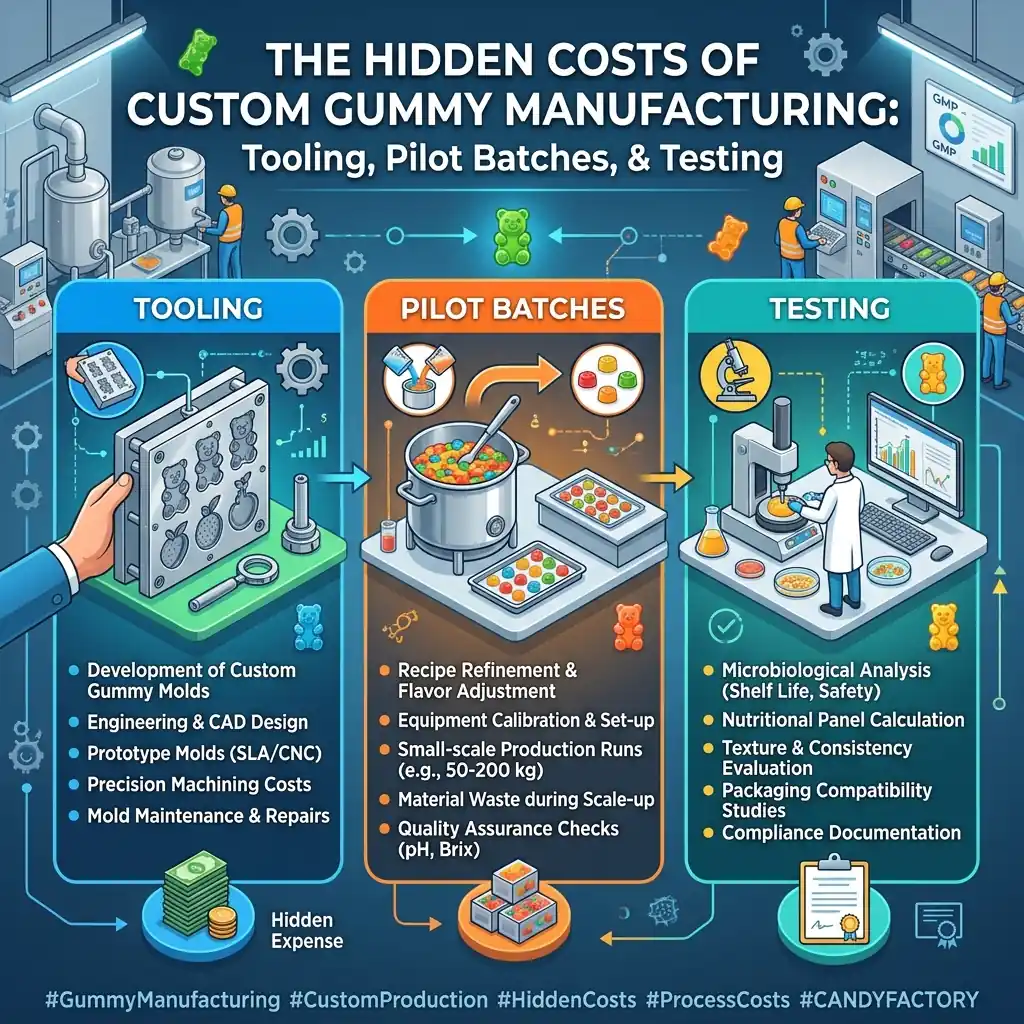
- Tooling: Starchless silicone molds cost more upfront than starch stamps. For a standard bear or dome shape, many Gummy Manufacturers already hold tooling, which eliminates cost. For a fully custom shape, expect 3-4 weeks for mold fabrication.
- Unit cost at scale: Once molds exist, starchless unit cost drops faster because labor per kg is lower, drying time is shorter, and rework from starch carryover is minimal. At 1 ton+ per SKU, starchless typically shows 10-20% lower conversion cost than mogul.
- MOQ: Mogul MOQ can be lower for shape tests, often 100-200 kg, because no hard mold is needed. Starchless MOQ is driven by cooker size and conditioning room efficiency, often 300-500 kg per SKU for cost-effective runs. For a Gummy OEM program with stable monthly demand, that MOQ difference is minor.
- Lead time: Starchless shortens manufacturing lead time to 15-25 days after formula lock for repeat orders, versus 25-35 days for mogul when curing room capacity is constrained. Mold creation adds time only on first order.
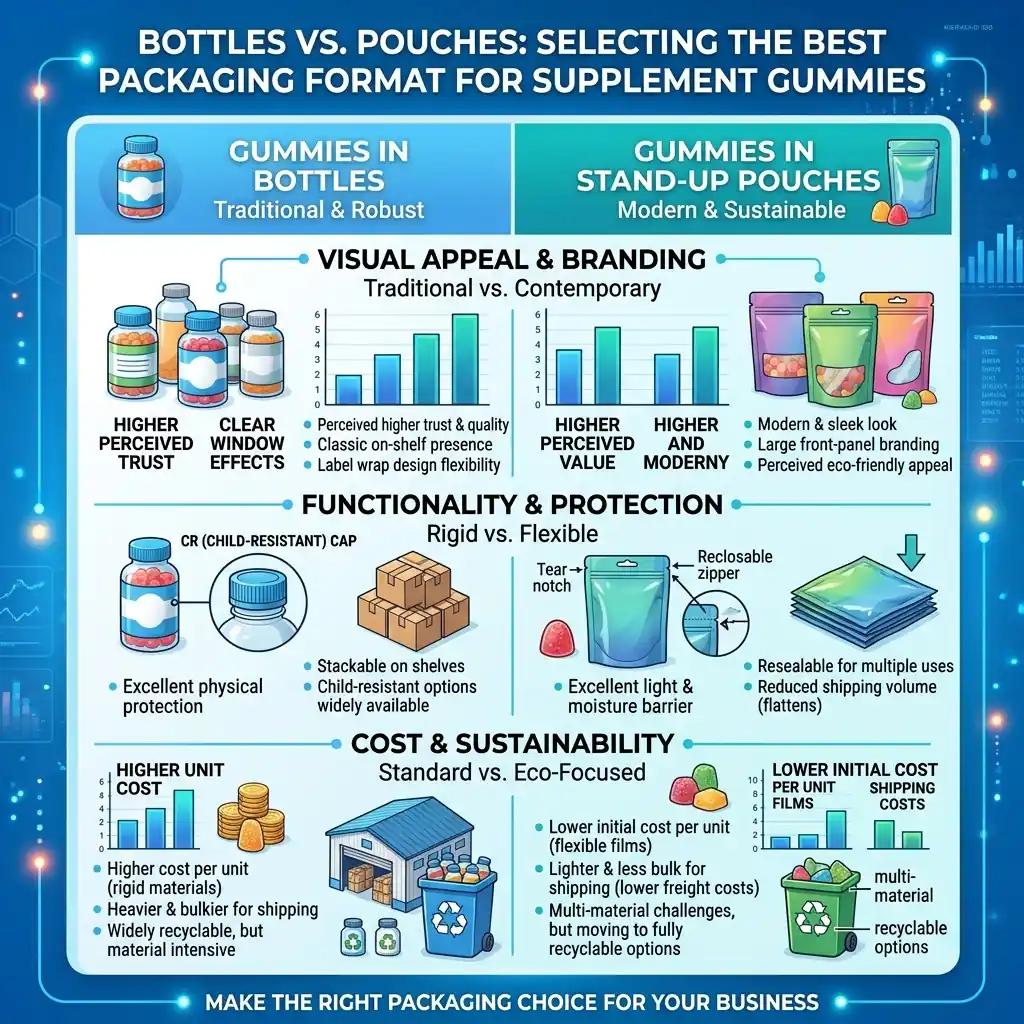
- Packaging compatibility: Lower and more uniform Aw from starchless reduces risk of gummies sticking in bottles or pouches during summer shipping. This affects packaging choice and need for desiccants.
Private Label Gummy Considerations: When Starch Mogul Still Makes Sense
Starch mogul is not obsolete. It makes sense when:
- You need a highly custom confectionery shape for a seasonal promotion and cannot justify silicone tooling.
- Initial test volume is below 150 kg and you want to validate market response before scaling.
- Your formula is a classic high-sugar gelatin candy-style gummy without sensitive actives or strict Aw targets.
For a private label gummy supplement with vitamins, minerals, or botanicals and a plan to scale beyond pilot, starting on starchless avoids reformulation and re-validation when moving from pilot to commercial. Texture and Aw profiles change between platforms, so switching later often requires formula adjustment.
How to Evaluate a Gummy Manufacturer for High-Volume Molding Capability
When sourcing high-volume OEM, ask for verifiable capabilities rather than general claims.
- GMP and quality systems: GMP certification, ISO22000, HACCP, BRC or FSSC 22000. Ask how environmental monitoring is handled for starch vs. starchless areas.
- Production capacity: Daily tonnage, number of starchless depositing lines, cooling tunnel capacity, and conditioning room area. Shenzhen Gothink Biotech Co., Ltd. operates a GMP-certified facility with a 100,000-class cleanroom, 10,000-class R&D lab, and approximately 16 tons of daily capacity, which illustrates the scale needed for high-volume programs.
- R&D to commercial scale-up: Pilot lab capability, process parameter logs, and ability to match pilot texture on commercial starchless lines.
- Formulation experience: History with your gel system, active loading level, and pH range. Ask how they handle acid addition timing and heat-sensitive actives.
- Testing and QC: In-process weight checks, Aw meters, metal detection, content uniformity testing for fortified actives, and microbiological release criteria.
- Ingredient sourcing and documentation: CoA for each raw material, traceability of actives, allergen statements, and vegan or Halal documentation when needed.
- Packaging and shelf-life validation: Experience with bottle, pouch, and blister formats, and data on Aw and texture over accelerated stability.
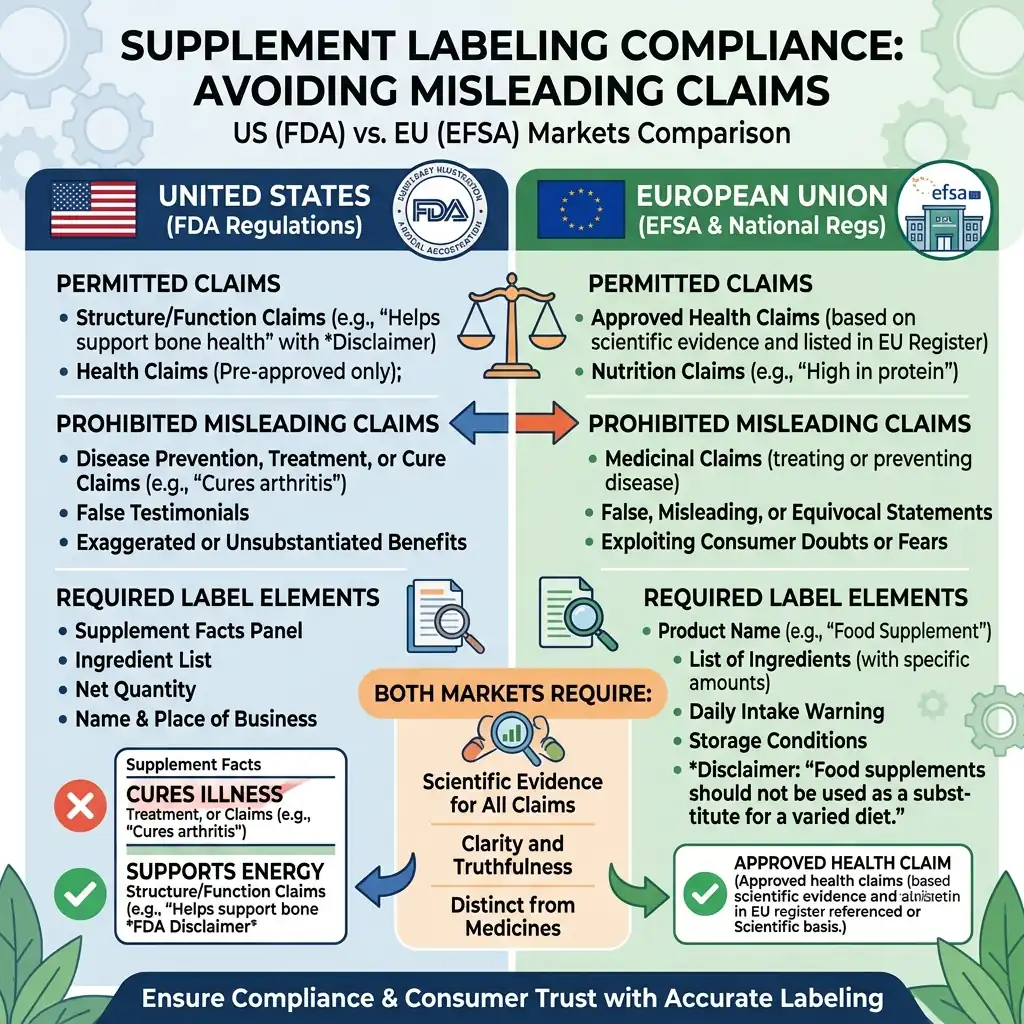
- Export experience and documentation: Support for label review, nutrition facts, and market-specific compliance files.
Common Mistakes Buyers Make When Selecting a Molding Platform
- Choosing mogul to save on molds, then scaling: The cost saved on first molds is lost to reformulation when moving to starchless for volume.
- Ignoring water activity impact on actives: Buyers specify flavor and color but miss Aw target. High Aw shortens shelf life for vitamin C and botanical extracts.
- Under-specifying weight tolerance: Not defining piece weight range leads to dosage variation and label compliance issues, especially with high mineral loading.
- Requesting low pH fruit flavors with high-methoxyl pectin without process control: This creates pre-gelation and depositing blockages that a mogul curing room cannot fix.
- Not providing full formula constraints: Failing to disclose hygroscopicity, pH, or heat sensitivity prevents the manufacturer from recommending the correct line.
Practical Decision Checklist Before You Request a Quotation
Provide this to your manufacturer to get an accurate technical and commercial assessment.
- Gel system preference: gelatin or pectin, and any vegan, Halal, or Kosher requirement
- Target actives and dosage per gummy and per serving, including overages if any
- Gummy weight target and shape, and whether shape is brand-critical
- pH range, acid type, and flavor profile
- Heat sensitivity and hygroscopicity of key ingredients
- Target water activity and texture description
- Annual volume and batch size forecast
- Packaging format and shelf-life expectation
- Required certifications and documentation for destination markets
- Whether you need custom mold development or can use existing molds
Commercial Next Step
If your project forecast exceeds 300 kg per SKU per month or requires tight dosage control and low water activity, start the technical review on a starchless platform. Share your actives, target dose, gel preference, and shape concept. A qualified manufacturer can recommend gel system, depositing temperature, conditioning parameters, and mold strategy before pilot.
For existing products currently on starch mogul, ask for a line-transfer assessment covering texture matching, Aw equivalence, and stability. That assessment should include pilot samples from starchless with full QC data.
To compare formulation options or discuss OEM/ODM feasibility, contact the manufacturer with your specification sheet and request a custom formulation and quotation.
Explore more: Knowledge Hub and Manufacturing & Processing
FAQ
1. Is starchless always more expensive than starch mogul for Gummy OEM?
No. Tooling is higher initially for starchless, but unit conversion cost is lower at high volume due to faster cycles, less labor, and lower rework. Over multiple tons, starchless usually has a lower total cost per piece.
2. Can I get the same custom shape on starchless as on mogul?
Most shapes are possible, but starchless requires a silicone mold. Very intricate undercuts or extremely fine details may need simplification. If shape is secondary to dosage accuracy and stability, starchless is preferred.
3. Which line is better for pectin-based vegan gummies?
Starchless. Pectin sets quickly and needs controlled cooling and precise acid addition. Starchless cooling tunnels and closed depositing give more consistent gel formation and reduce graininess.
4. How does molding choice affect shelf-life validation?
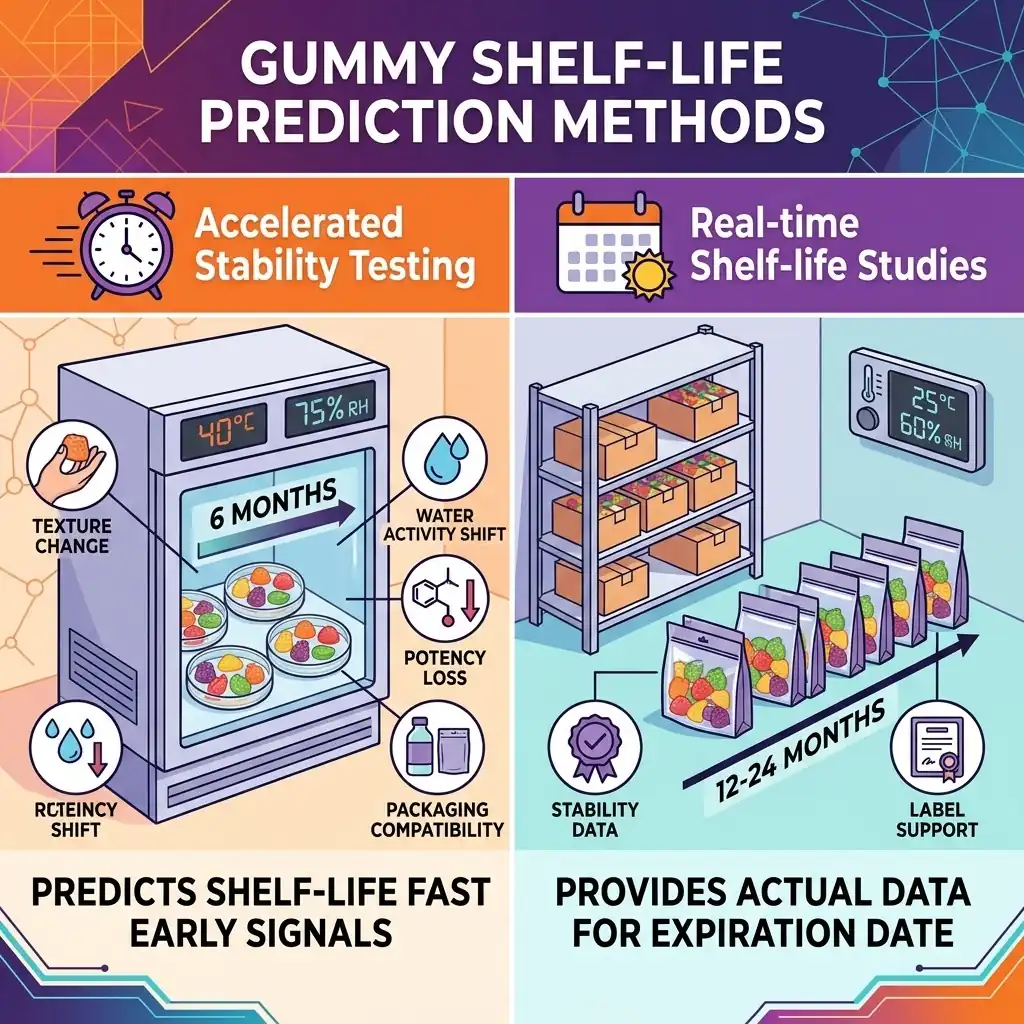
Shelf life depends on water activity, packaging, and active stability. Starchless allows tighter Aw control, typically 0.65-0.75, and more uniform coating, which supports stability for vitamins and botanicals. Mogul introduces starch moisture variability that must be managed in stability studies.
5. What MOQ should I expect for high-volume OEM on starchless?
MOQ is driven by cooker capacity and conditioning efficiency, often 300-500 kg per SKU per run. For buyers planning monthly repeats, manufacturers can often split that across flavors with the same gel base, subject to cleaning validation.
6. Can I start on mogul for a pilot and transfer to starchless later?
You can, but plan for reformulation. Texture, weight, and drying profiles differ. If you intend to scale, request pilot samples from the intended commercial platform to avoid re-doing stability and sensory evaluation.
7. What information does a Gummy Manufacturer need to recommend a molding line?
Provide gel preference, active list with dosage per piece, gummy weight and shape, pH and acid details, heat sensitivity, target Aw, volume forecast, packaging format, and required certifications. That data lets the manufacturer assess mixing, depositing temperature, cooling, conditioning, and coating parameters.
Jack Luo|Senior Technical Advisor, Nutrition Research Center Representing Gothink Biology, a GMP-certified dietary supplement manufacturer based in Shenzhen, China.