
Supplement Labeling Compliance: Avoiding Misleading Claims in US & EU Markets
For supplement brands selling in the US and EU, labeling is not a marketing exercise. It is a regulatory and manufacturing control point where a single unapproved claim can trigger FDA warning letters, EU market withdrawal, Amazon delisting, or retailer rejection. Working with an experienced gummy manufacturer early is critical because label claims must match what is actually formulated, processed, and stable through shelf life.
This article answers the core buyer question: how do I create a supplement label that sells effectively without crossing into misleading territory in two very different regulatory systems? It is written for brand owners, private label gummy buyers, product developers, and procurement teams who need to make formulation, sourcing, and documentation decisions before artwork goes to print.
Why Labeling Compliance Is a Commercial Risk, Not Just a Legal One
In both markets, enforcement comes from multiple directions. In the US, FDA enforces 21 CFR 101 food labeling and DSHEA requirements, while FTC polices advertising substantiation. In the EU, member state authorities enforce Regulation (EU) No 1169/2011 on Food Information to Consumers (FIC), Directive 2002/46/EC on food supplements, and Regulation (EC) No 1924/2006 on nutrition and health claims.
For gummy products, risk is higher. Gummies look like confectionery, have higher water activity than tablets, and contain sugars, acids, and flavors that affect stability. If your label declares 500 mg apple cider vinegar or 1000 IU vitamin D3 per serving but finished-product testing at 12 months shows 70% potency, the claim is misleading by definition, regardless of intent.
Retailers and platforms now act as secondary regulators. US and EU distributors routinely request Certificates of Analysis, stability summaries, allergen statements, and claim substantiation files. A non-compliant label can block a purchase order even before authorities intervene.
US vs EU: Two Different Regulatory Logics
US Framework: What You Can Say and How You Must Say It
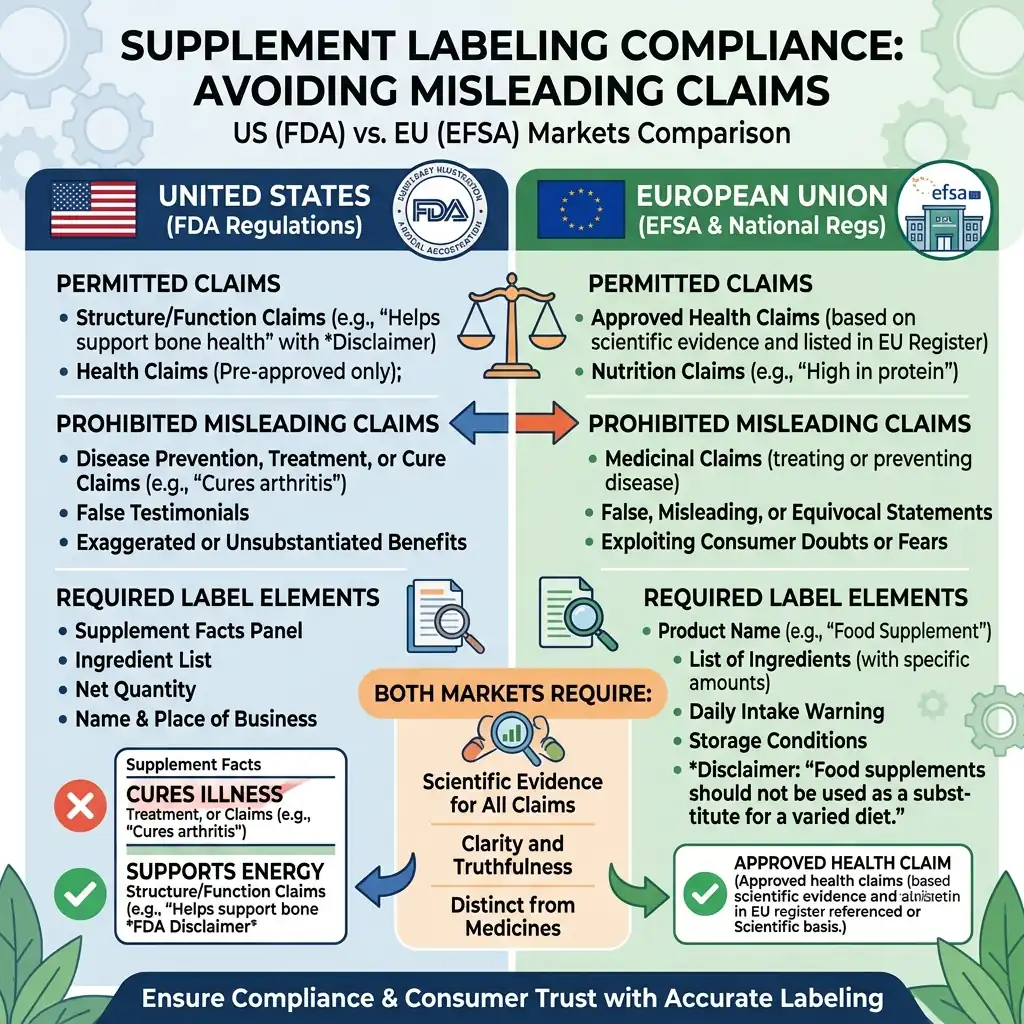
In the US, dietary supplements are regulated under DSHEA. You can make three categories of claims: nutrient content claims, structure/function claims, and health claims (with FDA authorization or qualified health claim language). Disease claims – diagnosing, treating, curing, or preventing disease – are prohibited for supplements.
Structure/function claims require two things: truthful, non-misleading language and a disclaimer, plus substantiation and a 30-day notification to FDA. Example compliant language: “Calcium supports bone health.” Example non-compliant: “Calcium prevents osteoporosis” without authorized health claim wording.
FTC standard is higher than FDA’s. You need competent and reliable scientific evidence for any express or implied claim, including claims implied by images, product names, or testimonials. “Melatonin gummies for perfect sleep” implies efficacy that demands substantiation.
EU Framework: Positive Lists Control Everything
The EU is more restrictive. Only nutrition and health claims listed in the EU Register of authorized claims under Regulation 1924/2006 may be used. If a botanical or new ingredient is not on the list, you cannot make a health claim for it in the EU, even with studies.
Food supplements must also comply with Directive 2002/46/EC for vitamin and mineral forms, maximum levels set by member states, and mandatory label elements under FIC: name of food, ingredient list, net quantity, date of minimum durability, storage conditions, name and address of food business operator, and nutrition declaration for certain presentations.
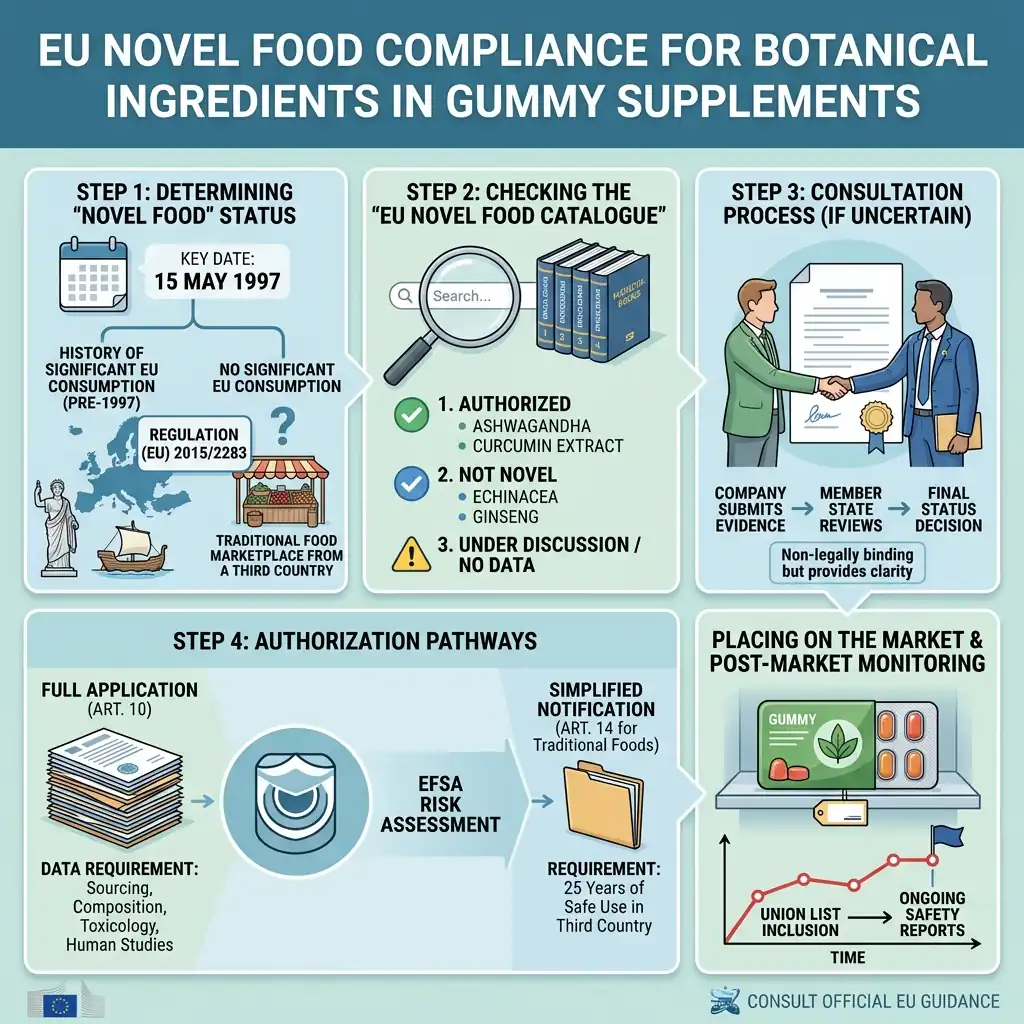
Novel Food Regulation (EU) 2015/2283 also matters for gummies. Ingredients like certain mushroom extracts, CBD, or new probiotic strains may require novel food authorization before they can be labeled at all.
| Area | United States | European Union |
| Claim System | Open with substantiation requirement, FDA notification for structure/function | Closed positive list, only authorized Article 13.1 and 14 claims allowed |
| Disease Claims | Prohibited, triggers drug status | Prohibited, triggers medicinal product status |
| Daily Values | % Daily Value based on FDA reference values, serving size defined in Supplement Facts | % Nutrient Reference Value (NRV) per Directive 2002/46/EC, 100g basis not required for supplements |
| Botanicals | Structure/function allowed with substantiation | Most health claims on hold, must use general wording plus specific botanical disclaimer in some member states |
| Language / Presentation | English required, all claims subject to FTC implied claim rule | Must be in official language of member state, FIC presentation rules on legibility and allergen emphasis |
What Counts as Misleading in Gummy Supplement Labels?
A misleading claim is not only a false sentence. It includes any information that creates a false impression in an average consumer’s mind.
- Direct disease claims: “Immunity gummies prevent colds” or “Apple cider vinegar gummies burn fat.”
- Implied disease claims: Using pharmaceutical imagery, before/after graphics, or product names like “Gut Repair” or “Anxiety Away.”
- Dosage misalignment: Declaring an active amount that cannot be delivered in the gummy weight or that degrades below label by end of shelf life.
- Free-from overreach: “Sugar-free” when pectin gummies contain 2.5 g sugar from fruit juice concentrates, or “vegan” when gelatin is used.
- Flavor and color misrepresentation: Labeling “natural strawberry flavor” when the formula uses artificial flavor, or failing to declare color additive E numbers in EU.
For gummies, FDA and EU authorities also review the Supplement Facts / nutrition declaration against actual composition. Moisture loss during drying, sugar crystallization, and active migration can shift net weight and % Daily Value if not controlled.
Manufacturing Factors That Directly Create Labeling Risk
Active Ingredient Loading vs Declared Potency
Gummy size limits how much active you can add. A standard pectin gummy is 2.5-3.0 g. If a buyer wants 1000 mg ACV, 400 mg ashwagandha root, and 200 mg vitamin C in one gummy, total solids exceed what the gel can hold without texture failure. The result is sticky, deformed gummies or a need to split into 2-3 gummies per serving, which changes serving size declaration and cost.
Manufacturers address this by calculating active load as % of total batch solids and checking compatibility with the gel system. High-mineral loads like zinc citrate or magnesium citrate can interfere with pectin crosslinking and cause syneresis, which then affects weight uniformity and label weight accuracy.
Heat Sensitivity and Degradation During Cooking
Pectin gummy mass is cooked to 105-110°C to activate pectin, then cooled to 85-90°C before active addition. Heat-sensitive ingredients like vitamin C, B12, probiotics, and certain botanical extracts lose potency if added too early.
Why this matters for labeling: if you declare 100% of label claim at manufacture but lose 15-20% during cooking and depositing, your product is misbranded under 21 CFR 101.36 and EU tolerance guidance. A capable manufacturer adds heat-sensitive actives at a controlled low-temperature phase, validates addition order, and applies a scientifically justified overage only when stability data supports it.
pH, Water Activity and Stability Over Shelf Life
Pectin requires pH 3.2-3.8 to set. Acidic actives like apple cider vinegar or vitamin C further lower pH, which can hydrolyze pectin over time and increase water release. Water activity (aw) in gummies typically ranges from 0.55 to 0.72. Higher aw accelerates microbial risk and active degradation.
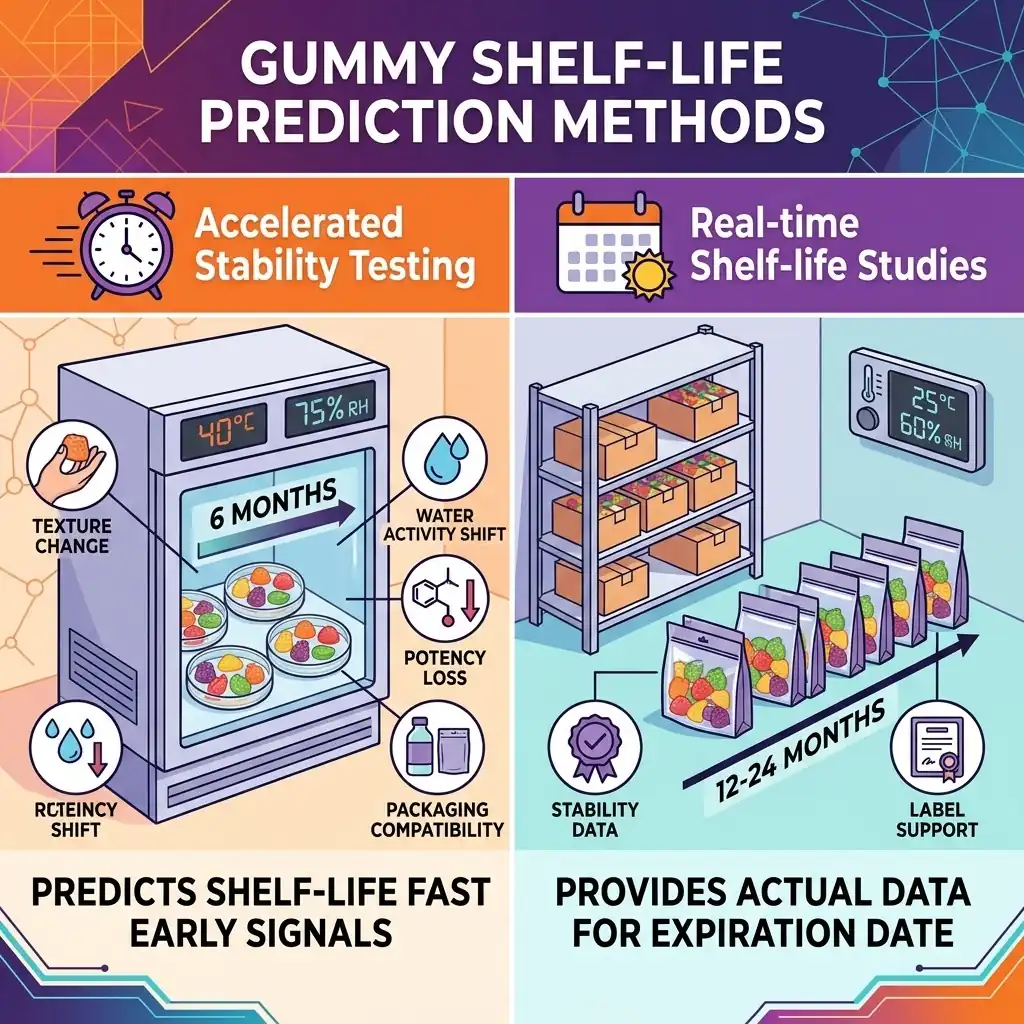
Labeling implication: best-before date and storage conditions must reflect real stability. If aw is not reduced to target through drying and conditioning, potency may drop and texture may harden, making “soft chews” claim inaccurate at month 18. Shelf-life validation via ICH-style accelerated and real-time testing links label claims to actual product performance.
Flavor, Color, Sweetener and Free-From Claims
Minerals create metallic notes, B-vitamins create bitterness, and botanical extracts create earthy off-notes. Flavor masking often requires sweeteners and acids that affect sugar declaration.
A “sugar-free” claim in EU means less than 0.5 g sugars per 100 g. In US, less than 0.5 g per serving. If you use tapioca syrup or fruit juice concentrate to mask taste, you may exceed thresholds. Similarly, “vegan,” “halal,” “gelatin-free,” or “pectin-based” must be supported by raw material specifications and certification status of gelling agents, flavors, and glazing oils.
Serving Size and Gummy Weight Variability
FDA requires serving size for supplements to be expressed in a way suitable for consumer understanding, and net quantity must be accurate. At commercial scale, depositing nozzles, cooling tunnels, and drying affect gummy weight by 5-10%.
If weight varies, count-based declarations like “60 gummies” must still meet minimum fill. Manufacturers control this through in-line checkweighers, statistical process control, and drying curves. Without this control, a private label gummy product labeled “2 gummies per serving, 30 servings” may fail net content checks in EU market surveillance.
How a Gummy Manufacturer Builds Compliant Labels Into Production
Label compliance should start at specification review, not artwork review. A systematic manufacturer follows these relevant stages:
- Concept and specification review: Map intended claims to US and EU authorized claim lists. Flag disease language, non-compliant “free-from,” and dosage conflicts.
- Ingredient selection: Verify vitamin/mineral forms allowed in EU, novel food status, allergen status, and certification for vegan/halal/kosher claims. Check color additive status: EU requires E numbers, US requires FD&C certification.
- Formula development: Calculate active load, pH impact, and predicted water activity. Adjust gel system (high-methoxyl pectin vs low-methoxyl pectin vs gelatin) based on acid and mineral content.
- Raw material testing: Test identity, potency, and microbiology. For botanicals, verify marker compounds that support claim wording.
- Batch preparation and active addition: Add heat-sensitive actives after cooling phase with controlled mixing and homogenization to avoid hot spots and uneven potency.
- Deposition, cooling, and drying: Control deposit weight, setting time, and drying to target aw 0.60-0.65 for pectin gummies to balance texture and stability.
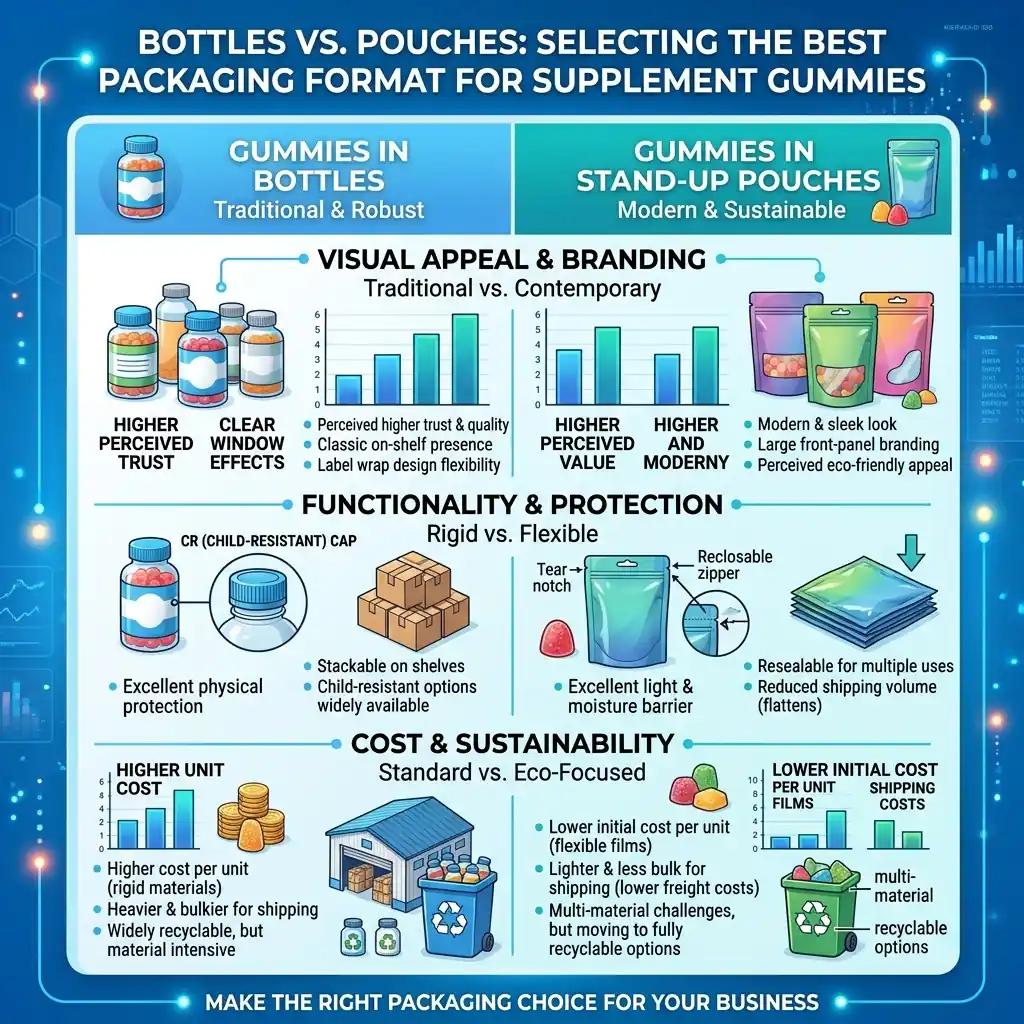
- Coating and packaging compatibility: Select wax or oil coating that does not interact with actives. Choose moisture-barrier packaging – e.g., induction-sealed HDPE bottles with desiccant or high-barrier stand-up pouches – to preserve potency.
- Finished-product testing and release: Test active assay, weight uniformity, microbiology, and aw. Compare results to label declaration tolerances (FDA allows 100% to not less than 100% for Class I nutrients, EU allows tolerance ranges per guidance).
Common Labeling Mistakes Private Label Gummy Buyers Make
- Copying US structure/function language to EU: “Supports immune defense” may be acceptable in US with disclaimer but is unauthorized in EU if not on the EU Register.
- Using clinical doses from capsules on gummies: A capsule dose of 1500 mg ACV cannot be compressed into a 3 g gummy without changing serving count, leading to inflated label claims.
- Ignoring overage justification: Adding 30% overage to compensate for degradation without stability data can cause over-potency at release and fail EU upper limits.
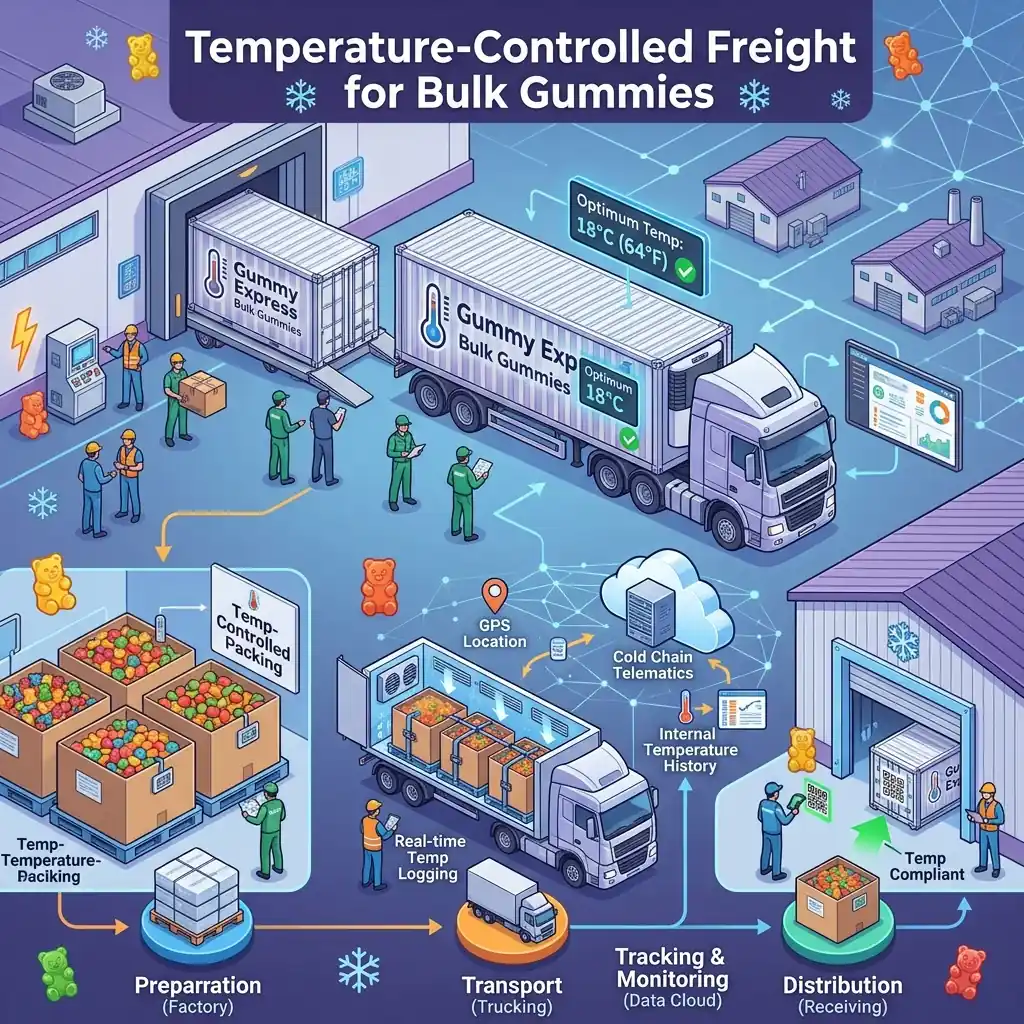
- Claiming probiotic CFU at expiry without process controls: Probiotic gummies require low-temperature processing, low aw, and refrigerated supply chain. Labeling “10B CFU at expiry” without these controls creates a misleading claim.
- Mismatched Supplement Facts and ingredient list: Listing “natural flavors” in ingredient list but declaring “artificial flavor” exemption or vice versa.
- Forgetting member-state nuances: France requires specific warnings for certain botanicals, Germany restricts certain health claim translations. A single EU label often needs local adaptation.
Cost, MOQ and Documentation Impacts of Compliant Labeling
Compliance has direct cost effects. A label that requires EU-authorized claims may need formula changes – for example, switching from gelatin to pectin to support vegan claims, or switching from artificial to natural colors, which cost more and have narrower pH stability.
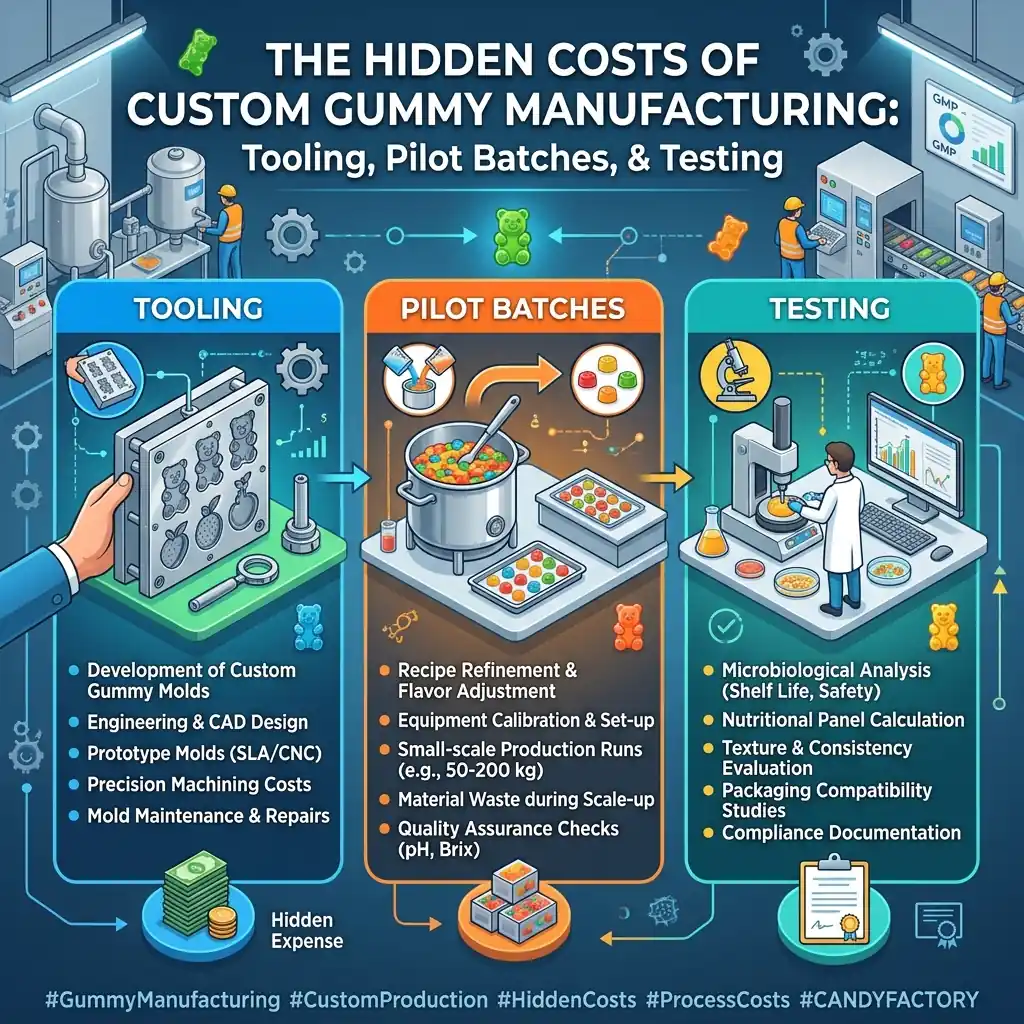
Testing requirements increase with claim complexity. If you make a vitamin C potency claim and a “sugar-free” claim, you need both nutrient assay and sugar profile testing per batch, plus periodic shelf-life testing to prove both remain valid at expiry. Testing for allergens, heavy metals, and microbiology is standard, but claim-specific testing adds to per-batch cost.
MOQ becomes commercially important when labeling requires specific molds or packaging. A custom gummy shape to support a brand claim may require a new starch mold or silicone mold set, with MOQ tied to mold cavitation and line time. Packaging with high-barrier film for stability has higher minimum order than standard PET bottles. A manufacturer with flexible pilot-to-commercial scale-up can run 10,000-50,000 unit pilot batches for label and stability validation before committing to 100,000+ unit commercial MOQ.
Documentation also affects lead time. US market requires Supplement Facts compliant with 21 CFR 101.36, allergen statement under FALCPA, and manufacturer contact information. EU requires FIC-compliant label in local language, EU food business operator address, lot marking per Directive 2011/91/EU, and for some ingredients, warning statements. Gathering certifications for free-from claims takes additional supplier lead time.
How to Evaluate a Gummy Manufacturer for US & EU Label Support
When evaluating a supplier for compliant gummy production, move beyond generic GMP statements and ask for verifiable capabilities:
- Quality systems: GMP-certified facility with 100,000-class cleanroom, 10,000-class R&D lab, HACCP, ISO22000, FSSC 22000, BRC, and FDA registration. Ask for recent audit reports, not just certificates.
- R&D capability: In-house formulation team that can model pH, aw, and active compatibility, and provide pilot samples with assay data.
- Testing and quality control: In-house or qualified third-party testing for potency, water activity, microbiology, heavy metals, and sugar profile. Ability to provide stability study protocols.
- Regulatory documentation: Experience providing US Supplement Facts formatting, EU FIC label review, allergen matrices, CoA templates, and claim substantiation support files. Export experience to US and EU markets with examples of compliant artwork checks.
- Batch traceability and scale-up: Documented traceability from raw material lot to finished batch, scale-up records from lab to 16 tons daily production, and control of mixing, depositing, cooling, and drying parameters.
- Packaging capability: Compatibility testing for bottles, pouches, and blisters, and knowledge of moisture vapor transmission rate requirements for gummies.
Shenzhen Gothink Biotech Co., Ltd. operates as a GMP-certified dietary supplement manufacturer based in Shenzhen, China, providing OEM, ODM, CMO, and CDMO services across gummy, capsule, tablet, powder, liquid, and drop formats. Its facility supports custom formulation development and commercial-scale production with systems including ISO9001, ISO22000, HACCP, FDA, HALAL, GMP, KOSHER, BRC, FSSC 22000, PJPH, and Vegan. These capabilities are relevant when a buyer needs both manufacturing capacity and documentation support for US and EU labeling compliance.
Practical Checklist Before Finalizing Your Label
- Have you mapped every marketing claim to the authorized claim list in target market (US structure/function with disclaimer vs EU Register)?
- Does active load fit gummy weight and serving size without texture failure?
- Have you confirmed vitamin/mineral forms and botanical status are allowed in EU and not novel food?
- Do you have stability data supporting potency at expiry, not just at manufacture?
- Are free-from claims (vegan, gelatin-free, sugar-free, halal, non-GMO) backed by supplier certificates and lab testing?
- Does Supplement Facts / nutrition declaration match ingredient list, flavor and color declarations, and actual net weight after drying?
- Is allergen declaration compliant with US FALCPA and EU FIC Annex II?
- Do you have the EU food business operator address, lot code, and language translations ready?
- Have you removed implied disease claims from images, icons, and testimonials?
FAQ
Can I use the same label artwork for US and EU markets?
No. The US allows structure/function claims with disclaimer and FTC substantiation, while EU allows only pre-authorized claims from the EU Register. Serving size, % Daily Value vs % NRV, allergen formatting, and language requirements differ. Most brands maintain two artwork versions with shared branding but market-specific claim and declaration panels.
What is the biggest labeling risk specific to gummy format?
Potency at expiry. Gummies have higher moisture and water activity than tablets, and pH-sensitive gel systems can degrade acid-sensitive actives. If your assay drops below declared amount before best-before date, both FDA and EU authorities treat it as misbranding. Controlled low-temperature active addition, target aw control, barrier packaging, and stability validation are needed.
Do I need overage to meet label claim in gummies?
Overage should be based on stability data, not a fixed percentage. For heat-sensitive nutrients like vitamin C or probiotics, a justified overage of 5-15% may be used to ensure 100% of label claim at expiry. Excessive overage without data can cause over-potency at release and exceed EU maximum levels.
How should I handle botanical claims for EU?
Most botanical health claims are on hold in EU and cannot be used unless authorized. You can still sell botanical gummies in EU, but you must avoid health claims and use only general well-being wording compliant with member-state guidance, plus required botanical warnings where applicable. In US, botanical structure/function claims are allowed with substantiation and FDA notification.
What documentation should I ask my gummy manufacturer for to support my label?
Request CoA for raw materials and finished product, allergen statement, water activity and microbiology results, stability summary, Supplement Facts / FIC label review, color and flavor regulatory status, and certificates supporting free-from claims (vegan, halal, kosher). For EU, also request food business operator details and novel food status confirmation.
When does MOQ affect labeling decisions?
When your claim requires custom molds, specialized natural colors, or high-barrier packaging. These items have their own MOQs. Running a pilot batch of 10k-50k units allows you to validate texture, assay, and label declarations before committing to full commercial MOQ and custom mold investment.
Can front-of-pack icons create misleading claims?
Yes. FTC and EU authorities treat images as implied claims. A heart icon next to “supports cardiovascular health” may be acceptable, but a crossed-out cold virus icon implying prevention is a disease claim. Review all icons, badges, and graphics with your regulatory advisor and manufacturer.
Commercial Next Step
Avoiding misleading claims is a joint effort between brand, regulatory advisor, and manufacturer. Before artwork is finalized, share your target markets, desired claims, active doses per serving, gummy weight target, and free-from requirements with your gummy manufacturer. Ask for a formulation feasibility check, pH and aw projection, and a label compliance review against US and EU rules.
If you are developing a new private label gummy or reformulating an existing product for export, request a custom formulation proposal and OEM/ODM quotation that includes stability plan, testing matrix, and documentation package for US and EU filing. Early technical alignment reduces artwork revisions, testing failures, and market entry delays.
Explore our manufacturing knowledge base for more technical guidance:
Gummy Manufacturing and Formulation Knowledge Center
Quality Systems and Regulatory Compliance Center
Jack Luo|Senior Technical Advisor, Nutrition Research Center Representing Gothink Biology, a GMP-certified dietary supplement manufacturer based in Shenzhen, China.