
Direct Answer:How Active Ingredient Homogeneity is Maintained in Large-Batch Gummy Cooking
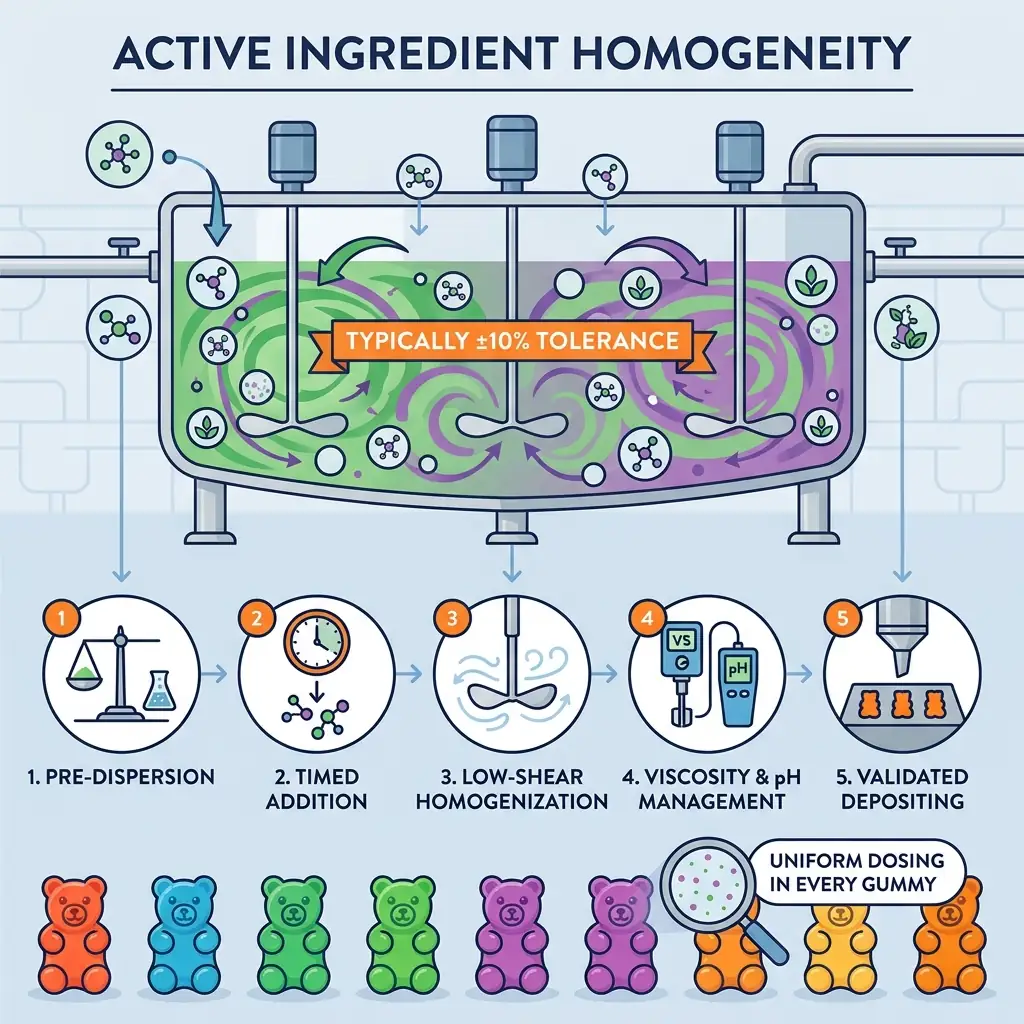
Active ingredient homogeneity in gummy cooking means every individual gummy in a large batch contains the target dose within a tight tolerance, typically ±10% of label claim. In large-batch production, this is not achieved by simply stirring longer. It is achieved through a controlled sequence of pre-dispersion, timed addition, low-shear homogenization, viscosity and pH management, and validated depositing.
For any buyer evaluating a Gummy Manufacturer, homogeneity is the core indicator of formulation maturity and process control. If actives are not uniformly distributed in the cooking kettle, no downstream testing or sorting can fix the batch. This article explains the manufacturing logic behind maintaining uniformity at commercial scale and what it means for your product specification, cost, and supplier selection.
Why Homogeneity Matters More at Large-Batch Scale
In a 5 kg lab batch, manual mixing can produce acceptable uniformity. In a 300 kg to 1000 kg commercial cooker, the same approach fails. Mass, viscosity, temperature gradients, and holding time all increase.
Non-uniform gummies create two commercial risks. Under-dosed pieces trigger content uniformity failures and regulatory risk. Over-dosed pieces create safety concerns, especially for minerals, fat-soluble vitamins, and botanicals with upper limits.
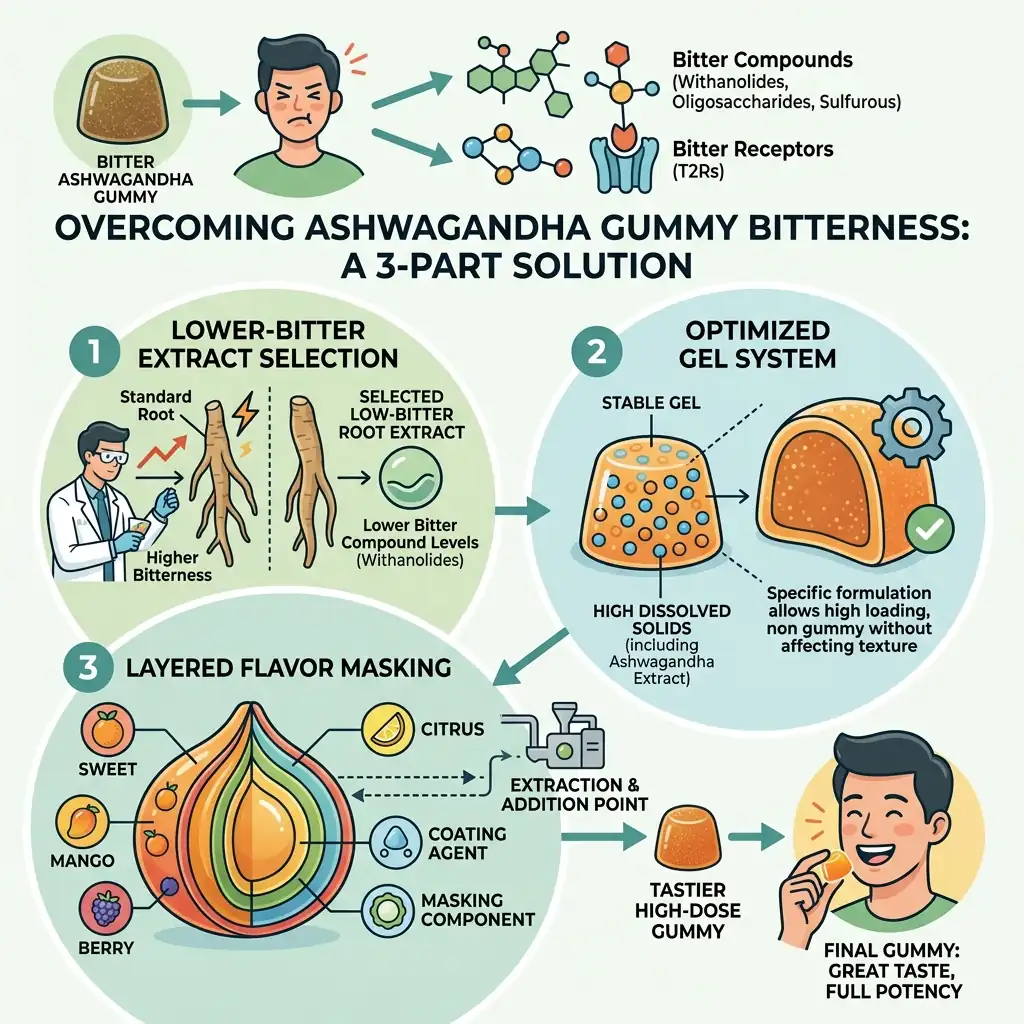
For private label gummy projects, homogeneity also affects consumer experience. Uneven distribution of minerals like zinc or iron causes localized metallic taste and color spotting. Uneven botanical extracts cause bitter pockets and inconsistent appearance.
What a Qualified Gummy Manufacturer Controls to Keep Actives Uniform
Homogeneity is not a single step. It is the result of six interdependent controls applied during Gummy Manufacturing. Each control addresses a specific failure mode that becomes more pronounced at scale.
1. Pre-Dispersion and Masterbatch Preparation
Direct addition of raw powder into a viscous gummy mass is the most common cause of inhomogeneity. Powders agglomerate, trap air, and sink or float based on density.
Professional practice is to convert actives into a flowable intermediate before they ever touch the main cooker. This intermediate is often called a masterbatch or slurry. Water-soluble vitamins are dissolved in a defined portion of water at controlled temperature. Minerals are milled to a target particle size, typically D90 < 80 microns, and suspended with a hydrocolloid or emulsifier.
Fat-soluble actives like vitamin D3, vitamin K2, CoQ10, or CBD require emulsification. Oil phase is heated, mixed with MCT oil or lecithin, and then high-shear emulsified to create droplets under 10 microns. This prevents oil separation and ring formation in the finished gummy.
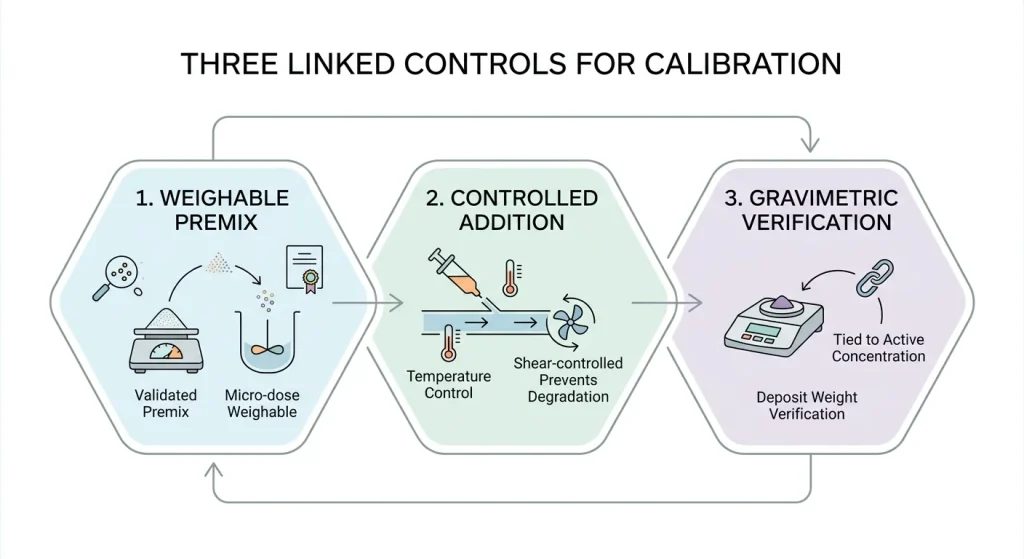
Why this matters: A stable masterbatch behaves like a liquid ingredient. It can be metered accurately and disperses rapidly in the main mass without creating concentration zones.
2. Gel System Selection and Viscosity Management
The gel system defines the processing window for active addition. Gelatin and pectin behave very differently.
Gelatin systems are thermoreversible and remain fluid at 70-80°C for an extended period. This gives a wider window for mixing actives. However, viscosity drops sharply above 85°C, which can cause heavier particles to settle.
Pectin systems, especially high-methoxyl pectin used for vegan gummies, require precise control of solids, pH, and temperature. Once pH drops below 3.6 and solids exceed 78 Brix, gelation starts quickly. Actives must be fully homogeneous before that point, or they become locked in a non-uniform network.
Manufacturers manage viscosity to balance mixing and stability. Target depositing viscosity is typically 2500-5000 cP. If viscosity is too high, shear is insufficient to distribute actives. If too low, dense minerals settle within minutes. Real-time viscometry and Brix monitoring are used to keep the batch inside the validated window.
3. Temperature Control and Timed Active Addition
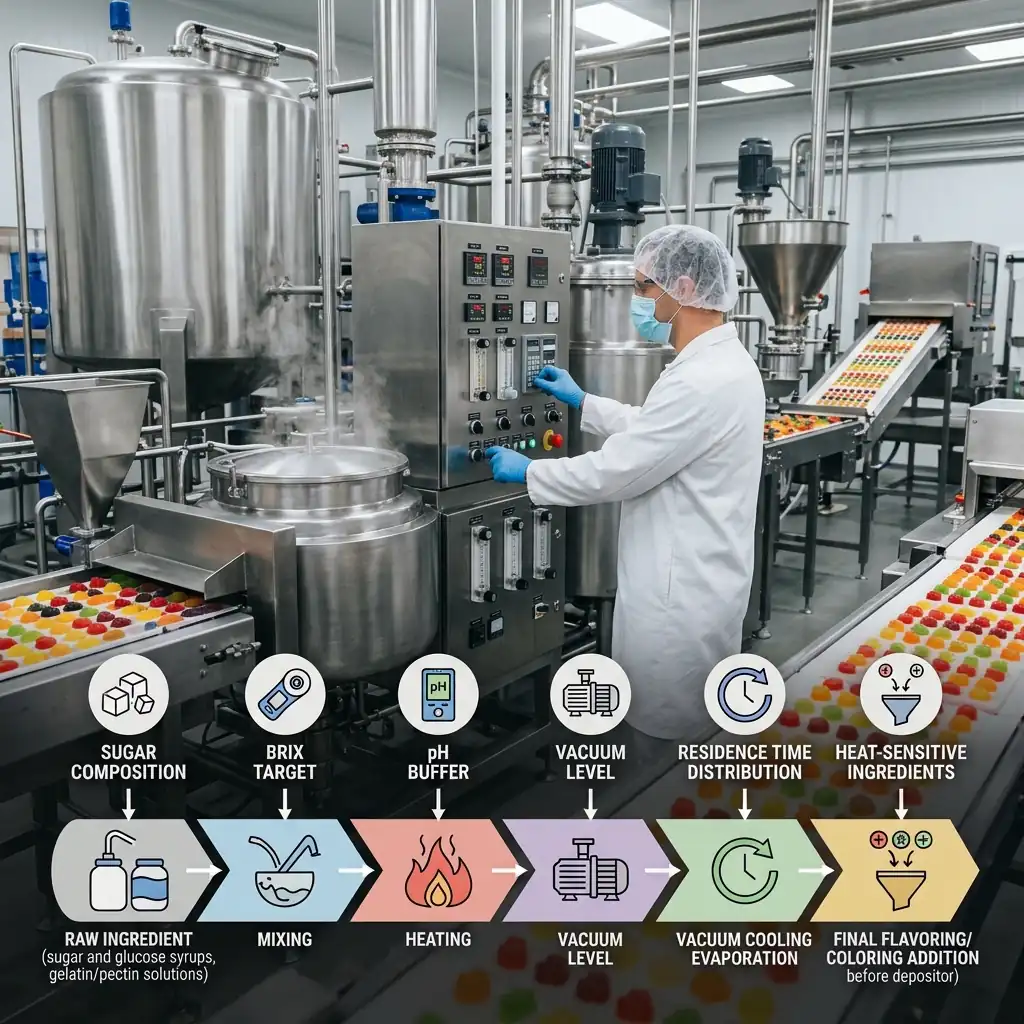
Heat sensitivity directly affects homogeneity strategy. Most vitamins, probiotics, and botanical polyphenols degrade above 90°C. Cooking of the sugar-gel base typically occurs at 95-108°C to achieve target solids.
The solution is split-process addition. The base syrup (sugar, glucose syrup, water, gel) is cooked and then cooled in a holding tank to 75-85°C for gelatin or 85-95°C for pectin. Actives are added only after cooling, under controlled agitation.
This logic serves two purposes. It protects heat-sensitive actives from thermal degradation. It also limits the time the active spends in a low-viscosity, high-temperature state where segregation can occur.
For extremely heat-sensitive ingredients like postbiotics or certain enzymes, some lines use inline dosing after the cooking vessel, just before depositing, reducing heat exposure to less than 5 minutes.
4. Mixing Geometry and Homogenization Equipment
Large-batch kettles use more than a single impeller. Effective homogenization requires a combination of low-shear planetary mixing for bulk turnover and high-shear inline homogenization for de-agglomeration.
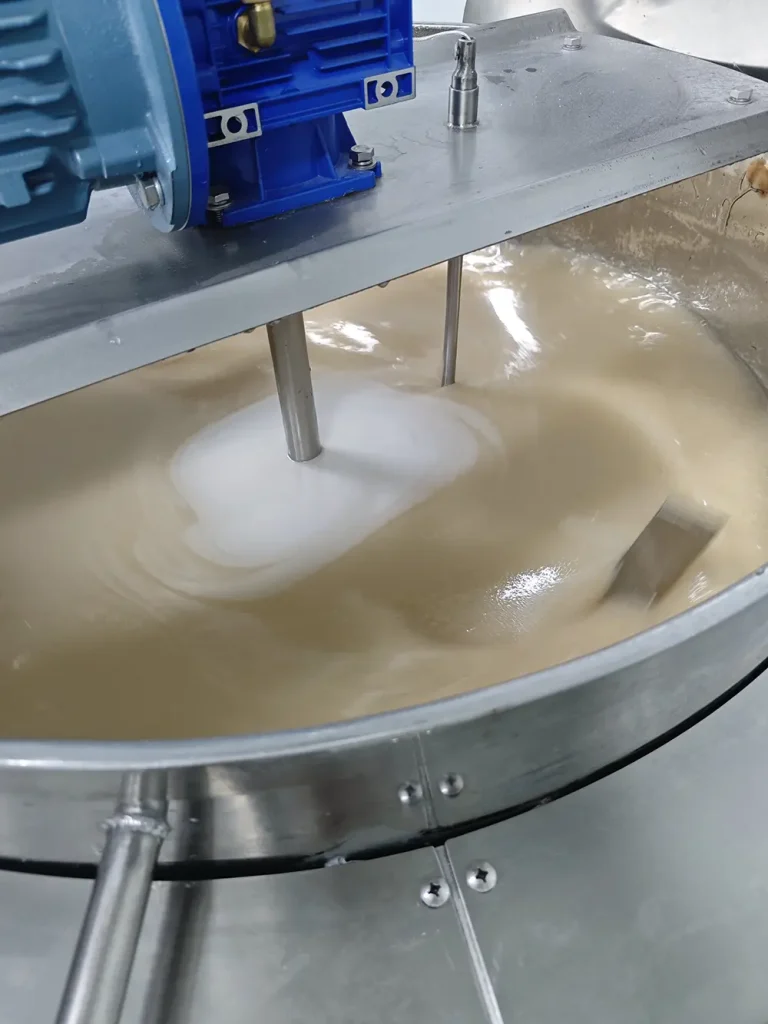
Bottom-entry high-shear mixers and external recirculation loops are common in commercial-scale Gummy Manufacturing. The loop pulls mass from the bottom of the kettle, passes it through a rotor-stator homogenizer, and returns it to the top. This creates 3 to 5 full turnovers in 8-15 minutes.
Mixing time is validated, not guessed. Over-mixing incorporates air, reduces gel strength, and can break pectin chains. Under-mixing leaves concentration gradients. Manufacturers validate mixing time through stratified sampling: samples taken from top, middle, bottom, left, and right of the kettle are tested for active content before approval to deposit.
5. pH, Ionic Strength, and Ingredient Compatibility
pH affects both gel formation and active solubility. Citric acid and sodium citrate buffer are often used to adjust final pH to 3.2-3.8 for pectin gummies.
Minerals like calcium, zinc, and iron are electrolytes. Even at 5-15 mg per gummy, they can prematurely crosslink pectin, creating grainy texture and trapping actives in local gel pockets. Chelated mineral forms such as zinc bisglycinate or calcium bisglycinate reduce free ion activity and improve compatibility.
Ascorbic acid and acidic botanical extracts lower pH. If added before pH stabilization, they can cause uncontrolled pre-gelation. Manufacturing logic dictates adding buffer first, then acid-sensitive minerals, then acids and flavors last, with continuous pH monitoring.
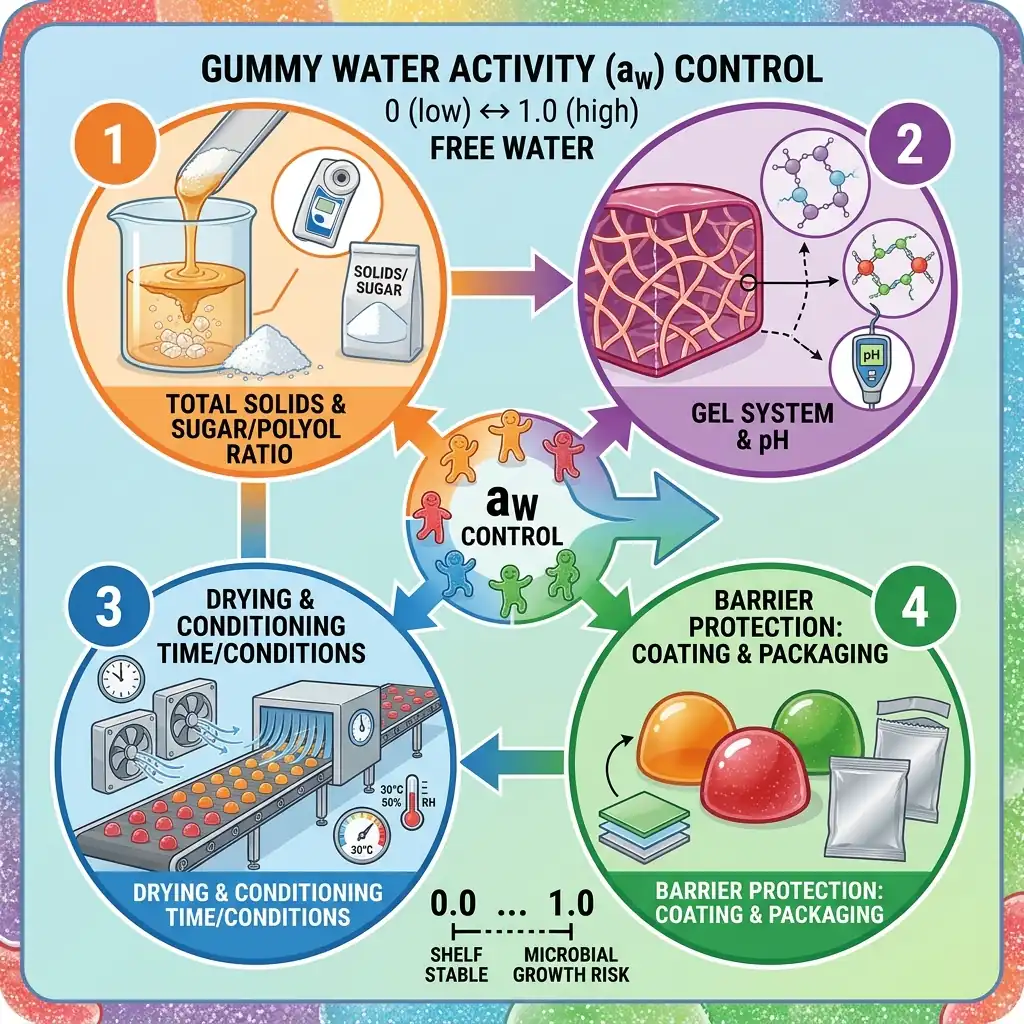
Water activity is also controlled. Target aw for finished gummies is 0.65-0.75. Hygroscopic ingredients like magnesium citrate or choline bitartrate pull moisture during holding, increasing local water activity and causing active migration during drying.
6. Deposition Precision and Post-Deposit Stability
Homogeneity in the kettle must survive depositing. Depositing hoppers must be temperature-jacketed and agitated. Without agitation, actives settle in the hopper during a 60-90 minute depositing run.
Servo-driven piston depositors dose by volume, typically ±1.5% weight accuracy. Gummy weight directly correlates to dose, so weight control is part of content uniformity control. Every 15-30 minutes, in-process weight checks are performed.
After depositing, cooling and drying can still cause migration. If gummies are dried too aggressively at high temperature, moisture moves from core to surface and carries dissolved actives with it. This creates a concentration gradient between core and shell. Controlled conditioning at 20-25°C and 35-45% RH for 24-48 hours stabilizes water activity and limits migration.
Scale-Up Considerations: From Pilot to Large-Batch Cooking
A formula that is uniform at 20 kg pilot scale often fails at 500 kg. The reasons are physical. Heat transfer is slower in large kettles, creating hot and cold zones. Shear rate distribution is less uniform. Holding time before depositing is longer.
Qualified manufacturers address this with scale-up protocols. They do not linearly scale ingredient amounts. They re-validate solids, mixing speed, addition sequence, and holding time at each scale. They also adjust gummy size when active loading is high.
For example, a high-dose vitamin C + zinc gummy requiring 250 mg ascorbic acid and 10 mg zinc per serving cannot be made at 2.5 g gummy weight without compromising texture and stability. Active loading above 15-18% of gummy weight typically requires larger molds (3.0-4.0 g) or splitting into two gummies per serving. This decision directly affects MOQ economics and packaging.
| Process Parameter | Why It Matters for Homogeneity | Typical Control in Gummy Manufacturing |
|---|---|---|
| Active particle size | Large particles settle and cause mouthfeel issues; small particles disperse better | Mill to D90 < 100 microns, verify with laser diffraction |
| Masterbatch solids | Too dilute masterbatch lowers final Brix and extends drying | Keep masterbatch at 30-50% solids, balance water in formula |
| Addition temperature | High heat degrades actives; low heat increases viscosity and poor mixing | Add actives at 75-85°C for gelatin, 85-95°C for pectin |
| Mixing turnover | Insufficient turnover leaves dead zones in large kettles | Validate 3-5 full kettle turnovers via recirculation loop |
| pH before depositing | pH drift triggers premature gelation and locks in non-uniformity | Control final pH within ±0.1, add acid in two stages |
| Hopper hold time | Long hold time allows settling and temperature drop | Limit hold to < 90 minutes, keep hopper agitated and jacketed |
Quality Control and Testing That Proves Homogeneity
Homogeneity cannot be assumed from process alone. It must be demonstrated with data.
In-process controls include Brix, pH, viscosity, and weight checks every production run. Stratified content testing is critical. Before depositing, a manufacturer should sample the kettle from at least five positions and test for the marker active. Relative standard deviation (RSD) should be below 5% for the kettle to be released.
Finished product testing follows USP <905> Uniformity of Dosage Units or equivalent internal specification. Ten gummies per batch are individually assayed for content uniformity. For multi-active formulas, marker actives are chosen based on risk: low-dose actives, minerals, and heat-sensitive vitamins are prioritized.
Additional testing includes water activity, texture analysis, and stability-indicating assay after accelerated storage. Migration during storage is a common hidden failure. An assay at day 0 that passes may fail at 3 months if actives migrated to the coating layer.
Common Homogeneity Failure Modes and How to Prevent Them
| Failure Mode | Technical Root Cause | Buyer Question to Ask |
|---|---|---|
| Mineral spotting / dark dots | Undispersed mineral agglomerates, insufficient high-shear mixing | What milling spec and pre-dispersion method do you use for minerals? |
| Top-bottom dose variance | Density difference, no hopper agitation, long depositing time | How do you prevent settling in the depositor during long runs? |
| Bitter or metallic pockets | Poor emulsification of botanicals or minerals, pH interaction | Do you validate flavor masking and active distribution together? |
| Content uniformity failure after storage | Moisture migration, high water activity, inadequate conditioning | What aw target and drying protocol do you use for this formula? |
| Color streaking | Incompatible extract or color added before homogenization | When in the sequence are colors and botanicals added? |
Cost, MOQ, and Formulation Trade-Offs
Homogeneity controls affect commercial terms. High active loading increases gummy size, which increases ingredient cost per unit and may require custom molds. Custom molds increase upfront cost and MOQ.
Emulsified actives and chelated minerals cost more than standard forms but reduce homogeneity risk and improve sensory quality. For startup brands, the choice between oxide and bisglycinate zinc is not only nutritional but also manufacturing-related.
MOQ is tied to kettle size and depositor efficiency. A single large-batch cooker may produce 300-500 kg per batch, equivalent to 100,000-200,000 gummies depending on weight. If your order is smaller than one full kettle, homogeneity validation may not be representative. Discuss with your manufacturer whether pilot-scale validation data will be bridged to commercial scale.
Lead time also reflects homogeneity work. Formulas with high-risk actives such as iron, calcium, or high-dose botanicals typically require 2-3 pilot trials before commercial confirmation. Budget this development time into your launch plan.
How to Evaluate a Gummy Manufacturer for Homogeneity Capability
When sourcing a private label gummy or custom formula, homogeneity capability is verifiable. Ask for specific evidence rather than general assurances.
- Equipment: Does the facility have temperature-controlled holding tanks, recirculation homogenization loops, jacketed and agitated depositing hoppers, and servo depositors?
- Process validation: Can they show a mixing validation protocol with stratified sampling data for similar active types?
- Lab capability: Do they perform in-house content uniformity, water activity, and texture testing? Is raw material particle size verified?
- Formulation experience: Have they commercialized gummies with your active type at similar dosage and pectin/gelatin system?
- Scale-up documentation: Do they have pilot-to-commercial bridging procedures and batch records that track addition time, temperature, and mixing time?
- Quality systems: Are GMP, HACCP, ISO22000, and FSSC 22000 systems in place with batch traceability?
- Stability data: Can they provide accelerated and real-time stability data showing content uniformity over shelf life for comparable formulas?
Shenzhen Gothink Biotech Co., Ltd. operates a GMP-certified facility with a 100,000-class cleanroom and a 10,000-class R&D laboratory. With approximately 16 tons of daily production capacity, the facility is configured for large-batch gummy cooking with controlled cooling, homogenization loops, and in-process testing that supports homogeneity validation from pilot to commercial scale. This type of infrastructure is relevant when your formula includes minerals, high-dose vitamins, or botanicals that are sensitive to mixing and pH.
Practical Checklist for Buyers
Before requesting an OEM/ODM quotation, prepare the following information to help the manufacturer assess homogeneity risk:
- Complete active list with target dose per gummy and per serving, including form (e.g., zinc citrate vs. bisglycinate)
- Preferred gel system (gelatin, pectin, or other) and dietary requirements (vegan, halal, kosher)
- Target gummy weight, shape, flavor, and color expectations
- Sensitivity flags: heat-sensitive, hygroscopic, or strongly acidic ingredients
- Serving size and daily dose count, and whether you allow two gummies per serving
- Packaging format (bottle, pouch, individual wrap) and target shelf life
- Target markets and any specific content uniformity or labeling requirements
- MOQ flexibility and whether you need pilot batch data before commercial order
Providing this information allows the manufacturer to recommend masterbatch strategy, mold size, mixing protocol, and testing plan upfront, rather than revising after a failed pilot.
FAQ
What is the acceptable tolerance for active ingredient content uniformity in gummies?
Most B2B specifications use 90-110% of label claim for individual gummies at release, with RSD below 6% for content uniformity per USP <905>. For low-dose actives below 5 mg per gummy, tolerance may be tightened. Your manufacturer should define the specification in the product technical data sheet before production.
Can high-dose minerals be uniformly distributed in a standard 2.5 g gummy?
It depends on the mineral form and total active load. Mineral oxides are dense and tend to settle. Chelated forms and pre-milled suspensions improve uniformity but increase cost. If total active load exceeds about 18% of gummy weight, increasing gummy weight to 3.0-4.0 g or splitting the dose into two gummies per serving is often required to maintain both homogeneity and acceptable texture.
When should actives be added during gummy cooking?
The sugar-gel base is cooked first to reach target Brix. After cooling to the validated window (typically 75-85°C for gelatin, 85-95°C for pectin), buffered and pre-dispersed actives are added under controlled mixing. Heat-sensitive vitamins, flavors, and acids are added last to minimize degradation and premature gelation.
How does pectin vs. gelatin affect homogeneity?
Gelatin offers a wider mixing window because it stays fluid longer at depositing temperatures. Pectin requires faster and more precise mixing before pH-driven gelation starts. Minerals that release divalent ions (calcium, zinc) can prematurely crosslink pectin, so chelated forms and buffer control are more critical in pectin systems.
What tests prove a batch is homogeneous?
Two levels are used. Kettle stratified sampling before depositing proves uniformity in the bulk mass, typically requiring RSD below 5% across positions. Finished product content uniformity testing on individual gummies proves uniformity after depositing and drying. Both should be part of the batch release criteria.
Why do some gummy batches show spotting or color streaks?
Spotting is usually undispersed mineral agglomerates or botanical extract particles. Streaking is often color or extract added before complete homogenization. Both indicate insufficient pre-dispersion, inadequate high-shear mixing, or incorrect addition sequence. Corrective actions include milling, masterbatch preparation, and re-validated mixing time.
How does large-batch scale affect homogeneity validation?
Larger kettles have greater temperature and shear gradients and longer hold times. A mixing protocol validated at 50 kg may not be valid at 500 kg. Manufacturers should re-validate mixing time, turnover number, hopper hold time, and deposition weight control at commercial scale, with documented stratified sampling.
What information should I provide to get an accurate OEM quotation for a complex gummy?
Provide active forms and doses, gel system preference, target gummy weight and count per serving, flavor and dietary requirements, target shelf life and packaging, and target market. This allows the manufacturer to assess homogeneity risk, recommend mold size, and estimate pilot trials, MOQ, and lead time accurately.
Next Step for Your Gummy Project
If your formula includes high-dose vitamins, minerals, botanicals, or oil-soluble actives, homogeneity should be addressed at the formulation review stage, not after pilot failure. Review your active forms, target gummy weight, and pectin or gelatin system with your manufacturer early.
To evaluate manufacturing fit, discuss your specification with an R&D team that can show mixing validation data and content uniformity results for similar actives. If you want to explore options, request a formulation feasibility assessment and ask for a process flow that shows when and how actives are added, homogenized, and validated at large-batch scale.
Explore related technical resources in the Knowledge Hub and the Manufacturing & Processing section.
Jack Luo|Senior Technical Advisor, Nutrition Research Center Representing Gothink Biology, a GMP-certified dietary supplement manufacturer based in Shenzhen, China.