
Direct Answer: What Optimizing Dehydration Curing Profiles Really Means
For any supplement brand scaling gummies, achieving target equilibrium moisture content (EMC) is not a cosmetic drying step. It is the control point that determines final texture, chew, water activity, and long-term stability. An experienced Gummy Manufacturer does not cure gummies to a fixed clock time. It builds a dehydration curing profile around temperature, relative humidity, airflow, and residence time to bring each batch to a defined EMC where moisture loss stops under controlled conditions.
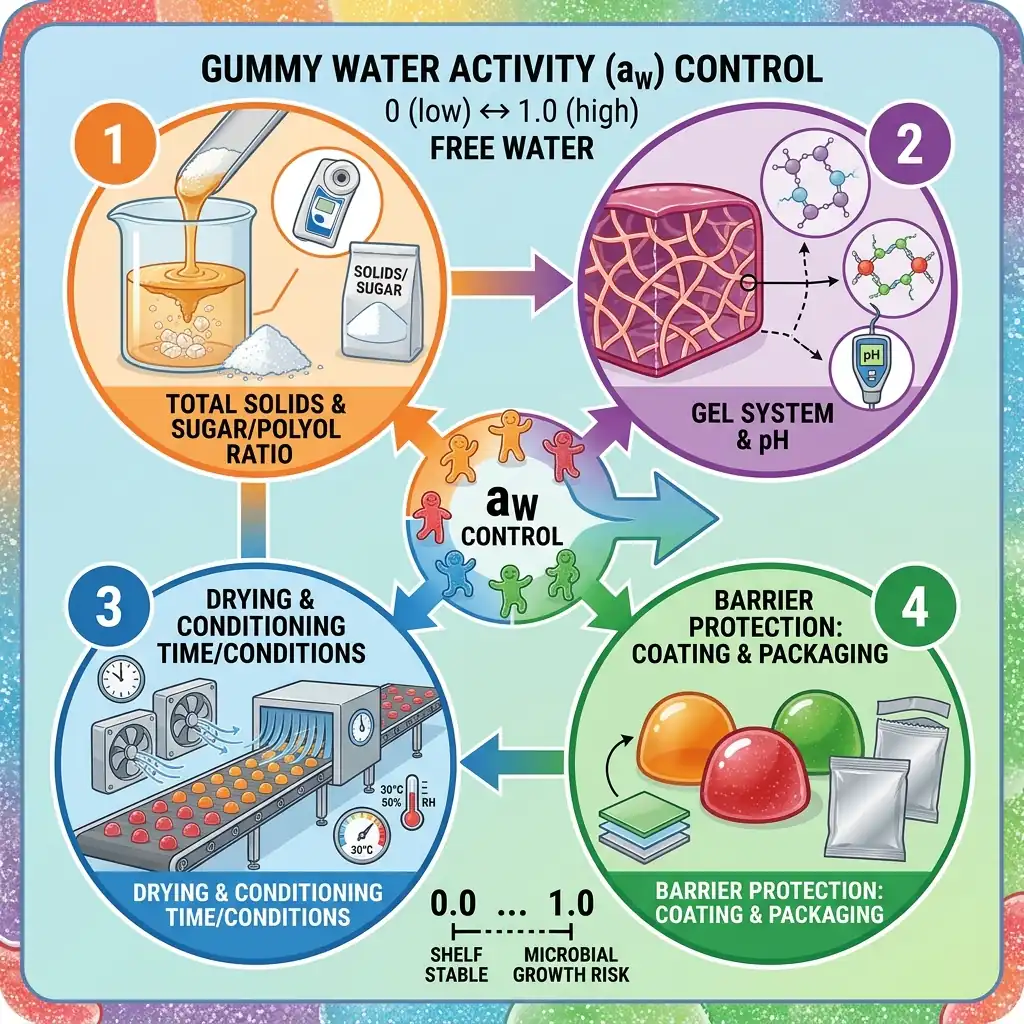
Equilibrium moisture content is the moisture level at which the gummy neither gains nor loses moisture in a given environment. In Gummy Manufacturing, the target EMC is selected to deliver the desired water activity (Aw), typically 0.65-0.75 for gelatin and 0.60-0.75 for pectin systems, while maintaining texture. Optimizing the profile means matching curing conditions to your formula so you reach that target consistently without over-drying, case hardening, or degrading actives.
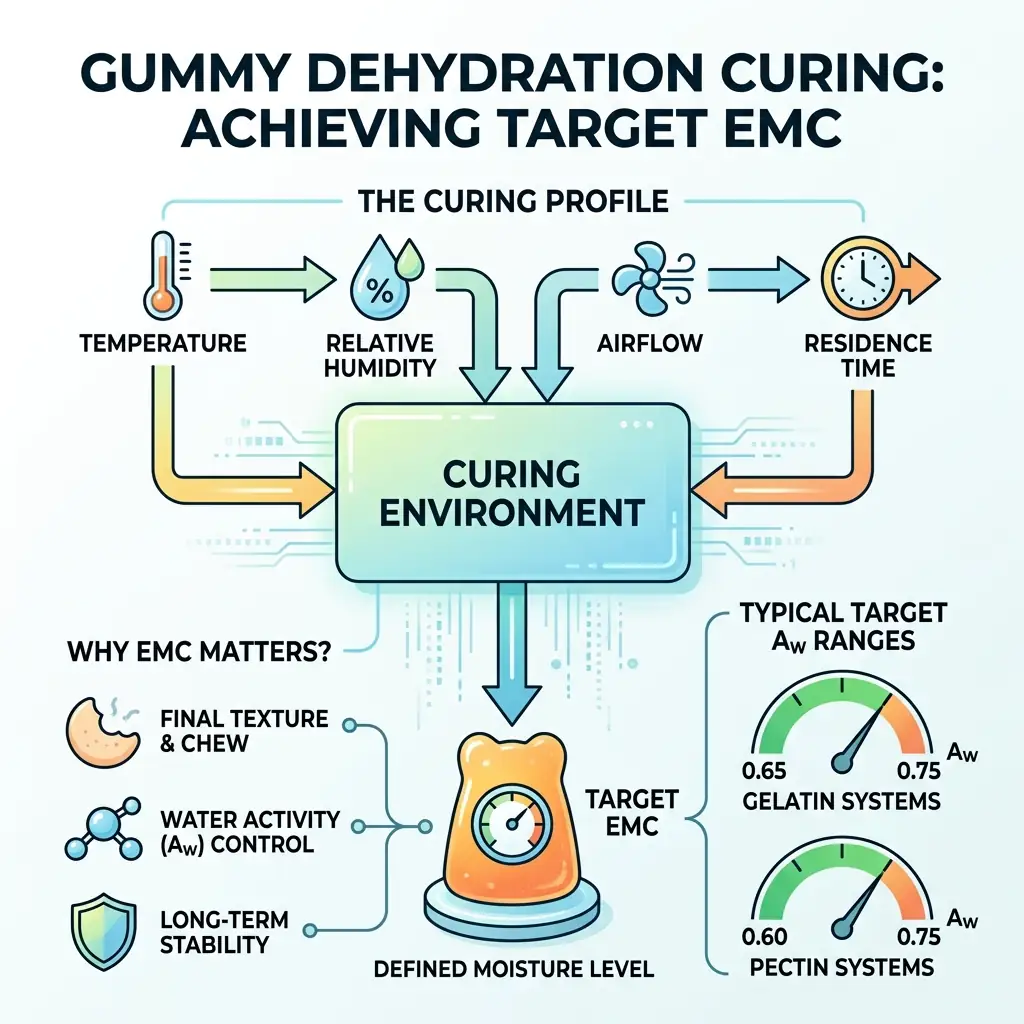
Why Equilibrium Moisture Content Matters for Supplement Brands
Buyers often focus on flavor and actives, but moisture balance decides whether a private label gummy survives distribution. If EMC is too high, water activity rises, increasing microbiological risk, stickiness, and active degradation. If EMC is too low, gummies turn tough, lose weight below label, and increase unit cost.
From a commercial perspective, EMC directly affects three buyer risks:
- Shelf-life validation: High Aw accelerates vitamin oxidation, probiotic loss, and color change. A stable Aw window is required for 18-24 month shelf-life claims.
- Texture consistency: Retailers reject gummies that are too soft in summer or too hard in winter. EMC control keeps chew consistent across lots.
- Weight and count compliance: Over-drying reduces average piece weight, creating net weight shortfalls. Under-drying creates sticky pieces and counting errors.
For procurement teams, this is a cost and QA question. A supplier that cannot explain its target EMC and Aw range cannot guarantee batch-to-batch consistency at scale.
How Dehydration Curing Works in Gummy Manufacturing
Curing is the conditioning stage after depositing and initial setting. Understanding it helps you evaluate supplier capability.
1. Depositing and Initial Set
After cooking, the mass is deposited into starch or silicone molds at 75-90°C depending on gel system. Gelatin sets by cooling to 15-25°C; pectin sets by pH drop and soluble solids increase. At this point, moisture is high, typically 20-28%, and the gummy is too soft for demolding and packaging.
2. Demolding and Entry to Curing
After 12-48 hours of setting, gummies are demolded. Surface moisture is still mobile. If packed immediately, free water migrates into packaging, causing clumping and elevated Aw inside the bottle or pouch.
3. The Dehydration Curing Stage
Curing exposes gummies to controlled temperature, relative humidity, and airflow in curing rooms or tunnels. The goal is to remove unbound water until the internal moisture reaches equilibrium with the curing air. This is not simple drying. The rate must be slow enough to avoid forming a dry crust that traps moisture inside, a defect known as case hardening.
A typical profile is defined by four variables:
- Dry-bulb temperature: 20-35°C for most supplement gummies. Higher speeds curing but risks melting gelatin or degrading heat-sensitive actives.
- Relative humidity (RH): 20-40% RH is common. Lower RH drives faster moisture loss but increases surface hardening risk.
- Air velocity and exchange: Uniform airflow prevents wet and dry spots across trays.
- Time: 24-72 hours depending on formula, piece size, and target EMC.
Formulation Factors That Change the Curing Profile
No single curing profile works for all formulas. The gel matrix and solids composition determine how water is bound and released.
- Gel system: Gelatin holds water loosely and releases it quickly, but softens above 32°C. High-methoxyl pectin binds water more tightly and requires lower RH to reach the same EMC. Pectin also tolerates higher curing temperatures.
- Sugar and polyol ratio: Sucrose, glucose syrup, and allulose increase solids and lower water activity at the same moisture content. Sugar-free systems with maltitol or erythritol often retain more hygroscopic moisture, requiring longer, lower-RH cures to avoid stickiness.
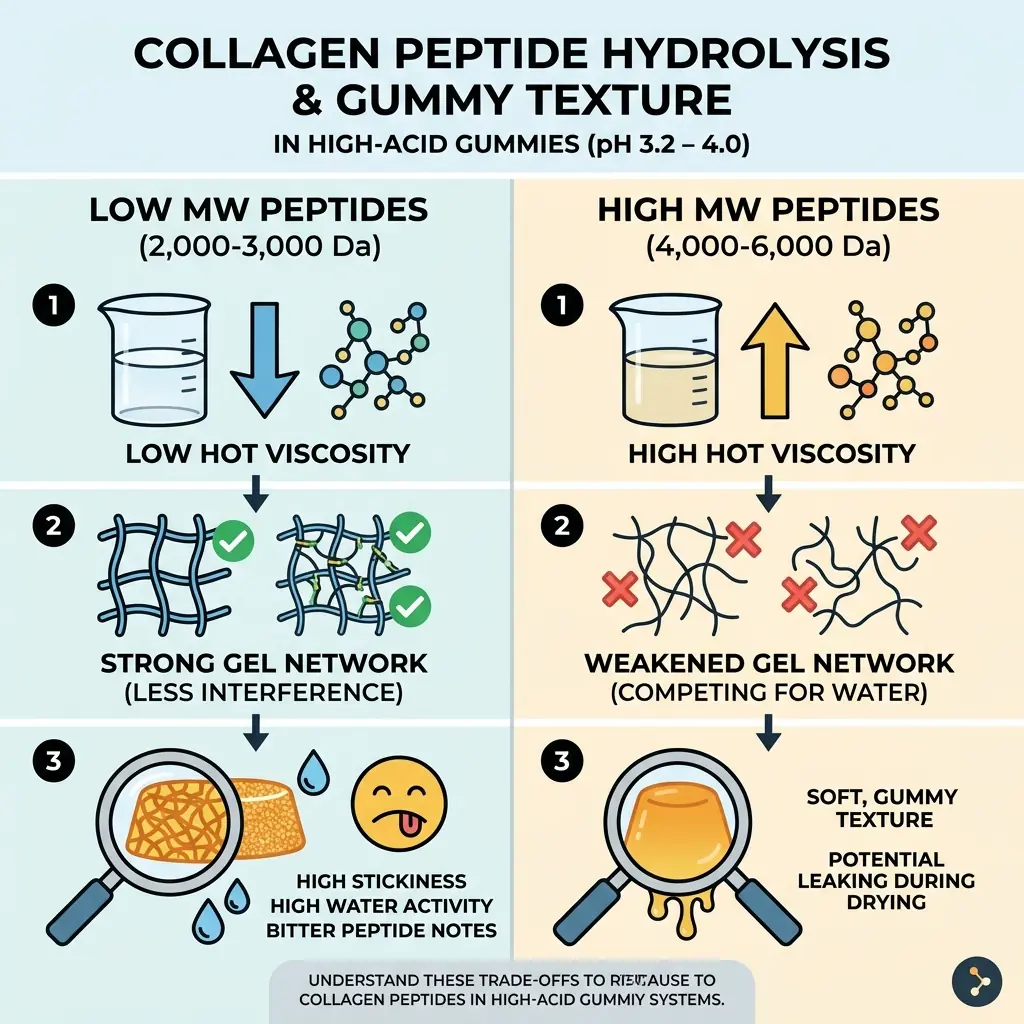
- Humectants and acids: Glycerin and sorbitol plasticize texture and shift the moisture sorption isotherm. Citric acid and sodium citrate affect pH and gel strength. In pectin gummies, pH 3.2-3.8 is critical; deviating changes set and water release.
- Active ingredient loading: Hygroscopic ingredients like magnesium citrate, ashwagandha extract, and choline salts pull moisture from air after curing. High-dose actives such as 500 mg vitamin C increase gummy mass and create uneven drying between center and edge.
- Piece weight and surface area: A 3.0 g gummy cures faster than a 4.5 g gummy. Shapes with thin edges dry faster than cubes, creating texture variation if tray loading is not controlled.
| Gel System | Typical Fresh Moisture After Deposit | Typical Target EMC Range | Curing Sensitivity |
| Gelatin (200-250 bloom) | 22-28% | 14-18% | Sensitive to heat above 30-32°C; risk of melting and deformation if cured too warm |
| High-methoxyl pectin | 24-30% | 16-20% | Sensitive to pH and RH; tolerates 35°C but case hardens quickly if RH is too low |
| Low-methoxyl pectin / gelatin + starch | 20-26% | 12-16% | Slower moisture release; requires longer time and tighter airflow control |
Optimizing the Profile: From Lab Trial to Commercial Scale
Optimization starts with defining the end product, not the dryer setting. The logical sequence used in OEM/ODM development is:
- Define target Aw and texture: Set Aw specification first, for example 0.68 ± 0.03, plus texture profile (hardness, chewiness, springiness measured by texture analyzer). Moisture content is a secondary indicator because two formulas at 16% moisture can have different Aw.
- Build moisture sorption isotherm: In R&D lab, measure EMC at different RH levels at 25°C. This shows where your formula stabilizes. A 10,000-class R&D laboratory can generate this data in small pilot batches.
- Run designed experiments: Vary temperature (22°C, 28°C, 32°C) and RH (25%, 35%) at constant airflow. Track weight loss, Aw, and texture every 6-12 hours. This identifies the fastest profile that reaches target without case hardening.
- Check active retention: For heat-sensitive actives such as probiotics, vitamin C, or methylated B-vitamins, assay active content before and after curing. If loss exceeds specification, lower dry-bulb temperature and extend time.
- Lock curing endpoint criteria: Replace time-based release with Aw + weight loss + texture criteria. For example, release when Aw 0.66-0.70, average piece weight 3.0 ± 0.15 g, and no surface stickiness after 2 hours at 25°C / 60% RH open exposure.
For a buyer, the key question to ask is not “how long do you cure” but “what endpoint criteria and in-process checks control release from curing”.
Scale-Up Considerations and Equipment Requirements
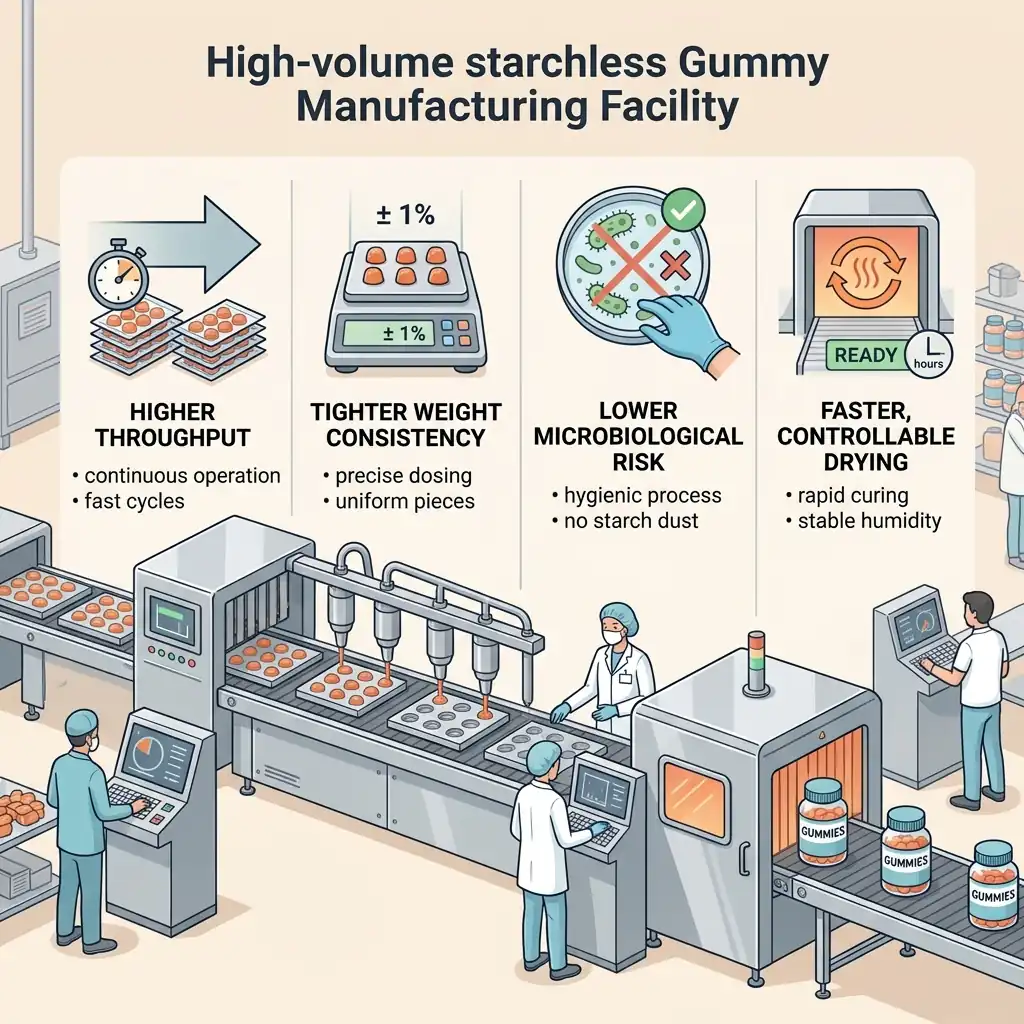
What works in a lab tray dryer fails in a 16-ton-per-day production hall if airflow and loading are not controlled. At commercial scale, three scale-up risks appear:
- Uneven tray loading: Overfilled trays restrict airflow, creating wet centers and dry edges. Standard loading density and spacing must be validated.
- Temperature stratification: Large curing rooms show 3-5°C variation top to bottom. Qualified facilities map temperature and RH and rotate trolleys or use tunnel curing for uniformity.
- Moisture re-absorption after curing: If cured gummies move to a high-humidity packing hall, they regain moisture within hours. Dehumidified packing areas with <45% RH are needed to hold EMC.
Equipment capability directly affects quality. Ask whether the supplier has humidity-controlled curing rooms with real-time RH logging, automated tray handling to avoid manual stacking damage, and dehumidified coating and packaging lines. These systems reduce batch-to-batch moisture variation from ±1.5% to ±0.5%, which matters for texture claims.
| Curing Variable | Too Aggressive | Too Conservative | Optimized Trade-off |
| High temperature | Melting, active loss, sugar browning | Long cycle, higher WIP, mold risk | Gelatin: 22-28°C; pectin: 28-35°C with Aw monitoring |
| Low RH | Case hardening, wrinkled surface, trapped internal moisture | Slow drying, sticky surface | Start at 35-40% RH, step down to 25-30% RH after 12h |
| High airflow | Deformed pieces, uneven weight | Stagnant zones, Aw variation | 0.5-1.5 m/s with baffles and tray rotation |
Quality Control, Testing, and Batch Consistency
Moisture content alone is not enough for release. Mature GMP-certified manufacturers test both moisture and water activity because they answer different questions. Moisture content shows how much water is present. Water activity shows how available that water is for microbes and chemical reactions.
A practical QC program for curing includes:
- In-process weight loss checks: Sample trays weighed at fixed intervals to plot drying curve. Deviation from curve triggers investigation before end of cure.
- Aw and moisture at release: Aw measured by dew-point instrument, moisture by vacuum oven or Karl Fischer for high-sugar systems. Both reported on COA.
- Texture profile analysis: Hardness and chewiness measured on texture analyzer to correlate with sensory panel.
- Microbiological control: Total plate count, yeast and mold on finished gummies. Elevated Aw is a leading cause of yeast growth in gummies during summer distribution.
- Packaging compatibility: If EMC is high, gummies need higher barrier packaging or added desiccant consideration. Bottles with induction seals behave differently than stand-up pouches.
Batch traceability from cooking to curing room ID helps isolate root cause when a lot is too soft or too hard.
Cost, Lead Time, and MOQ Implications
Curing affects production economics more than most buyers expect. A longer, low-temperature cure ties up curing rooms and trays, reducing daily output and increasing work-in-progress. That extends lead time by 2-3 days per batch.
Main cost drivers linked to EMC control:
- Formula complexity: High active loading or hygroscopic botanical extracts may require lower RH and longer cure, increasing energy and labor.
- Gummy weight: Larger pieces need longer curing to reach center EMC, reducing throughput per square meter of curing space.
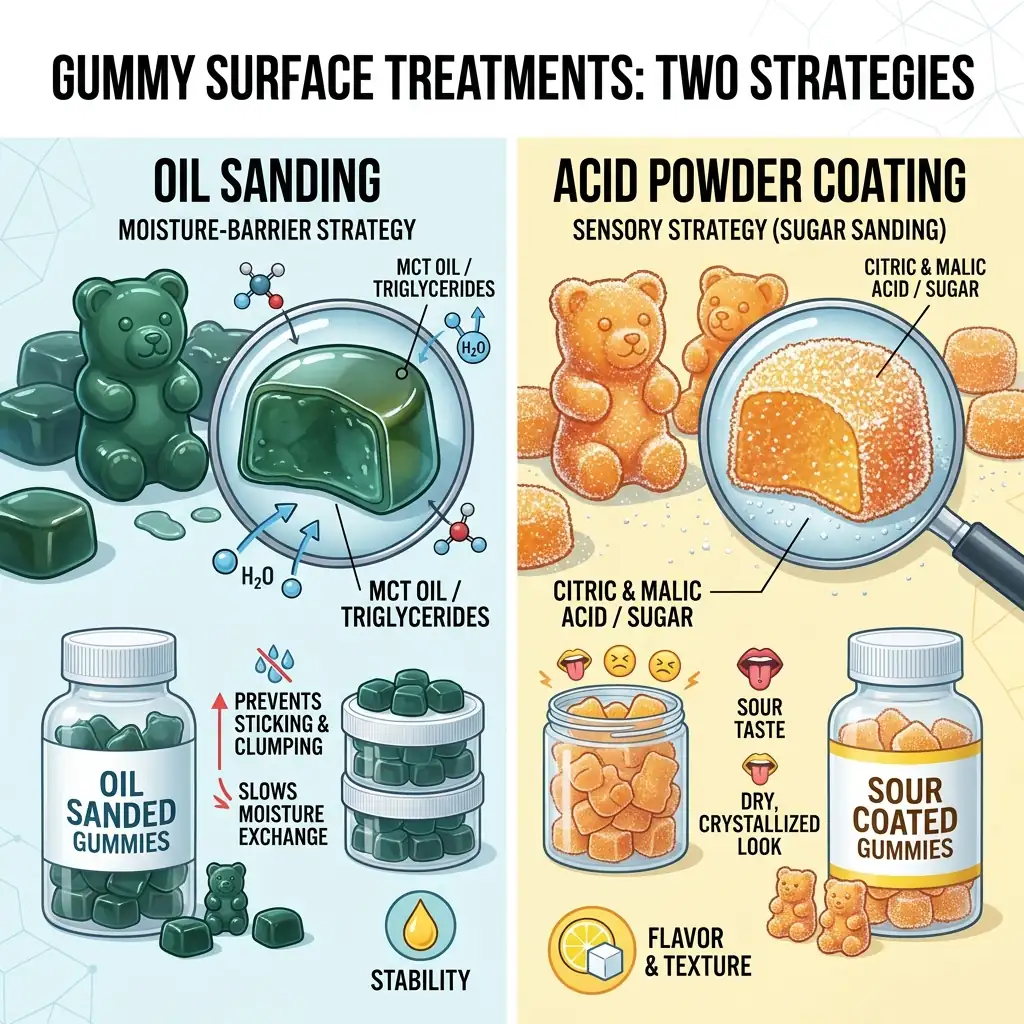
- Coating requirement: Oil or wax coating after curing adds a barrier that slows moisture regain but adds a process step.
- Testing: Aw and texture testing per batch adds cost but avoids rework or returns.
- MOQ: Because curing rooms run most efficiently at full load, suppliers often set MOQ per SKU based on curing trolley capacity. Changing flavor or gel system resets the profile, so small MOQs may not be feasible until the profile is locked.
When you request an OEM/ODM quotation, provide target texture, target Aw, piece weight, and expected storage conditions. This allows the manufacturer to estimate cure time and cost accurately.
How to Evaluate a Gummy Manufacturer for Curing Capability
Not every facility that can deposit gummies can control EMC at commercial scale. When evaluating a Gummy Manufacturer for private label or custom formulation, verify specific capabilities:
- Documented curing parameters: Can they show temperature, RH, airflow, and time ranges per gel system, not just a generic “48-hour dry”?
- Environmental monitoring: Does the curing area have continuous temperature and RH logging with alarms and mapping reports?
- R&D to scale-up process: Do they have pilot curing capacity and a 10,000-class R&D laboratory to develop isotherms before commercial runs?
- Quality systems: ISO9001, ISO22000, HACCP, GMP, BRC, FSSC 22000, FDA registration indicate systematic process control. These systems govern how deviations in curing are documented and corrected.
- Testing capability: In-house Aw meter, moisture analyzer, and texture analyzer for rapid in-process decisions.
- Packaging integration: Ability to pack in low-RH environment and recommend packaging that matches EMC and market climate.
- Export experience: Experience shipping to humid markets where moisture regain in transit is a real failure mode.
Shenzhen Gothink Biotech Co., Ltd., for example, operates a GMP-certified facility with 100,000-class cleanroom manufacturing, 10,000-class R&D laboratory, and approximately 16 tons daily capacity. That scale requires dedicated curing capacity with documented controls to maintain batch consistency across high-volume orders, which is relevant when your private label gummy moves from pilot to 5,000-ton annual scale.
Common Mistakes That Cause Moisture Failure
- Specifying only moisture, not Aw: Two batches at 17% moisture can have Aw 0.66 or 0.74 depending on sugars and humectants. Aw predicts stability better.
- Rushing cure to meet shipment: Releasing gummies early based on surface dryness traps internal moisture, leading to stickiness inside the package after 2-3 weeks.
- Ignoring seasonal RH shifts: A profile that works in winter fails in humid summer if curing rooms are not dehumidified.
- Adding hygroscopic actives late without adjusting profile: Adding magnesium, choline, or herbal extracts at high load without revalidating isotherm raises EMC and Aw.
- Packing in uncontrolled areas: Cured gummies left in open bins in a 60% RH hall regain 1-2% moisture within hours.
Practical Checklist Before You Request a Quotation
To help a manufacturer develop an accurate curing profile, prepare:
- Target gel system (gelatin, pectin, vegan blend) and dietary claim (halal, kosher, vegan, pectin vegan)
- Active ingredients, dosage per serving, and heat sensitivity data
- Desired gummy weight, shape, and texture description (soft, firm, bouncy)
- Target water activity and shelf-life expectation
- Sugar vs. sugar-free preference and any polyol restrictions
- Packaging format and target markets / climates
- Expected order volume, MOQ flexibility, and timeline for pilot to commercial
- Any reference samples for texture matching
FAQ
What is the difference between moisture content and equilibrium moisture content?
Moisture content is the total water in the gummy at any moment. Equilibrium moisture content is the moisture level where the gummy stops exchanging water with the surrounding air at a specific temperature and RH. In Gummy Manufacturing, we cure to reach a defined EMC that gives the target water activity and texture.
What water activity should we target for gummy supplements?
Most gelatin gummies target Aw 0.65-0.72, pectin gummies 0.62-0.72, depending on formula and preservative system. Lower Aw improves microbiological stability but can make texture too firm. The target should be validated with texture and stability data, not set arbitrarily.
How long does dehydration curing take at commercial scale?
Typically 24-72 hours. Gelatin with sugar often 36-48 hours at 22-28°C and 30-40% RH. Pectin sugar-free may need 48-72 hours at 28-35°C and staged RH. High-dose or hygroscopic actives extend time. Exact time depends on piece size, loading, and target EMC.
Can curing degrade vitamins or botanicals?
Yes, if temperature is too high or time too long. Heat-sensitive vitamins such as vitamin C, vitamin B complex, and probiotics lose potency with prolonged exposure above 30°C. The profile should be optimized for active retention, using lower temperature and protective formulation such as encapsulation or adding actives after cooling when feasible.
Why do my private label gummy samples feel different from bulk production?
Lab samples are often cured in small ovens with different airflow and RH than commercial curing rooms. Without matching endpoint criteria based on Aw and texture, lab-to-commercial translation drifts. Ask your Gummy Manufacturer for pilot curing that mimics production airflow and for Aw and texture data across both scales.
How does packaging affect EMC after curing?
If cured gummies are packed in low-barrier pouches or stored in humid conditions, they absorb moisture and Aw rises, causing stickiness. High-barrier bottles with induction seals, desiccant liners where appropriate, and packing in dehumidified rooms help maintain the EMC achieved during curing.
What information does a manufacturer need to quote curing and production accurately?
Provide gel system, complete formula with dosage, gummy weight and shape, target Aw and texture, sugar or sugar-free, packaging format, target shelf life, annual volume, and destination markets. This allows engineering to estimate curing time, throughput, testing, and true MOQ.
Next Step: Align Formulation with Curing Capability
Optimizing dehydration curing profiles is not an isolated drying problem. It links formulation design, active loading, gel chemistry, equipment capability, and packaging. The most efficient path is to lock target EMC and Aw early, develop the isotherm in R&D, and validate the profile at pilot scale before committing to commercial MOQ.
If you are evaluating suppliers for a new supplement gummy, review their curing and conditioning controls, QC methods for Aw and texture, and their ability to document and repeat the profile across seasons. For projects involving high-dose, hygroscopic, or heat-sensitive actives, request a technical discussion on curing endpoint criteria and stability approach.
To move forward, consider exploring gummy manufacturing process details to compare gelatin and pectin platforms, and prepare your specifications for an OEM/ODM quotation. A manufacturer with GMP systems, in-house R&D, and humidity-controlled curing can help translate your target EMC into consistent commercial batches.
Jack Luo|Senior Technical Advisor, Nutrition Research Center Representing Gothink Biology, a GMP-certified dietary supplement manufacturer based in Shenzhen, China.