
Direct Answer: How Precision Dosing Is Controlled for Micro-Nutrients on High-Speed Lines
Precision dosing calibration for micro-nutrients in high-speed depositing is the process of ensuring each gummy contains the labeled amount of an ingredient dosed below 1 mg, often below 100 mcg, despite line speeds of 15,000 to 40,000 pieces per hour. For any Gummy Manufacturer, the core challenge is not the depositor speed itself, but maintaining content uniformity when the active represents less than 0.05% of total mass.
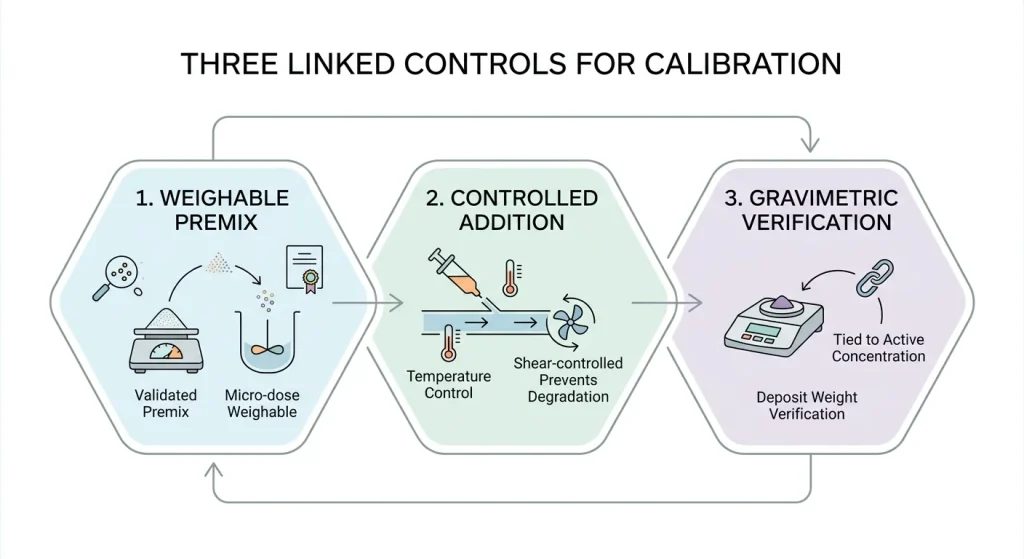
Calibration depends on three linked controls: a concentrated, validated premix that makes a micro-dose weighable, a temperature and shear-controlled addition point that prevents degradation and separation, and gravimetric verification of deposit weight tied to active concentration. When these controls are aligned, you can hold individual gummy weight within +/- 2.5% and active content within USP <905> acceptance value limits at commercial speed.
Why This Topic Matters for Supplement Brands
Brands add micro-nutrients like vitamin D3, methylcobalamin, methylfolate, iodine, selenium, and chromium to differentiate formulas without increasing gummy size. The commercial risk is high. A 25 mcg error in vitamin D3 is a 100% label claim error. That creates regulatory exposure and potential toxicity at the high end, and efficacy failure at the low end.
From a sourcing perspective, this is where many private label gummy projects fail in scale-up. A formula that passes in a 5 kg lab kettle often fails content uniformity in a 300 kg commercial batch because settling, thermal degradation, and depositor dead-volume were not calibrated.
What High-Speed Depositing Changes for a Gummy Manufacturer
Starchless high-speed depositing lines use servo-driven piston depositors fed from a heated hopper and manifold. The mass is held at 75-90°C for gelatin or 85-105°C for pectin, then deposited into molds at 1-2 deposits per second per nozzle.
At this speed, you cannot correct a micro-nutrient error after depositing. Calibration must happen upstream. The mass is in motion for only 60-120 seconds from final active addition to deposit, so homogeneity, viscosity, and temperature must be locked before that window.
Depositor Mechanics That Affect Dose
- Piston volume accuracy: Servo pistons are calibrated by weight, not active content. If active concentration in the mass drifts by 5%, every gummy drifts by 5% even if weight is perfect.
- Manifold residence time: Long manifolds create different ages of mass in different nozzles. Heat-sensitive micro-nutrients degrade more in the outer lanes.
- Hopper agitation: Insufficient low-shear agitation allows dense mineral salts or oil-based vitamin D3 carriers to stratify. Over-agitation introduces air and breaks gel structure.
Core Formulation Risks in Gummy Manufacturing With Micro-Doses
1. Homogeneity at <0.1% Load
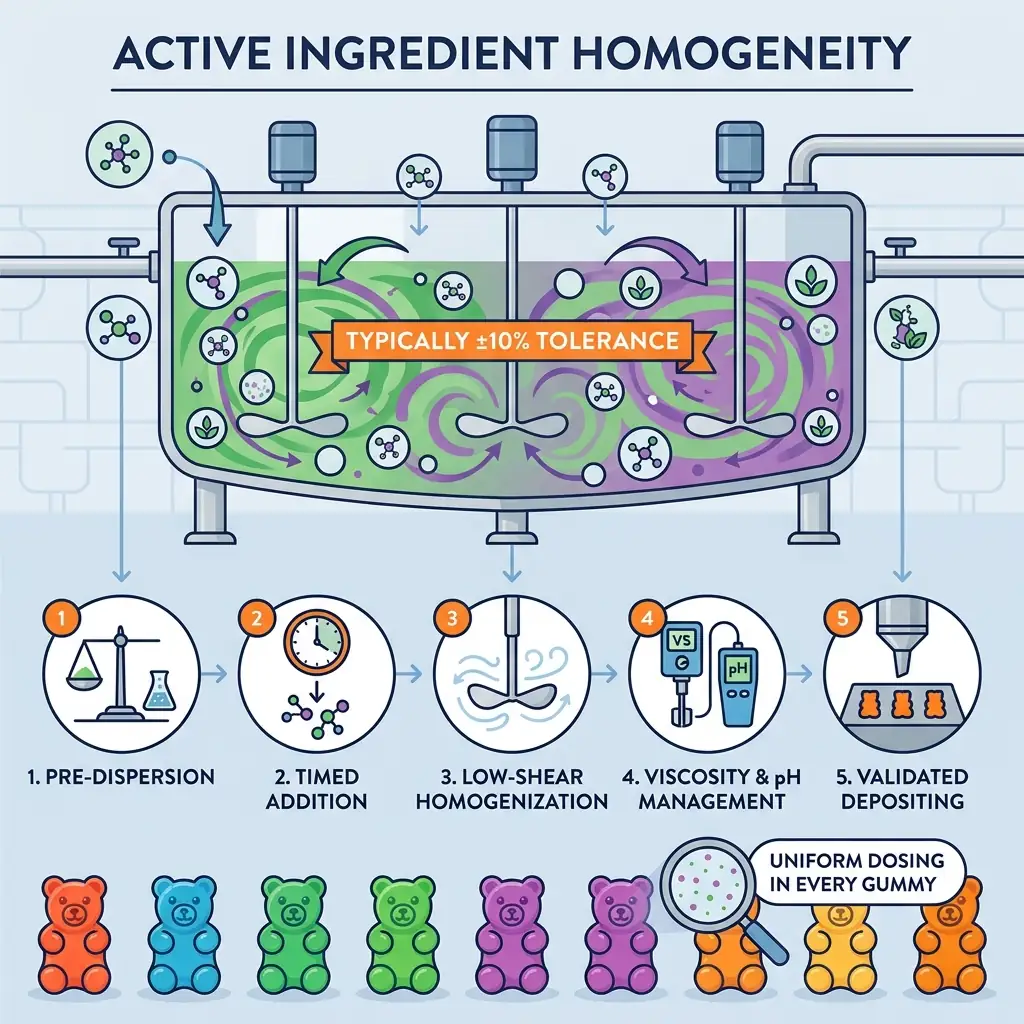
Direct addition of 50 mg of vitamin B12 into 100 kg of gummy mass will never disperse uniformly. Gummy Manufacturing practice for micro-nutrients is to create a 1% to 10% concentrated premix first. For oil-soluble D3 or K2, the carrier is typically MCT oil or sunflower oil with a high-shear pre-emulsion. For water-soluble methylcobalamin or folate, the carrier is a small portion of water, glycerin, or syrup at controlled pH.
This premix is then added to the main batch under controlled shear. The logic is to convert a micro-dose weighing problem into a macro-dose mixing problem.
2. Heat Sensitivity and Oxidation
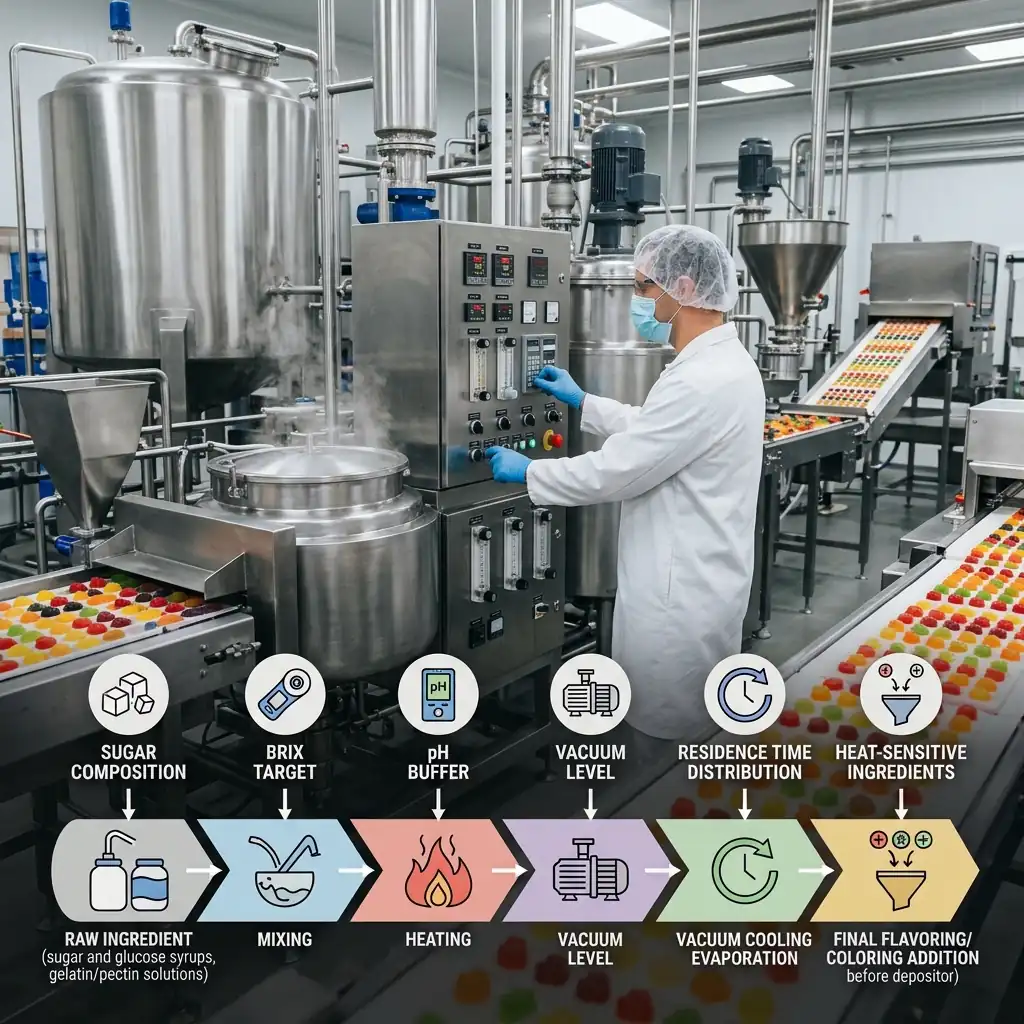
Methylcobalamin, methylfolate, and vitamin D3 degrade with prolonged heat. Gelatin systems require holding at 80-85°C to maintain flow. Pectin systems require cooking to 106-108°C Brix, then rapid cooling before depositing.
The addition point matters. Heat-sensitive micro-nutrients are added after the high-heat cooking stage, during the cooling/holding phase at 70-80°C. The batch is held for the minimum time needed for uniform mixing, not for convenience. Every extra 10 minutes at 80°C reduces B12 potency measurably.
3. pH and Gel System Interaction
Pectin requires pH 3.2-3.8 to set. At that pH, some mineral forms like sodium selenite can cause discoloration or interact with flavor. Gelatin sets at pH 3.8-4.5 and is more tolerant, but acidic fruit acids added for flavor can still cause hydrolysis if added too early.
Micro-nutrients rarely drive pH, but their carriers do. Citric acid buffer solutions used to dissolve minerals can drop local pH and cause pre-gelation. That creates lumps that trap actives and cause dose variation.
4. Water Activity and Hygroscopicity
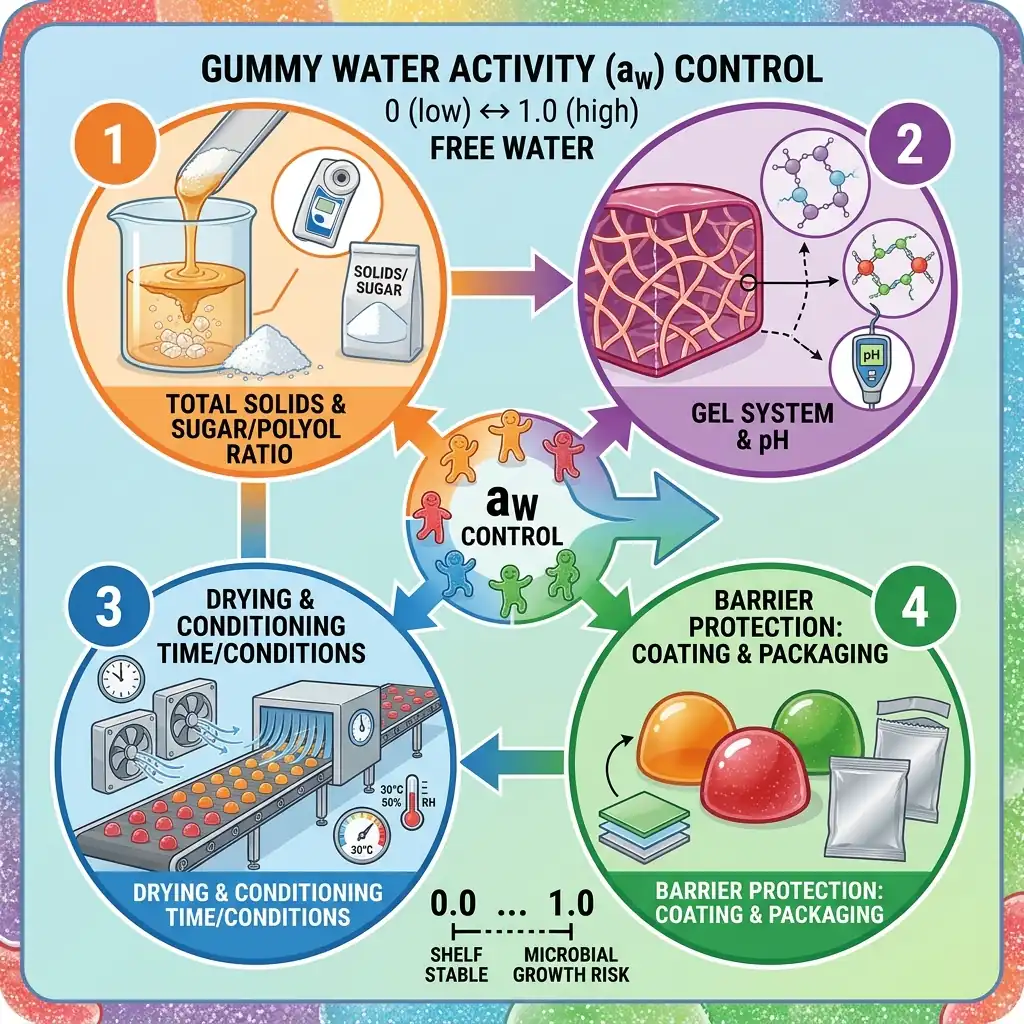
Mineral salts like potassium iodide are hygroscopic. If introduced as dry powder, they pull moisture and create spots with high local water activity (Aw). That affects both microbial stability and texture. Dissolving them in the premix water phase gives more uniform Aw distribution.
Precision Dosing Calibration Workflow Used in Commercial Production
Step 1: Define Dose per Gram, Not per Gummy
The first calculation is active concentration in mg per gram of final gummy mass at target Brix, not mg per piece. Example: a 3.0 g gummy with 25 mcg vitamin D3 needs 8.33 mcg per gram of mass. All premix calculations start from that number.
Step 2: Build and Validate the Premix
A 2-5 kg premix is made for a 200-300 kg batch. The premix itself is assayed for content uniformity before it enters the main batch. If the premix RSD is >3%, it will not improve in the large batch. This is a critical quality gate.
Step 3: Calibrate Depositor by Weight and Verify by Assay
Calibration has two layers. First, gravimetric calibration: 20-30 gummies per lane are weighed at start-up, and piston stroke is adjusted to reach target average weight. Second, active calibration: composite samples from each lane are tested by HPLC or ICP-MS for the micro-nutrient.
Weight alone does not prove dose. A line can deposit perfect 3.0 g gummies that are all low in D3 if the premix settled. True precision dosing requires weight calibration plus in-process assay correlation during first article inspection.
Step 4: Control Line Speed to Stability Window
For highly sensitive actives, many manufacturers reduce depositing speed by 10-15% to shorten hopper hold time, or use a smaller hopper with more frequent batch additions. This keeps total time above 70°C under 90 minutes. The trade-off is throughput versus degradation.
| Micro-Nutrient Type | Typical Dose per Gummy | Common Form for Depositing | Main Calibration Risk | Practical Control |
|---|---|---|---|---|
| Vitamin D3 | 10-50 mcg | Oil solution in MCT | Oil separation, oxidation | Emulsified premix, low-oxygen addition, assay per lane |
| Methylcobalamin B12 | 10-100 mcg | Water solution, protected from light | Heat and light degradation | Addition at <75°C, amber hopper cover, minimal hold time |
| Methylfolate | 100-400 mcg | Dissolved in neutral pH glycerin/water | pH sensitivity | Premix pH adjusted to 6.0-7.0 before addition |
| Iodine / Selenium | 20-150 mcg | Potassium iodide / selenite in water | Hygroscopic clumping, taste | Fully dissolved, flavor masking after addition |
Equipment and Process Controls That Protect Content Uniformity
High-speed lines for micro-nutrient gummies require specific features. Temperature-controlled hoppers with jacketed heating and low-shear sweep agitation prevent stratification without whipping air. Inline static mixers after premix injection improve homogeneity before the manifold.
Mass flow meters on the premix feed provide more accurate addition than volumetric dosing. Servo depositors with individual lane feedback allow compensation for lane-to-lane variation. Some lines add checkweighers that reject individual gummies outside +/- 4% weight, but that only catches weight errors, not content errors.
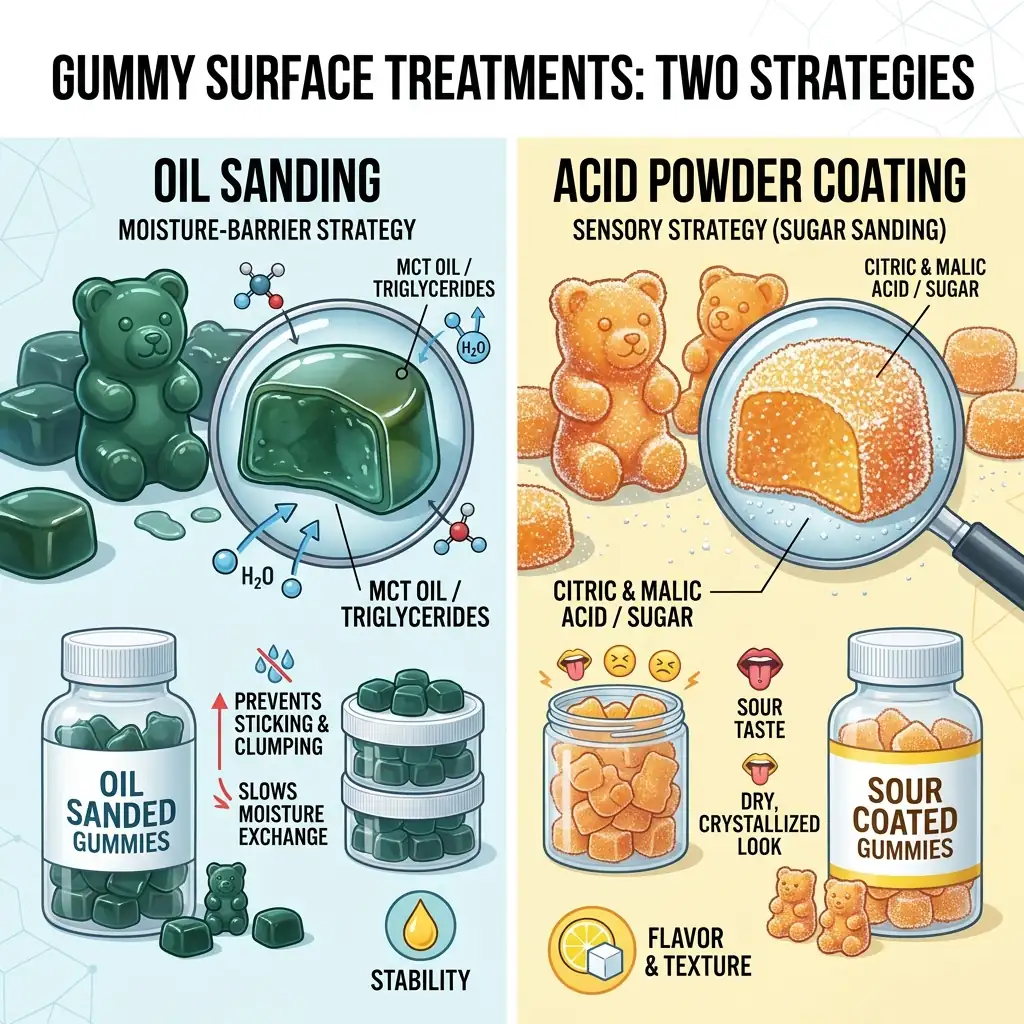
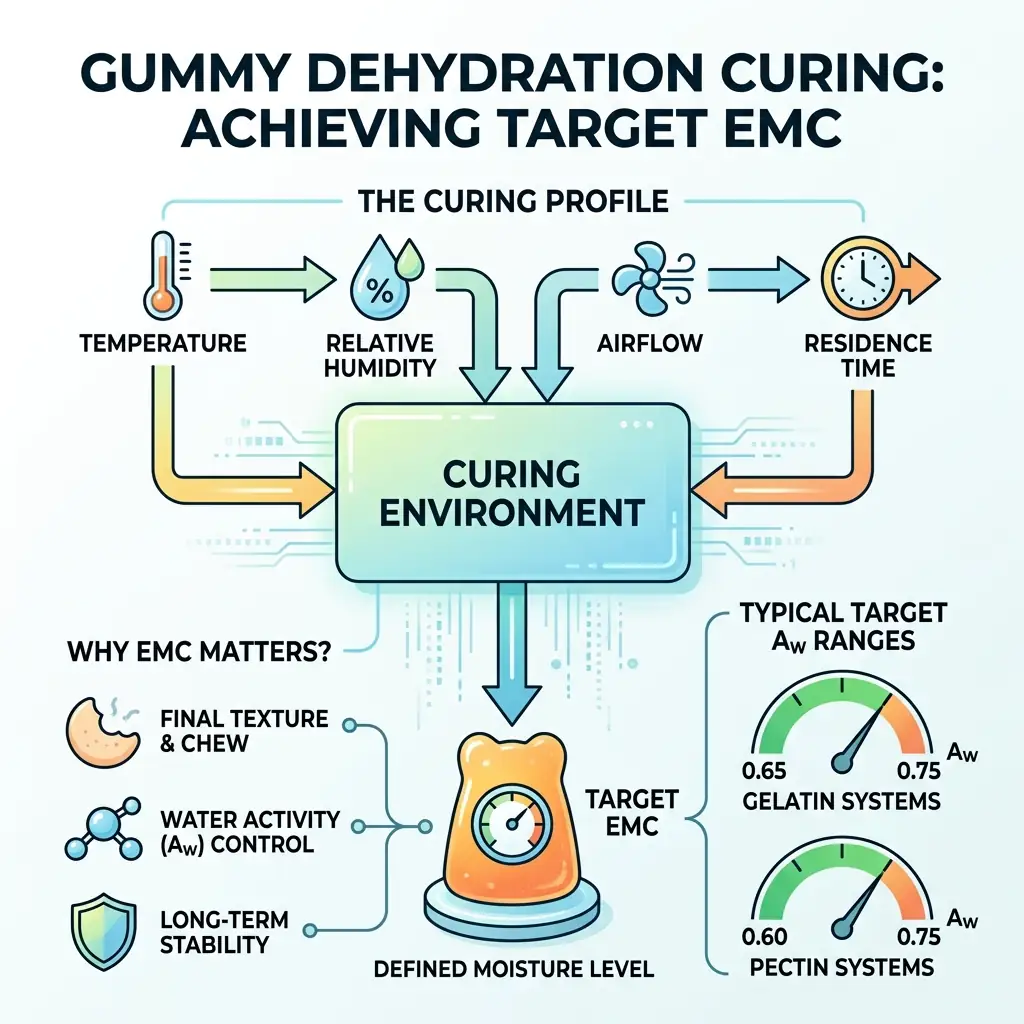
Coating and drying stages also matter. If gummies are oiled or sanded after demolding, uneven coating can create weight variation that masks as dose variation. Drying to a target final water activity of 0.65-0.75 must be uniform across trays. Over-dried pieces weigh less and show artificially high potency per gram.
Quality Control and Testing Strategy
Quality for micro-nutrients is built on layered testing. Raw material assay confirms premix potency. Premix assay confirms homogeneity before scale-up. In-process testing during depositing includes gummy weight every 15 minutes and composite active assay at start, middle, and end of batch.
Finished product testing must include content uniformity per USP <905> for micro-doses, not just average assay. Microbiological testing, water activity, pH, and texture analysis confirm that controls to protect the active did not compromise gel structure. Texture failure often indicates pH or thermal process drift that also affects dose.
Stability protocol should include active testing at 0, 3, 6, 12 months under intended packaging. Micro-nutrients like D3 in pectin gummies can migrate into packaging if the oil barrier is inadequate. Packaging compatibility testing with both bottle and pouch formats is recommended.
Scale-Up Considerations: From Pilot to Commercial
Pilot batches of 10-20 kg mix in 30 minutes. Commercial batches of 300 kg require 60-90 minutes to heat, mix, and deposit. The thermal history doubles. A formula that shows 98% B12 recovery at pilot may show 88% at commercial if addition timing is not adjusted.
Scale-up validation should lock three parameters: premix concentration and mixing time, main batch addition temperature and hold time, and maximum hopper residence time. If any of these change, re-validation of content uniformity is needed.
Equipment differences matter. A lab depositor with one nozzle does not replicate lane-to-lane variation of a 20-nozzle commercial manifold. Qualification should include lane-specific sampling.
Cost, MOQ, and Production Economics for private label gummy With Micro-Nutrients
Micro-nutrient gummies carry cost drivers that do not exist for high-dose vitamin C gummies. Premix preparation adds labor and testing. HPLC/ICP-MS testing for 10-lane validation is more expensive than simple weight checks. Overages to compensate for heat loss add ingredient cost.
MOQ becomes important because of cleaning and line loss. The manifold and hopper hold 5-15 kg of mass that is purged at start-up. For a 500 kg order, that loss is 1-3%. For a 100 kg trial, it is 5-15%. Most manufacturers set higher MOQs for micro-dose gummies to keep economics viable.
Lead time is affected by premix sourcing. Custom oil-based D3 or chelated selenium premixes may require 2-3 weeks from specialty ingredient suppliers. Packaging with higher barrier (induction-sealed bottles with desiccant) may be recommended for iodine and B12 stability, which adds cost but reduces stability failure risk.
How to Evaluate a Gummy Manufacturer for Micro-Nutrient Capability
Not every gummy line can hold micro-nutrient accuracy. Ask for verifiable capabilities rather than general claims.
- GMP and quality systems: GMP, ISO22000, HACCP, FSSC 22000, BRC. Ask how they document content uniformity for low-dose products.
- R&D capability: Do they have a 10,000-class lab that can make and assay premixes independently from production? Can they develop oil-in-water emulsions for D3/K2?
- Depositing controls: Servo piston depositors with gravimetric feedback, jacketed hoppers with low-shear agitation, ability to sample by lane.
- Testing: In-house HPLC, ability to test B12 and folate without light degradation, ICP-MS for minerals, and content uniformity testing per batch.
- Scale-up experience: Pilot-to-commercial data showing recovery of heat-sensitive micro-nutrients at commercial batch size.
- Documentation: Batch records that record premix lot, addition temperature, hopper time, lane weight, and in-process assay.
- Export experience: Understanding of label claim tolerances for vitamin D and iodine in US, EU, and other target markets.
Shenzhen Gothink Biotech Co., Ltd. operates a GMP-certified facility with a 100,000-class cleanroom and a 10,000-class R&D laboratory, with approximately 16 tons of daily production capacity. For micro-nutrient projects, relevant capabilities include custom premix development, temperature-controlled depositing, and batch traceability from premix to finished gummy. Mention of capacity is only relevant when evaluating whether a supplier can handle both trial and commercial volumes without changing lines.
Common Mistakes Buyers Make
- Specifying dose per gummy only: Without defining gummy weight and target Brix, the manufacturer cannot calculate concentration per gram.
- Requiring zero overage: Zero overage for B12 or D3 guarantees end-of-shelf-life failure. Overage should be justified by stability data, typically 10-20% for sensitive micro-nutrients, not arbitrary.
- Adding micro-minerals as dry powder: Dry addition creates hot spots and metallic taste. Dissolved addition is standard for <1 mg doses.
- Ignoring lane variation: Accepting a composite average assay without lane-specific data hides systematic errors in outer nozzles.
- Choosing pectin without checking pH interaction: Pectin needs low pH, which can destabilize some folate forms. Gelatin or low-pH-stable folate salts may be better.
Practical Checklist Before You Request a Quote
- Define active form and dose per gummy: e.g., vitamin D3 as cholecalciferol 25 mcg, methylcobalamin 50 mcg.
- Define target gummy weight, gel system (gelatin/pectin), flavor profile, and sugar/sugar-free base.
- State whether active is oil or water soluble and any carrier restrictions (vegan, allergen-free).
- Provide target market and label claim tolerance (e.g., FDA 100-150% for vitamins at expiry).
- Share packaging format: bottle count, pouch, barrier requirements, desiccant need.
- Ask for premix strategy, addition point, maximum hopper time, and lane-specific content uniformity plan.
- Request pilot batch with full content uniformity data before committing to commercial MOQ.
FAQ
How accurate can high-speed depositing be for micro-nutrients under 100 mcg?
Weight accuracy is typically +/- 2-3%. Active accuracy depends on premix homogeneity. With a validated premix and controlled hopper time under 90 minutes, commercial lines can achieve content uniformity with acceptance value <15.0 per USP <905>. Without a premix, accuracy fails.
Do micro-nutrients require slower line speeds?
Not always, but often yes for B12, folate, and D3. Reducing speed by 10-15% or using smaller, more frequent batch additions shortens thermal exposure and prevents stratification. The decision is based on stability data, not a fixed rule.
Can vitamin D3 and iodine be combined in one pectin gummy?
Yes, but formulation trade-offs exist. D3 needs oil-phase protection and pectin needs low pH. Iodine is sensitive to oxidation and can cause flavor issues. The combination requires an emulsified D3 premix, fully dissolved iodine in neutral pH water, and addition after pectin cooking. Stability validation is essential.
What information does a Gummy Manufacturer need to quote a micro-nutrient gummy?
Active form, dose per piece, target gummy weight, gel system, flavor direction, sweetener system, packaging, target market, and required shelf life. For micro-doses, also specify any carrier restrictions and whether you require vegan certification. That allows calculation of premix cost and testing burden.
Why is overage necessary for micro-nutrients and how is it set?
Overage compensates for manufacturing loss and degradation during shelf life. For heat-sensitive micro-nutrients, overage is set from pilot recovery data and accelerated stability, not guessed. Typical justified overage is 10-20%. Excessive overage creates toxicity risk for D3 and selenium.
How does water activity affect micro-nutrient gummies?
High water activity increases mobility and degradation of water-soluble B12 and folate. Low water activity below 0.60 can make pectin gummies hard and trap actives unevenly. Target 0.65-0.75 balances texture and stability. Uniform drying is part of dosing calibration.
What packaging is best for micro-nutrient gummies?
High-barrier bottles with induction seal and desiccant are common for B12 and iodine gummies due to light and moisture sensitivity. Pouches need metallized film with oxygen barrier. Packaging choice affects stability and should be part of the quotation.
Next Step: Align Specification With Process Capability
If you are developing a formula that includes D3, K2, B12, folate, iodine, or selenium at microgram doses, align your specification with depositing capability before locking gummy size and flavor. Share your target dose per gram, gel system preference, and market tolerance with your manufacturing partner.
For brands evaluating suppliers, review the detailed gummy manufacturing process controls, quality systems, and R&D scale-up approach. If you need a private label gummy with micro-nutrients, request a custom formulation that includes premix strategy, lane-specific content uniformity plan, and stability-based overage justification.
For further technical background, explore our Knowledge Hub and our Quality & Compliance Center.
Jack Luo|Senior Technical Advisor, Nutrition Research Center Representing Gothink Biology, a GMP-certified dietary supplement manufacturer based in Shenzhen, China.