
Direct Answer: How Water Activity Control Prevents Clumping and Mold in Gummies
Water activity (aw) is the amount of free water in a gummy available for microbial growth and for migration between gummies. In Gummy Manufacturing, controlling aw is what separates a stable commercial product from one that clumps in the bottle, sweats in the pouch, or grows mold before its expiry date.
For most supplement gummies, the target aw range is 0.55 to 0.70 at release. Below 0.65, most molds and yeasts cannot grow. Below 0.60, you gain additional safety margin, but texture can become too firm if drying is excessive. The practical goal is to hit a low, consistent aw while preserving chew, clarity, and active potency.
Clumping and mold are not packaging problems alone. They are symptoms of incomplete aw control during cooking, conditioning, coating, and packaging. If you are evaluating formulas or suppliers, ask how aw is designed into the formula and controlled in the process, not just what final moisture content is reported.
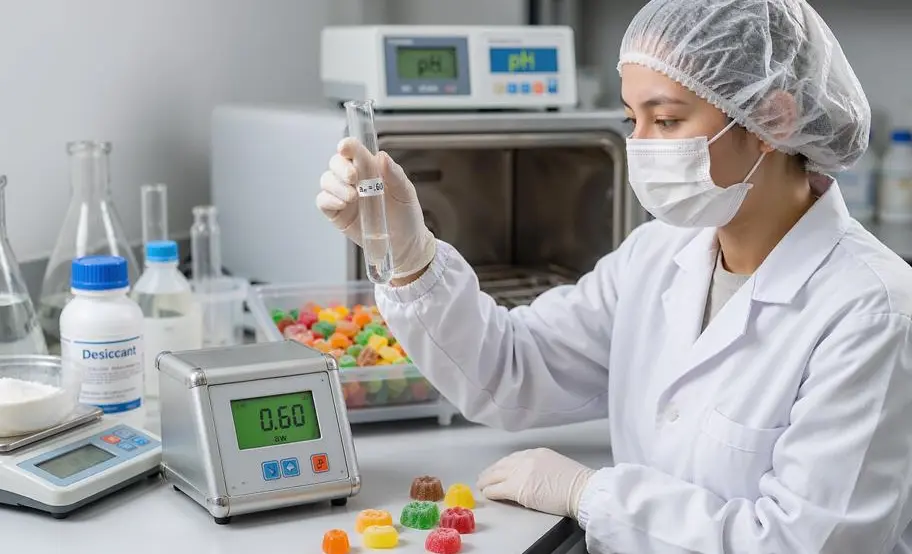
Why Water Activity Control Matters for Supplement Brands
A brand owner searches for this topic after seeing white spots, wet gummies, fused blocks in jars, or a failed micro test. These issues trigger consumer complaints, retail chargebacks, and in worst cases, recalls.
From a manufacturing perspective, high aw means free water is still mobile. It migrates to the surface, dissolves sanding sugars or surface oil, and creates liquid bridges between gummies. That is clumping. The same free water raises the risk of yeast and mold growth, especially for pectin gummies which are often deposited at higher pH and higher moisture than gelatin.
For buyers of private label gummies, aw directly affects shelf-life claims, packaging choice, and shipping stability. A gummy that passes QC at 25°C / 60% RH in Shenzhen can still clump after a summer shipment to Texas if its aw was 0.72 at release instead of 0.63.
Water Activity vs Moisture Content: What Buyers Should Understand
Moisture content is total water in the gummy. Water activity is free water available to react. Two gummies can both have 12% moisture but have very different aw because of how water is bound by sugars, polyols, and hydrocolloids.
High-solids sugar syrups, polydextrose, and certain fibers bind water and lower aw without necessarily lowering total moisture to extreme levels. This is why a specification should include both: moisture as a process control, aw as a stability and safety release parameter.
A capable manufacturer measures aw with a calibrated water activity meter at multiple points, not only on finished product. Relying on loss-on-drying alone will miss batch-to-batch risk.
Gummy Manufacturing Stages Where Water Activity Is Determined
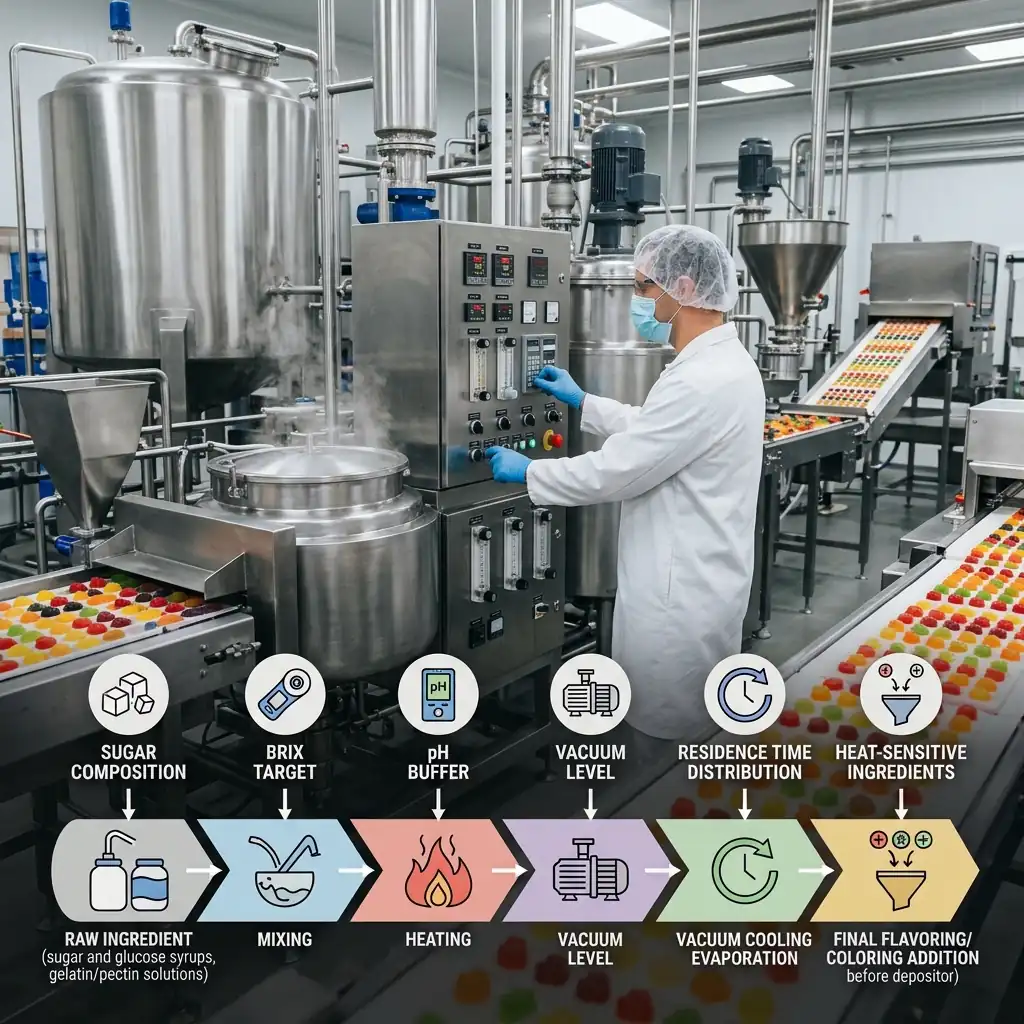
Water activity is not fixed in one step. It is built across five stages in Gummy Manufacturing. Each stage has a specific technical purpose.
1. Cook and Solids Content
The cook sets the initial solids. For pectin gummies, solids are typically cooked to 78-82 Brix; for gelatin, 75-80 Brix depending on texture target. Under-cooking leaves excess free water that cannot be removed efficiently later.
Vacuum cooking helps remove water at lower temperature, which protects heat-sensitive actives like vitamin C or B vitamins. Atmospheric open cooking is faster but creates more color darkening and higher heat exposure for the gel system.
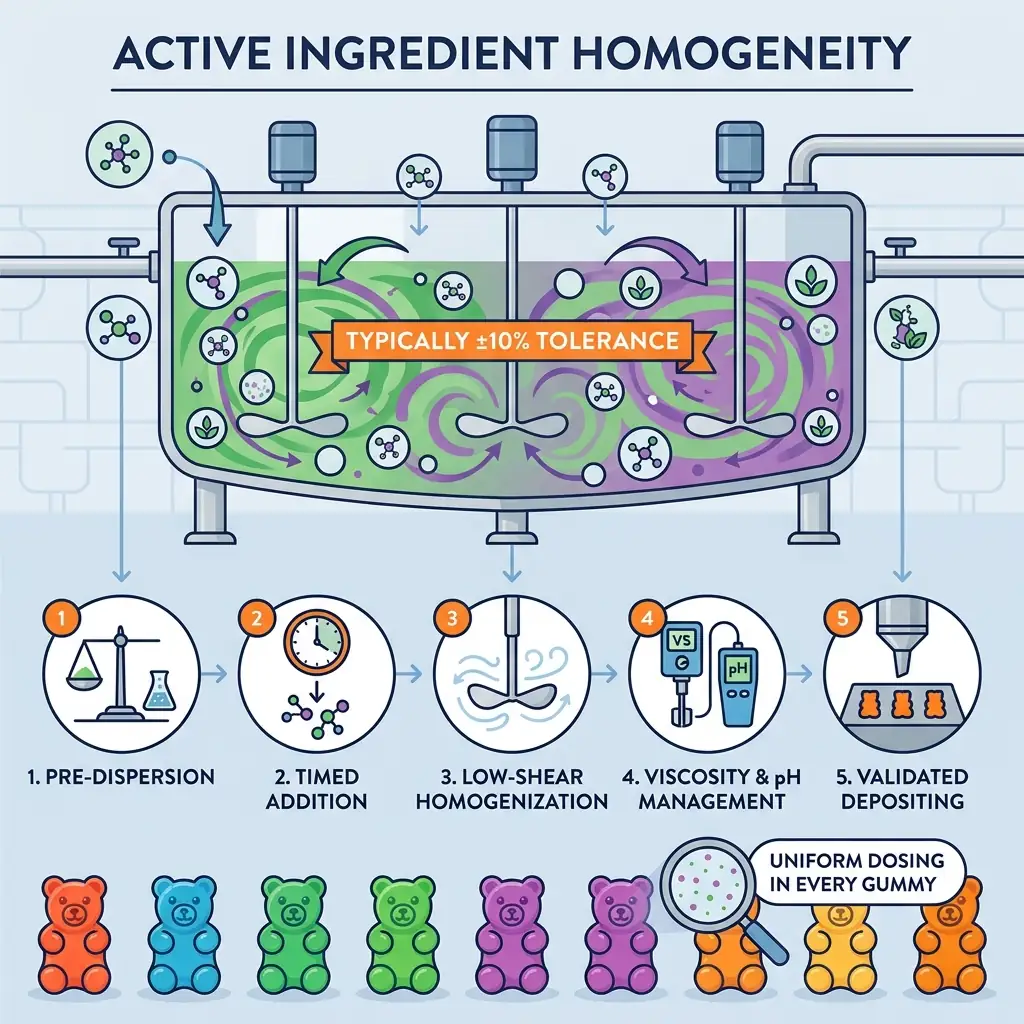
2. Active Ingredient Addition and pH Control
Actives are added after cooling the mass to 85-95°C for gelatin or 95-105°C for pectin to limit degradation. Many hygroscopic ingredients, such as magnesium citrate, zinc citrate, or sodium ascorbate, pull moisture from the air and release it into the matrix.
pH affects gel structure and water binding. Pectin requires 3.2-3.8 for high-methoxyl pectin to set, which requires acid addition. If acid is added too early or too fast, it breaks pectin and releases bound water, raising aw. Gelatin is more tolerant but loses bloom strength at very low pH over storage.
3. Depositing, Cooling and Setting
Depositing must be rapid and uniform. Uneven depositing creates weight variation, and heavier gummies retain more core moisture than smaller ones in the same batch. That variation shows up as mixed aw in finished product testing.
Cooling tunnels set the structure. If gummies are pulled too early, starch molds retain moisture and the surface stays tacky. Silicone mold systems cool faster and give more consistent initial aw because demolding is cleaner.
4. Drying / Conditioning – The Main aw Control Point
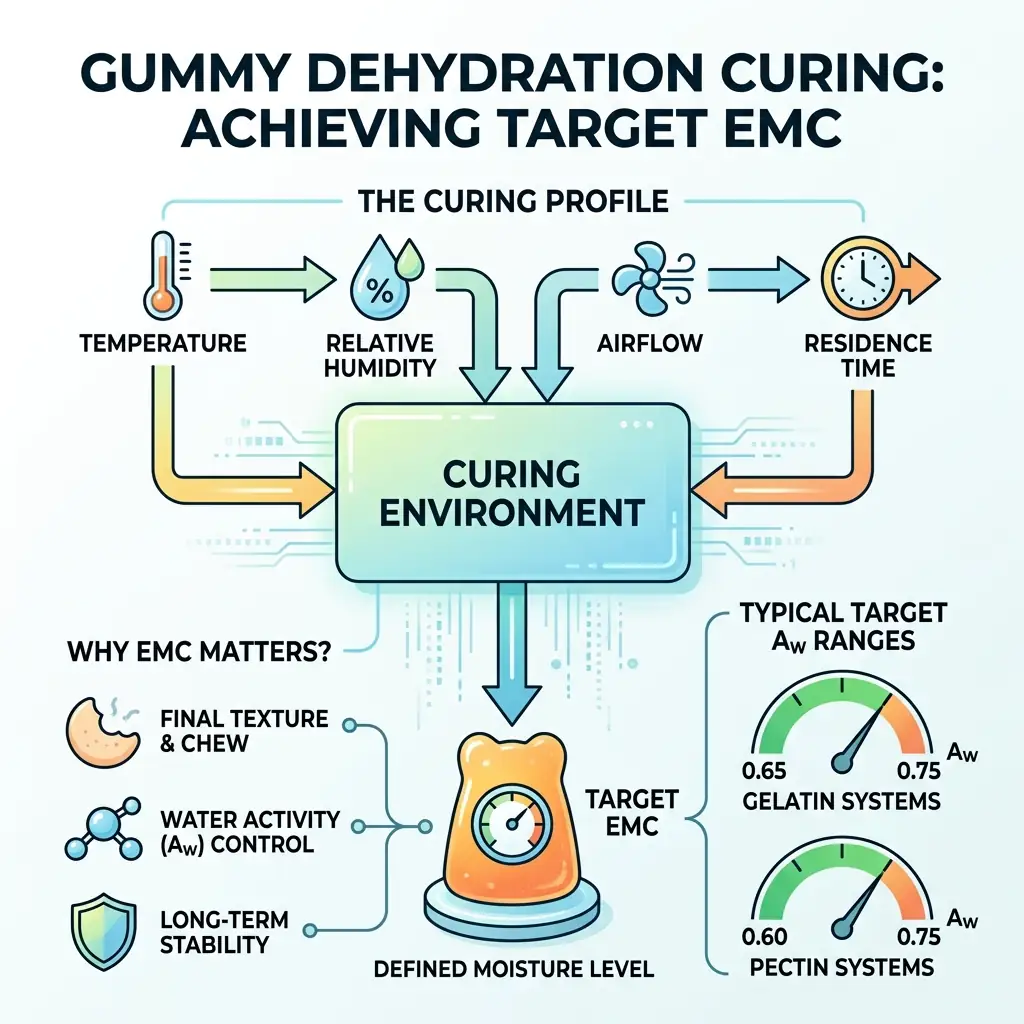
Conditioning is where aw is actively reduced. Gummies are held in drying rooms or tunnel dryers at 18-25°C, 20-35% RH, with controlled airflow for 24-72 hours depending on formula, size, and gel type.
This step removes surface water and equilibrates internal moisture. Skipping or shortening it is the most common cause of clumping. For high-dose or hygroscopic formulas, a longer, low-temperature conditioning curve prevents case-hardening, where the surface dries too fast and traps water inside.
5. Coating and Packaging
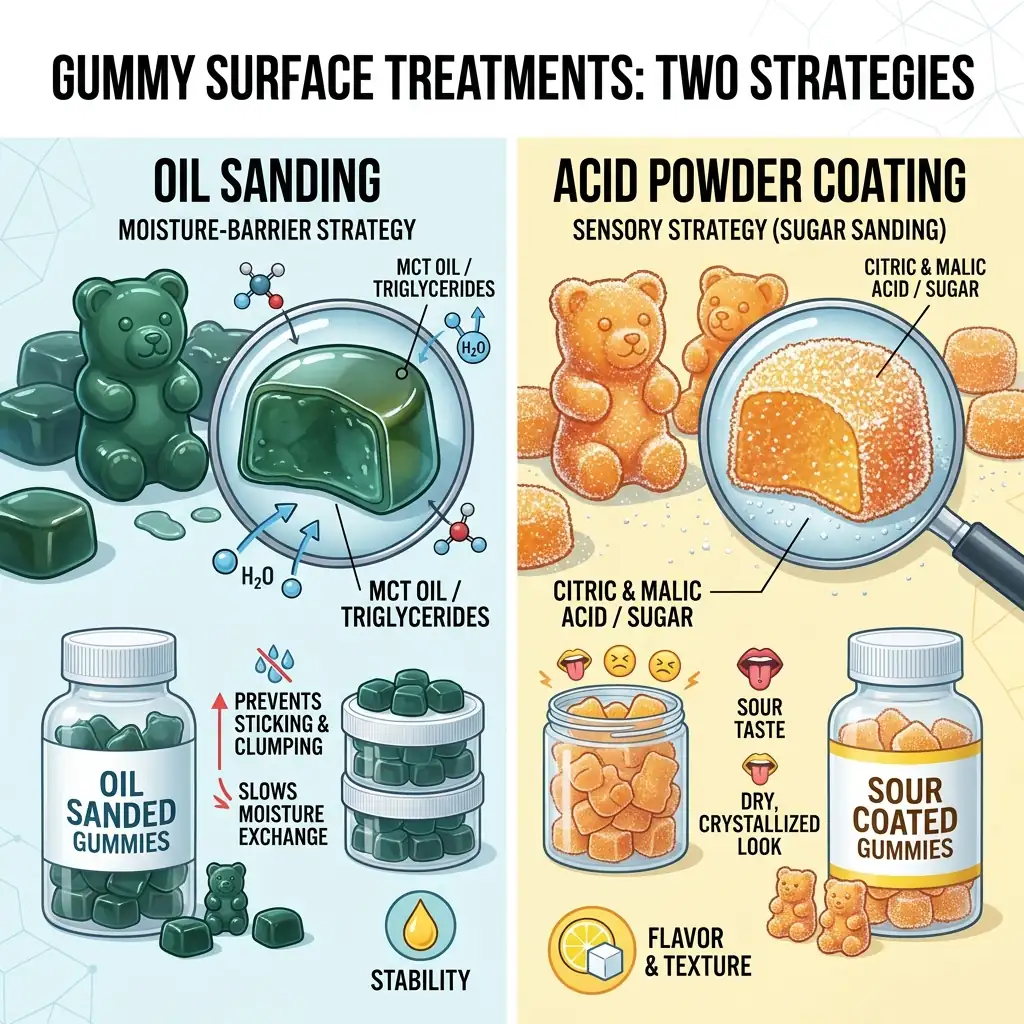
Surface treatment creates a barrier to moisture migration. Options include oil polish with carnauba wax or beeswax, sanding with fine sugar, or non-stick starch-based coating for sugar-free systems. Each affects aw differently. Wax polish reduces surface tack but does not fix a high internal aw. Sanding absorbs surface moisture temporarily but can dissolve if aw is too high.
Packaging must match the aw target. Bottles with induction seal and high-barrier pouches with aluminum layers reduce moisture ingress. Standard poly bags are not sufficient for formulas with aw above 0.65 or for tropical markets.
Formulation Factors That Drive Water Activity Up
Some ingredients inherently increase aw risk. Understanding this before finalizing dosage helps avoid unworkable specifications.
| Ingredient Category | Why It Raises aw / Stability Risk | Typical Manufacturing Control |
| Mineral salts (magnesium, zinc, calcium citrate) | Highly hygroscopic, loose water binding, bitter taste limits sugar masking | Reduce dose per gummy, use coated mineral forms, increase drying time, consider gelatin system for lower aw tolerance |
| Vitamin C, B complex, choline | Hygroscopic and heat-sensitive, degradation releases moisture | Low-temp vacuum addition, pH buffering, faster drying, barrier packaging |
| Botanical extracts with high water content or sugars | Introduces additional water and fermentable sugars, color bleed | Use concentrated dry extracts, adjust Brix target, pre-test aw of extract itself |
| Liquid flavors, fruit juices, honey | Lowers solids, increases free water if not compensated in cook | Account for water contribution in formula solids calculation, switch to oil-soluble flavors where possible |
| Polyols for sugar-free (maltitol, erythritol) | Different water binding than sucrose, can recrystallize and release water | Optimize polyol blend, controlled conditioning RH, anti-crystallization agents |
High active loading is a common trade-off. A 500 mg botanical extract per 3 g gummy leaves little room for water-binding sugars. The result is a larger gummy or higher aw. Experienced developers split the dose into two gummies per serving to keep aw in range without sacrificing texture.
Gel System Differences: Gelatin vs Pectin vs Starch-Based
Gel choice changes water binding, process temperature, and final aw tolerance.
| Gel System | Typical Release aw | Clumping / Mold Risk Profile | Key Process Note |
| Gelatin | 0.58-0.68 | Lower risk if properly dried, melts at high ambient temperature | Avoid boiling after gelatin addition, dry at lower temp to protect bloom |
| Pectin (high-methoxyl) | 0.62-0.74 | Higher inherent aw, more prone to syneresis if acid timing is off | Requires precise pH 3.2-3.8 and solids control, longer conditioning often needed |
| Pectin (low-methoxyl) + starch assist | 0.60-0.70 | Better heat stability for vegan formulas, sensitive to calcium level | Calcium dosing affects water binding, needs starch mold or silicone with anti-stick |
For vegan positioning, pectin is standard, but buyers should accept longer drying time and tighter packaging. For markets with high ambient temperature, gelatin with wax polish plus barrier bottles often gives lower aw and better clump resistance.
Practical Controls to Prevent Clumping and Mold at Commercial Scale
Scale-up magnifies small aw variations. A pilot batch dried in a small oven can show aw 0.60, while the same formula in a 500 kg commercial batch shows aw 0.70 in the center of the drying pallet because airflow is blocked.
- Set a dual specification: Define both moisture (e.g., 10-13%) and aw (e.g., ≤0.65) on the finished product specification. Require aw on Certificate of Analysis.
- Control drying environment: Use drying rooms with dehumidification and RH logging, not open air racks. Map temperature and RH uniformity with data loggers across positions.
- Stage the conditioning: For hygroscopic formulas, start at higher RH (40%) for 6-12 hours to avoid case hardening, then reduce to 20-30% RH to pull core water out.
- Measure aw at three points: After demolding, mid-drying, and before coating. This identifies whether a clumping issue originates from cooking or from insufficient conditioning.
- Optimize surface treatment: For sugar-sanded gummies, ensure aw is below 0.62 before sanding. For wax-polished gummies, apply thin, uniform coating after aw is stable, otherwise wax traps moisture.
- Prevent reabsorption: Cool gummies to room temperature before packaging. Packing warm gummies creates condensation inside the container and raises headspace humidity.
- Validate packaging: Conduct accelerated stability at 30°C/65% RH and 40°C/75% RH with aw and visual inspection at 0, 1, 2, 3 months. Check for clumping, sugar dissolution, and yeast/mold counts.
Quality Control and Shelf-Life Validation
A robust QC program includes calibrated aw meters (verified daily with salt standards), microbiological testing per batch for yeast and mold, and periodic water migration studies.
Batch consistency depends on mixing uniformity. Active ingredients that are not fully dissolved create localized high-aw spots. High-shear mixing after active addition and in-line viscosity checks help keep aw uniform across the depositor.
For documentation, B2B buyers should request: raw material aw for hygroscopic actives, in-process aw logs during drying, final aw and moisture on CoA, and stability data supporting shelf-life claim under the intended packaging.
Cost, MOQ and Lead Time Implications
Low-aw production costs more time, not necessarily more expensive ingredients. Extended conditioning from 24 to 48 hours reduces dryer throughput and increases energy use. This can affect lead time by 1-2 days per lot and increase unit cost for small runs.
MOQ matters because drying rooms are loaded by tray or pallet. A 5,000-bottle order of a high-moisture pectin gummy with a hygroscopic active may still require a full drying room cycle, making per-unit overhead higher than a 20,000-bottle order. If a buyer needs low MOQ for testing, consider a gelatin system or a lower active load to shorten drying and reduce cost.
Packaging upgrades also affect cost. A high-barrier pouch with zipper and desiccant-free design or an induction-sealed bottle with oxygen barrier adds $0.02-0.08 per unit but prevents clumping-related returns that cost far more.
How to Evaluate a Gummy Manufacturer for Low-aw Capability
When sourcing a gummy manufacturer for products sensitive to clumping or mold, go beyond standard GMP questions. Ask for specific capabilities:
- GMP and quality systems: ISO22000, HACCP, FSSC 22000, and documented allergen and cross-contamination controls.
- Environmental control: Does the facility have dedicated low-RH drying rooms with continuous monitoring and alarm, or only ambient drying?
- R&D capability: Can the lab adjust Brix, pH, and hydrocolloid ratio to hit aw target while maintaining texture for your active dose?
- Testing: In-house water activity meter, calibrated, with aw on CoA? Micro lab for yeast/mold per USP or equivalent?
- Scale-up history: Examples of handling hygroscopic ingredients like magnesium, vitamin C, or apple cider vinegar powder without clumping at commercial scale.
- Traceability: Batch records that link cooking Brix, drying time/RH, aw results, and coating lot.
- Export experience: Stability data under ICH zones for target markets and guidance on packaging for humid climates.
Shenzhen Gothink Biotech Co., Ltd. operates a GMP-certified facility with 100,000-class cleanroom and 10,000-class R&D laboratory, with approximately 16 tons of daily capacity. Its R&D team supports formulation adjustments for water activity control across gelatin and pectin systems, which is relevant for brands needing stable private label gummies for international distribution.
Common Mistakes That Lead to Clumping and Mold Complaints
- Specifying only moisture, not aw, on the purchase order. Suppliers hit moisture but miss free water.
- Shortening drying time to meet shipment deadline. The batch looks dry externally but core aw remains high.
- Adding too much liquid flavor or juice without raising cook Brix target.
- Sanding or polishing before aw is equilibrated, sealing moisture inside.
- Using low-barrier packaging for high-aw pectin gummies shipped to humid regions.
- Packing gummies while still warm from coating or from a hot production floor.
- Storing finished bulk gummies in open bins before bottling in a humid area, allowing reabsorption.
Buyer Checklist Before OEM/ODM Order
- Provide target dosage per gummy and per serving, including overages if required.
- Disclose hygroscopic ingredients and whether you require vegan (pectin) or gelatin.
- Define target aw and moisture in your specification sheet, not just texture description.
- Request pilot data: Brix at deposit, aw at demold, aw after drying, aw after coating.
- Confirm coating type and packaging barrier film or bottle specification.
- Ask for accelerated stability protocol and criteria for clumping and yeast/mold.
- Align on MOQ based on dryer capacity and lead time impact of extended conditioning.
FAQ
What is an acceptable water activity for supplement gummies to prevent mold?
Most commercial supplement gummies are released at aw ≤0.65 to prevent mold growth. Many brands target ≤0.62 for sugar-sanded products and ≤0.60 for products shipped to hot, humid markets. Below 0.60 provides extra safety margin but may make pectin gummies too firm if over-dried. The target should be balanced with texture and confirmed by stability testing.
Why do my gummies clump together in the bottle even though moisture is low?
Clumping is driven by surface free water and low surface barrier, not just total moisture. If aw is 0.68-0.72, water migrates to the surface, dissolves sanding or creates liquid bridges between gummies. Insufficient drying, premature coating, or packing while warm are common causes. Check aw, not only loss-on-drying, and review drying logs and coating timing.
Does pectin or gelatin give lower water activity?
Gelatin typically achieves lower and more consistent aw at equivalent drying time because its network binds water differently and is deposited at lower solids. Pectin gummies, especially high-methoxyl, often release at higher aw (0.65-0.72) and require longer conditioning. Choice depends on vegan claim, heat stability, and target texture, not just aw alone.
How long should gummies be dried to control water activity?
Drying time ranges from 24 hours for small, low-dose gelatin gummies to 48-72 hours for large, high-dose pectin gummies with hygroscopic actives. Time depends on gummy weight, solids, dryer RH, airflow, and tray loading. Manufacturers should determine time by aw endpoint, not by fixed clock.
Can coating or wax prevent clumping if water activity is high?
No. Coating reduces surface tack but cannot compensate for high internal aw. If core aw is high, moisture will continue to migrate, dissolve sugar sanding, or create stickiness under wax. Coating should be applied after aw has equilibrated to specification. Packaging barrier is secondary defense, not a fix.
What information should I give my gummy manufacturer to avoid aw issues?
Share full formula including flavors and extract carriers, target gummy weight, dose per gummy, vegan or gelatin preference, target markets and storage conditions, packaging format, and desired shelf life. Ask the manufacturer to propose Brix target, drying curve, aw specification, and stability protocol. For private label gummies, also share any prior complaints about clumping or mold.
Should water activity be on the Certificate of Analysis?
Yes, for any gummy prone to clumping or mold. Include both moisture content and water activity, plus yeast and mold counts. This gives buyers a measurable release criterion and provides traceability if complaints arise during distribution.
Next Step: From Formula Concept to Stable Production
Controlling water activity is a formulation, process, and environmental control problem. Getting it right early prevents costly rework, returns, and shelf-life failures.
If you are developing a new gummy or troubleshooting an existing product that clumps, start with a formula review focused on solids contribution, hygroscopic actives, and gel system compatibility. Request a pilot that reports aw at multiple stages, not only final QC.
For brands evaluating OEM/ODM partners, compare how potential suppliers control drying RH, measure aw, and validate packaging for your target market. A factory with controlled drying rooms, in-house aw testing, and documented stability studies will produce more consistent low-aw gummies at scale.
To discuss your dosage, gel system, and target aw specification, request a custom formulation evaluation and OEM quotation. Review related manufacturing guidance in our Knowledge Hub and Formulation R&D Center for additional insights on texture, stability, and scale-up.
Jack Luo|Senior Technical Advisor, Nutrition Research Center Representing Gothink Biology, a GMP-certified dietary supplement manufacturer based in Shenzhen, China.